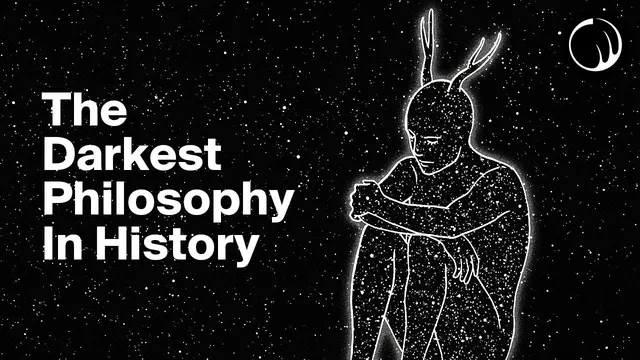
The Existential Elk Theory - The Darkest Philosophical Essay Ever Written
Based on Pursuit of Wonder's video on YouTube. If you like this content, support the original creators by watching, liking and subscribing to their content.
The Irish elk’s extinction is used as a model for how an evolutionary advantage can become a burden when it grows beyond what the organism can support.
Briefing
Human consciousness may function like the Irish elk’s oversized antlers: a once-useful evolutionary “weapon” that eventually becomes a burden, forcing people to survive by constantly trimming—or distracting themselves from—the full weight of awareness. The core claim, drawn from Norwegian existential philosopher Peter Wessel Zapva (spelled in the transcript as “Zapva/Zappa/Zapo”), is that consciousness has grown beyond its practical purpose. Instead of simply helping humans navigate the world, it exposes them to suffering, decay, futility, and the absence of guaranteed meaning—an excess that turns existence into a problem.
The analogy begins with the Irish elk, a giant deer that roamed Eurasia until roughly 5700 B.C.E. Its massive antlers—up to about 7 feet tall, 10 feet long, with antlers spanning as much as 12 feet—were advantageous for mating, display, and survival. But as antlers kept growing, they became maladaptive. Their weight impaired mobility, made it harder to evade predators and hunters, and nutritional needs could not keep up with the overgrowth, leading to deficiencies. What was supposed to be a survival feature became an obstruction, and the species went extinct.
Zapva’s parallel targets modern humans. Human consciousness, treated as a “weapon forged by and wielded against nature,” enabled hunting, agriculture, morality, civilization, and industry. Yet the same awareness that powers achievements also produces an intolerable clarity about being trapped in a body, governed by chaotic reality, and abandoned by the universe’s promise of redemption. In works such as “The Last Messiah” (1933) and “On the Tragic” (1941), Zapva frames death anxiety as a lens that sharpens perception of human awareness itself—how people sense suffering, decay, and futility, and how they crave meaning and solace.
The central puzzle then becomes endurance: if this condition is so bleak, why do humans persist? Zapva’s answer is that people “save themselves” by artificially limiting consciousness. The transcript lists four main strategies. Isolation involves ignoring or repressing existential truths—especially death and absurdity—so conversation and thought avoid the hardest realities. Anchoring relies on inherited structures of purpose and guidance, such as God, church, state, morality, fate, law, people, and the future. Distraction keeps minds occupied through work, markets, sports, entertainment, and routine responsibilities. Sublimation, the least common but most powerful method, transforms dread into art or expressive creation.
But these defenses are temporary and self-destructive. They resemble the elk’s inability to trim its antlers: humans can “shave down” awareness, yet doing so means living partially mutilated—surviving as a species while losing wholeness as individuals. Zapva’s dilemma is sharper still: humans want both species-continuation and ultimate solace, but solace cannot be achieved through mere continuation. The result is an internal contradiction that the transcript describes as fragments of absurdity “emerging” from the mind.
“The Last Messiah” introduces a figure meant to strip humanity of illusions, leaving only the burden of awareness and, in the most extreme reading, self-extinction. The transcript then gestures toward an alternative: not ending the species, but ending dependency on purpose—an “exposure therapy” to consciousness that could produce indifference rather than despair. The closing note ties the philosophy to lived practice: climbing mountains, writing, and creating art become ways to face reality without denying it, suggesting that survival and evolution may still be possible if humans learn to bear the weight of awareness rather than constantly deflect it.
Cornell Notes
The transcript draws an analogy between the Irish elk’s massive antlers and human consciousness: both start as evolutionary advantages but can become burdens. Irish elk antlers grew so large they reduced mobility, worsened nutrition, and contributed to extinction around 5700 B.C.E. Zapva’s existential claim is that human consciousness has similarly expanded beyond practical function, making people vividly aware of suffering, decay, futility, and the lack of guaranteed redemption. To endure, humans limit consciousness through isolation, anchoring, distraction, and sublimation—strategies that provide temporary relief but can also distort full self-knowledge. The transcript ends by suggesting a possible escape route: reduce dependence on purpose through gradual exposure to awareness, aiming for indifference rather than self-deception.
How does the Irish elk example set up the argument about consciousness?
What does Zapva claim consciousness does to humans that antlers did to the elk?
Why does the transcript say humans still endure despite this bleak outlook?
What are the four methods Zapva lists for limiting consciousness, and how do they work?
What is the critique of these defenses?
What alternative does the transcript suggest beyond self-deception or self-extinction?
Review Questions
- How does the transcript connect maladaptation in the Irish elk’s antlers to maladaptation in human consciousness?
- Which of Zapva’s four methods (isolation, anchoring, distraction, sublimation) seems most socially reinforced, and why?
- What tension between species-continuation and the desire for solace creates the central dilemma described in the transcript?
Key Points
- 1
The Irish elk’s extinction is used as a model for how an evolutionary advantage can become a burden when it grows beyond what the organism can support.
- 2
Zapva’s core claim is that human consciousness has expanded past practical function, making people acutely aware of suffering, decay, futility, and the lack of guaranteed redemption.
- 3
Humans endure by limiting consciousness through isolation, anchoring, distraction, and sublimation rather than confronting existential reality directly.
- 4
These defenses provide temporary relief but require ongoing denial, risking distortion of full self-knowledge and wholeness.
- 5
The transcript frames a dilemma: humans want both species-continuation and ultimate solace, yet solace cannot be secured through continuation alone.
- 6
A proposed alternative is reducing dependency on purpose through gradual exposure to awareness, aiming for indifference rather than despair.