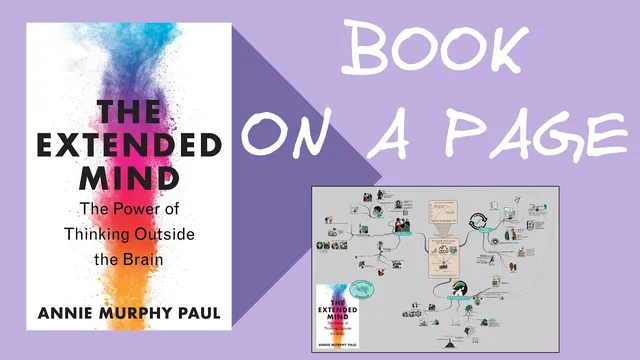
The Extended Mind - Book on a Page
Based on Zsolt's Visual Personal Knowledge Management's video on YouTube. If you like this content, support the original creators by watching, liking and subscribing to their content.
Intelligence is treated as an outcome of embodied, situated, and distributed cognition—not just internal reasoning.
Briefing
Annie Murphy Paul’s “The Extended Mind” frames human intelligence as something built with help from the world outside the skull. Instead of treating thinking as a purely internal process, the book argues that people become smarter by skillfully engaging three kinds of “outside” resources: embodied cognition (body-based thinking through gestures and movement), situated cognition (thinking shaped by physical context), and distributed cognition (thinking supported by other people and shared tools). The metaphor is a nest-building bird using whatever materials it can find; similarly, the mind “borrows” from spaces, bodies, feelings, and social interactions to assemble ideas.
A central thread is that the brain is context sensitive—performance changes depending on what surrounds it and how information is represented. One practical implication is re-embodying information: turning abstract concepts into physical experiences. The transcript points to Einstein’s thought experiments as an example of mentally “inhabiting” a scenario (imagining being a light beam traveling at light speed) to gain a new perspective on physical reality. It also recommends enacting concepts—standing up, moving, and making ideas spatial—along with paying attention to other people’s gestures and to internal bodily signals such as heartbeat, sweaty hands, and other interoceptive cues that can guide decisions.
Memory and understanding are treated as spatial and externalizable as well. Techniques like the Memory Palace (also described as the “method of Loki”) rely on walking through a familiar mental location and attaching items to specific stops, improving recall through mental rehearsal. The transcript also emphasizes that language already reflects spatial thinking—“looking ahead” and “behind”—so creating mind maps, concept maps, diagrams, or charts can help externalize abstract ideas and make them easier to work with.
Because intelligence is social, the book links creativity and learning to shared context. “Socializing information” can mean debating ideas, seeking synchronicity (getting “on the same wavelength”), or teaching and storytelling. The transcript gives concrete examples: eating spicy food together to feel heat in unison, karaoke or hiking as activities that align bodies and attention, and informal workplace chit-chat as a channel for spreading best practices more effectively than formal training.
The book also recommends designing environments that support the desired mental state. Small cues—like family photos on a desk—can make a workspace feel “at home,” while indoor green plants are described as attention-restoring. It further introduces transactive memory systems: groups remember more collectively because members know who to ask rather than trying to store every detail themselves. Stability matters too; even in hot-desk offices, using the same spot is framed as a way to reduce friction and improve performance.
Finally, the transcript highlights “looping” and offloading habits. Ideas should be moved outside the head—onto Post-its, whiteboards, or shared conversations—then revisited and reshaped. Feelings can be looped through labeling, reappraisal, and tools like an interceptive journal or body-scan meditation. For decision-making, it recommends a decision log that tracks options, bodily feelings, and outcomes to learn what signals correlate with better results. The overall takeaway is direct: intelligence and creativity improve when people deliberately leverage embodied, situated, and distributed cognition—alone and as a team—rather than relying on internal thinking in isolation.
Cornell Notes
“The Extended Mind” argues that intelligence is built from resources outside the head. Thinking improves when people use embodied cognition (gestures and movement), situated cognition (the physical environment shaping attention and meaning), and distributed cognition (other people and shared systems supporting memory and problem-solving). The transcript emphasizes context sensitivity: re-embody concepts, externalize information with tools like memory palaces and concept maps, and use bodily signals to guide decisions. It also ties creativity to social and environmental design—debate, synchronicity, transactive memory, stability, and informal collaboration. The practical message is to offload ideas, loop them through others and feelings, and deliberately alter mental state before demanding work.
What does “extended mind” mean in practical terms, beyond a general philosophy of learning?
How can someone make abstract concepts easier to understand using context and embodiment?
What memory technique is described, and why does it work?
How does the transcript connect creativity and learning to social interaction?
What is transactive memory, and how should teams use it?
What habits help “loop” ideas and incorporate feelings into thinking?
Review Questions
- Which three forms of cognition (embodied, situated, distributed) are used to explain why intelligence depends on the outside world? Give one concrete example for each.
- How do memory palaces and concept maps differ in how they externalize information, and what problem does each solve?
- What does “synchronicity” mean in the transcript, and what activities are offered as ways to create it?
Key Points
- 1
Intelligence is treated as an outcome of embodied, situated, and distributed cognition—not just internal reasoning.
- 2
Re-embody abstract ideas by enacting them with movement, spatial thinking, and attention to gestures.
- 3
Use spatial memory tools like the Memory Palace to attach information to locations and improve recall.
- 4
Boost creativity and learning by socializing information through debate, teaching, storytelling, and activities that build synchronicity.
- 5
Design environments that support focus and recovery, such as adding identity cues and green plants, and maintaining stability in workspaces.
- 6
Adopt “offloading” habits—templates, whiteboards, and external notes—to reduce cognitive burden and gain a detached perspective.
- 7
Track decisions with a decision log that records bodily feelings and later outcomes to learn what signals correlate with better choices.