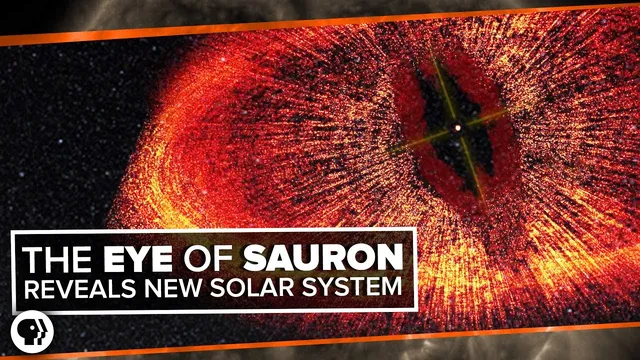
The Eye of Sauron Reveals a Forming Solar System!
Based on PBS Space Time's video on YouTube. If you like this content, support the original creators by watching, liking and subscribing to their content.
Fomalhaut’s most informative structure is a cold, infrared-bright ring of ice and dust roughly 40 billion kilometers across, interpreted as leftover protoplanetary debris.
Briefing
Fomalhaut—an A-type star about 25 light-years away—appears to be hosting a long-lived, sharply edged ring of ice and dust, and the system may be in the middle of forming planets. The “eye” look comes from Hubble’s famous view of the star, but the most revealing structure is the ring itself: infrared observations show a giant disk roughly 40 billion kilometers across, widely interpreted as the leftover debris from the star’s protoplanetary disk after planet formation began.
Astronomers use a coronagraph in some Hubble images to block the star’s glare so the surrounding material can be studied. In infrared data from observatories such as Herschel and ALMA, the star’s heat glow is less important than the ring’s emission, which traces cold dust and ice. The ring’s sharp inner edge is the key clue. In many disk systems, gravity from newly formed bodies can carve gaps and maintain clean boundaries—much like Saturn’s F ring is shaped by shepherd moons. For Fomalhaut, the leading idea is that one or more “shepherd” planets are guiding dust into a narrow, well-defined region, keeping the ring from blurring out over time.
The system’s youth adds urgency. Fomalhaut is about 440 million years old—still young by stellar standards—but it seems to retain part of its protoplanetary material far longer than expected. That unusual longevity makes it a valuable laboratory for understanding how our own solar system might have evolved. Planet formation is generally thought to start with a collapsing molecular cloud that spins into a disk around a hot protostar. Over time, dust grains stick and grow, then larger bodies accrete more material through gentle collisions, eventually becoming planetesimals and then planets. In the Solar System, this process is believed to have occurred roughly 4.5 billion years ago, with the remaining disk material dispersed tens of millions of years after the Sun formed.
Fomalhaut’s standout candidate for sculpting the ring is Fomalhaut B, nicknamed Dagon by the International Astronomical Union. Hubble has detected it as a bright object in visible light, yet it appears faint or absent in infrared. That mismatch has several interpretations: it could be a smaller planet still wrapped in dust, with Hubble seeing reflected starlight; it could be a planet surrounded by a large reflective ring system; or it could be a transient cloud of debris from a recent collision. The orbit is highly eccentric—about 1,700 Earth years—and lies farther out than Neptune, raising questions about how much material could be available to build a planet there.
One proposed solution is dynamical reshuffling. Dagon may have formed closer to the star, then been flung outward by interactions with other massive planets—possibly producing “hot Jupiter” behavior for an inner planet while sending Dagon to its current wide orbit. Similar migration and scattering scenarios are used to explain the current spacing of the Solar System’s gas giants.
Complicating the picture, Fomalhaut is part of a rare triple-star system. One companion is a red star that may also host its own protoplanetary disk, and the third is a flare star classified as a BY Draconis variable. With multiple stars influencing the environment, researchers say more observations are needed to confirm whether the ring-sculpting object is truly a planet and to determine why visible and infrared observations don’t line up. If the system is typical, it offers a snapshot of planet formation in action; if it’s unusual, it may reveal which conditions make disks persist and planets carve structure for longer than expected.
Cornell Notes
Fomalhaut, an A-type star 25 light-years away, shows a massive ring of ice and dust about 40 billion kilometers wide. Infrared observations from instruments like Herschel and ALMA reveal the ring’s heat glow and sharp edges, especially a distinct inner boundary. The leading explanation is that one or more planets act as “shepherds,” using gravity to confine dust the way Saturn’s moons shape the F ring. A candidate object, Fomalhaut B (Dagon), is bright in visible light but surprisingly faint in infrared, suggesting possibilities such as a dusty young planet, reflected starlight, or a reflective ring system—or even debris from a collision. Because Fomalhaut is 440 million years old yet still retains disk material, the system may be unusually long-lived, making it a key testbed for planet formation and disk evolution models.
Why does Fomalhaut’s ring look sharply bounded, and why does that matter for planet formation?
What does the visible-vs-infrared mismatch for Fomalhaut B (Dagon) imply?
How could a planet end up on a very wide, eccentric orbit like Dagon’s?
What general sequence connects collapsing gas clouds to a disk and then to planets?
Why is Fomalhaut considered an especially useful laboratory compared with many other systems?
How does Fomalhaut’s triple-star environment complicate the interpretation?
Review Questions
- What observational evidence points to planets shaping Fomalhaut’s ring, and what specific ring feature is most emphasized?
- How do the visible and infrared properties of Fomalhaut B (Dagon) constrain competing explanations?
- Which dynamical scenario is proposed to reconcile Dagon’s wide, eccentric orbit with planet formation expectations?
Key Points
- 1
Fomalhaut’s most informative structure is a cold, infrared-bright ring of ice and dust roughly 40 billion kilometers across, interpreted as leftover protoplanetary debris.
- 2
The ring’s sharp inner edge suggests gravitational carving and confinement, analogous to how shepherd moons maintain Saturn’s F ring.
- 3
Fomalhaut is about 440 million years old yet still shows disk material, making the system unusually long-lived and valuable for studying late-stage disk evolution.
- 4
Fomalhaut B (Dagon) is bright in visible light but nearly absent in infrared, pointing toward reflected light, dust enshrouding, reflective rings, or possibly a debris-cloud interpretation.
- 5
Dagon’s highly eccentric orbit (~1,700 Earth-year period) is wider than Neptune’s, raising formation challenges that motivate migration and scattering models.
- 6
A proposed migration pathway involves interactions that could send an inner planet inward as a hot Jupiter while flinging Dagon outward.
- 7
Fomalhaut’s triple-star setup (including a BY Draconis variable companion) adds external gravitational and radiative influences that may affect disk and planet dynamics.