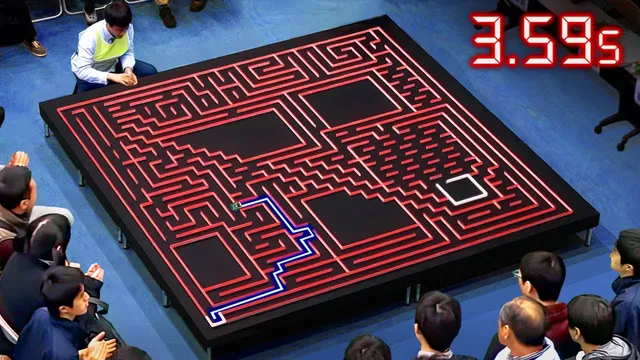
The Fastest Maze-Solving Competition On Earth
Based on Veritasium's video on YouTube. If you like this content, support the original creators by watching, liking and subscribing to their content.
Micromouse rules demand fully autonomous robots with strict size limits and no GPS or remote control, making sensing and control central to performance.
Briefing
Micromouse racing has evolved from a maze-solving curiosity into a high-stakes robotics discipline where the fastest route often beats the shortest one—and where success depends as much on how a robot moves as on how it thinks. The competition’s modern rules force fully autonomous robots to fit tight size and power limits, run without GPS or remote control, and race through a maze whose layout is revealed only at the start. With only a handful of timed runs allowed, teams must balance early exploration with later sprinting, turning navigation into a real-time optimization problem under uncertainty.
The roots trace back to Claude Shannon’s 1952 “electronic mouse” Theseus, which used a computer embedded in the maze to guide a magnet-on-wheels through trial-and-error learning. That idea—learning paths and then using memory to avoid false turns—became associated with early machine learning. Decades later, IEEE’s Amazing Micro-Mouse Maze Contest drew thousands of entrants, but few reached the finals, even as public interest spread and Micromouse clubs proliferated worldwide.
As the field matured, strategies for finding the goal shifted from brute-force certainty toward efficient decision-making. Depth-first search can eventually reach the goal but may miss shortcuts because it backtracks only when forced. Breadth-first search guarantees the shortest path but wastes time revisiting routes. Flood fill became the dominant approach: the robot starts with an optimistic map that assumes no walls, follows a gradient of distances to the goal, then updates its internal distance field when it hits unexpected obstacles. After reaching the goal, it can “smooth” the path and—crucially—use the return trip to refine the map further, making it highly likely to discover the true shortest route without exploring every cell.
Yet the headline twist came in performance terms. In the 2017 All Japan Micromouse Competition, many top finishers found the shortest path and then drove it in about 7.4 seconds. Masakazu Utsunomiya’s winning mouse, Red Comet, took a route 5.5 meters longer than the common shortest path because it contained fewer turns. The robot was effectively searching for the fastest path, not the shortest one, and won by 131 milliseconds.
The remaining gap between “solving” and “racing” is physical. As robots got faster, friction and control—not raw computation—became the limiting factors. A major breakthrough, dubbed a “Fosbury flop” for Micromouse, came from vacuum-style fans that generate several times the robot’s weight in downward force, enabling high cornering accelerations approaching six Gs. Diagonal driving also reshaped the sport: implemented first by the mouse Mitee 3, diagonals required new chassis dimensions and new control algorithms, and they increased crash risk while reducing turn-heavy paths into longer straightaways.
Nearly 50 years on, Micromouse remains unsolved in the sense that it keeps producing new paradigms—more wheels, omnidirectional motion, and even computer vision—because the challenge is fundamentally robotics: navigation plus speed plus mechanical interaction with the maze. The competition’s enduring lesson is that a “simple” maze hides a complex problem of control, sensing, and strategy under real-world constraints.
Cornell Notes
Micromouse turns maze-solving into an autonomous robotics sprint where speed—not just correctness—decides winners. Robots must fit strict size limits, run without GPS or remote help, and cope with a maze revealed only at the start, with only a few runs allowed. Flood fill dominates strategy: the robot begins with an optimistic distance map, follows decreasing distance values toward the goal, updates the map when walls are encountered, and often uses the return trip to improve the route. Even when the shortest path is known, the fastest route can be longer if it reduces turns; Red Comet won by taking a 5.5-meter-longer path with fewer turns. The biggest performance leaps came from mechanical “Fosbury flops” like vacuum fans for grip and diagonal driving for smoother motion.
Why did Micromouse shift from “shortest path” thinking to “fastest path” outcomes?
How does flood fill work, and why is it efficient for Micromouse?
Why are depth-first search and breadth-first search less attractive in practice?
What constraints make Micromouse a robotics problem rather than just a software problem?
How did vacuum fans become a “Fosbury flop” for Micromouse performance?
What did diagonal driving change, and why was it risky?
Review Questions
- What specific mechanism allows flood fill to update its map and converge on a useful route without exhaustive exploration?
- Why can a longer path outperform a shorter one in Micromouse, and what evidence from competition results supports that?
- Which physical factors (friction, centripetal force, dust, turning control) most directly limit Micromouse speed as robots get faster?
Key Points
- 1
Micromouse rules demand fully autonomous robots with strict size limits and no GPS or remote control, making sensing and control central to performance.
- 2
Flood fill is popular because it uses a distance-to-goal map, starts with optimistic assumptions, updates when walls are discovered, and often leverages the return trip to refine the route.
- 3
Shortest-path algorithms can underperform in racing because turning costs time; winners may choose a longer route with fewer turns.
- 4
Red Comet’s 2017 victory showed the fastest path can differ from the shortest path: it ran a route 5.5 meters longer than the common shortest route and won by 131 milliseconds.
- 5
Diagonal driving (introduced by Mitee 3) can speed runs by reducing turns, but it increases crash risk and requires new chassis dimensions and control algorithms.
- 6
Vacuum fans act like a grip upgrade by generating several times the robot’s weight in downward force, enabling cornering accelerations approaching six Gs.
- 7
Micromouse progress repeatedly comes from “Fosbury flop” style paradigm shifts that combine navigation strategy with mechanical interaction with the maze.