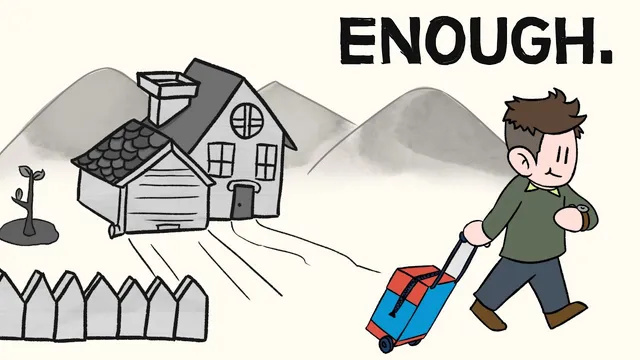
The feeling of wanting to leave everything behind...
Based on Einzelgänger's video on YouTube. If you like this content, support the original creators by watching, liking and subscribing to their content.
The urge to leave often intensifies when past pain, present constraints, and a bleak sense of the future combine into persistent discontent.
Briefing
A persistent urge to “leave everything behind” isn’t just a romantic fantasy about greener pastures—it often tracks dissatisfaction, but it also reflects something deeper about human freedom and exploration. The central claim is that packing up can feel like a cure for discontent, yet long-term relief is unlikely if the underlying problem is internal. The more meaningful question becomes what the urge is really for: escape from unhappiness, or a way of choosing a life.
The transcript frames the feeling as an almost universal contradiction: people cling to a small “bubble” of roots, family, and familiar faces, even though life is vast and change is inevitable. Some eventually break away—sometimes from necessity, sometimes from a wish to sever ties with the past and start fresh. The narrator’s own turning point comes during depression and the painful end of a long-term relationship in 2010. In that period, leaving becomes a kind of psychological release valve: the past feels like a “millstone,” daily work feels mismatched and draining, and the future feels hopeless. The desire to go anywhere—Asia, Spain, Iran, “anything”—is portrayed as a craving for novelty that might wash away old pain and remake identity.
But once conditions improve—finding work that feels right, enrolling in university, expanding a social circle—the urge to leave goes dormant. Contentment with the present crowds out past grief. Still, it never fully disappears. When friends move to Germany and build new lives, the call to adventure returns, tied to a recurring restlessness. At that moment, the narrator identifies two paths: fix dissatisfaction locally through mindset and environment, or follow the stronger pull to relocate. The transcript argues that the second option often rests on a flawed assumption: that changing scenery can permanently solve unhappiness.
Stoic philosophy is used to challenge that assumption. Seneca’s argument is quoted directly: travelers don’t escape gloom because “you need a change of soul rather than a change of climate,” and “your faults will follow you whithersoever you travel.” The transcript extends the point: even if people rebuild lives elsewhere—new continents, new communities, even new names—they still “have to put up with ourselves.” From this view, relocating merely moves the problem, since how people feel depends heavily on how they think about circumstances.
Yet the transcript refuses to reduce the urge to mere irrational escapism. It pivots to existentialism, where “existence precedes essence” and freedom is both a blessing and a burden: without an intrinsic script, people must author meaning through choice. Leaving the familiar becomes an assertion of self-determination—stepping out of a preordained habitat, redefining values, and taking responsibility for a future rather than living inside expectations.
Finally, the transcript adds a more cosmic interpretation through a line from Interstellar: “We’re not meant to save the world. We’re meant to leave it.” That framing casts the urge as part of humanity’s exploratory nature—mirroring how people have always moved into unfamiliar places, and how the species might one day spread beyond Earth. The conclusion: the desire to leave may be less an anomaly and more a reflection of an adventurous, curious self—sometimes misused as a shortcut to happiness, but also capable of expressing freedom and purpose.
Cornell Notes
The transcript treats the urge to “leave everything behind” as both a psychological signal and a philosophical question. When discontent rises, relocation can feel like a reset—novelty promises to erase old pain and remake identity. Stoic thinkers, especially Seneca, argue that travel won’t cure discontent because people carry their minds with them; “a change of soul” matters more than “a change of climate.” The discussion then shifts to existentialism, where leaving can be meaningful: freedom allows people to author their lives rather than accept a predetermined “bubble.” The urge is ultimately framed as more than escape—also an expression of human exploration and self-determination.
Why does the urge to leave often intensify during periods of depression or relationship breakdown?
What is the Stoic critique of using travel or relocation as a cure for unhappiness?
How does the transcript reconcile the narrator’s improved life after staying put with the idea that leaving is sometimes irrational?
What does existentialism add to the meaning of leaving everything behind?
How does Interstellar’s line about leaving Earth change the interpretation of the urge?
What personal example is used to argue that the urge to leave may reflect an adventurous human nature?
Review Questions
- When does the transcript suggest relocation can genuinely help, and when does it warn it won’t?
- How do Stoic ideas (via Seneca) and existentialist ideas (via de Beauvoir and Sartre) lead to different interpretations of the same urge?
- What does the Interstellar quote add to the argument beyond the personal and psychological level?
Key Points
- 1
The urge to leave often intensifies when past pain, present constraints, and a bleak sense of the future combine into persistent discontent.
- 2
Improving one’s life without relocating can reduce the desire to escape, suggesting the impulse is not always a reliable signal that “elsewhere” will fix things.
- 3
Stoic philosophy argues that travel cannot cure discontent because people carry their minds and “faults” with them; novelty fades and internal patterns return.
- 4
Existentialism reframes leaving as an expression of freedom—an active choice to author meaning rather than accept a predetermined life script.
- 5
Leaving the familiar can be meaningful even if it doesn’t deliver lasting happiness, because it can represent self-determination and responsibility.
- 6
The transcript ultimately treats the urge to leave as potentially tied to human exploration and curiosity, not only to unhappiness.