The Final Barrier to (Nearly) Infinite Energy
Based on PBS Space Time's video on YouTube. If you like this content, support the original creators by watching, liking and subscribing to their content.
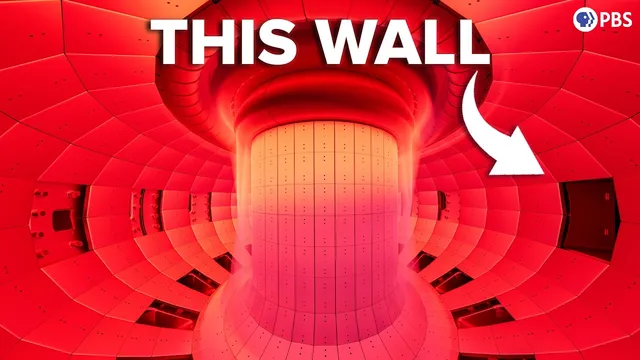
Magnetic confinement can keep plasma away from the chamber, but fusion neutrons still strike the first wall directly and drive the hardest engineering constraints.
Briefing
Fusion’s “final barrier” isn’t getting hydrogen hot enough—it’s building a reactor wall that can survive a mini–star long enough to make electricity, while also enabling a sustainable fuel cycle. The core challenge is that deuterium–tritium fusion produces intense heat and radiation that relentlessly batter the chamber’s first-contact surface, degrade materials, and can destabilize the plasma. Solving that materials-and-confinement interface is what separates lab milestones from a power plant that runs reliably for years.
The Sun offers the template: it keeps fusion going for billions of years by compressing plasma under enormous pressure and sustaining extreme temperatures. Earth can’t match the Sun’s densities, so fusion reactors rely on two main strategies—compressing fuel with lasers (inertial confinement) or trapping a hot, electrically charged plasma with strong magnetic fields (magnetic confinement). In magnetic confinement, the plasma is held in a donut-shaped configuration by superconducting magnets cooled to near absolute zero. The system must also manage instabilities that can abruptly dump energy into the chamber.
Even if the plasma is stable, the reactor wall faces a brutal reality. Fusion reactions generate fast neutrons and gamma rays that stream out of the magnetic bottle and slam into the first wall. That bombardment heats the wall, erodes it through sputtering, and makes it radioactive by creating new isotopes. Energetic helium and hydrogen ions can also escape the magnetic field and implant into the wall, including tritium—an added complication because tritium is both scarce naturally and tightly regulated. Worse, imperfections in the wall and plasma edge can trigger edge-localized modes, causing localized failures that can cascade into larger magnetohydrodynamic instabilities.
To turn fusion into usable power, the wall must transfer heat to a coolant—water, molten salts, or lithium—without melting. But the wall also has to help solve the fuel problem. Deuterium is abundant; tritium is not. A power plant must breed its own tritium by using fusion neutrons to convert lithium into tritium. That means placing lithium behind the first wall and often adding a neutron multiplier to boost the neutron flux, since deuterium–tritium reactions alone may not produce enough neutrons for a sustainable tritium breeding ratio.
Material choices then become a balancing act. Tungsten is attractive because it has a high melting point and low sputtering, and it tends to retain less tritium than many alternatives. But tungsten’s high atomic number makes it radiate energy efficiently when it contaminates the plasma via “line emission,” which can cool the plasma and undermine fusion. ITER initially planned a boron-based approach to reduce such radiation losses—boron can act as a neutron multiplier and can help manage oxygen impurities—but boron’s higher sputtering rate, toxicity, and dust-handling risks pushed ITER back toward tungsten. ITER is also testing ways to mitigate tungsten pollution, including coating strategies using boron powder.
The timeline underscores how hard this is: ITER is projected to achieve first plasma this year, first fusion reactions in 2035, and commercial-grade deuterium–tritium fusion in 2039 if milestones hold. The race may still be won by smaller private efforts, but the decisive bottleneck remains the same—engineering a first wall that can take the radiation, avoid poisoning the plasma, and support tritium breeding without turning the reactor into a maintenance nightmare.
Cornell Notes
Fusion’s biggest hurdle is not igniting deuterium–tritium reactions—it’s engineering the “first wall” that faces the plasma. That wall must survive extreme heat from neutrons and gamma rays, resist erosion and sputtering, avoid contaminating the plasma (which can cool it via line emission), and help breed tritium using lithium. Magnetic confinement keeps plasma away from matter using superconducting magnets, but neutrons ignore magnetic fields and still strike the wall directly. Tungsten is the leading candidate because it’s strong and has a high melting point, yet it can radiate away plasma energy if it enters the plasma. Boron and liquid-lithium concepts aim to reduce radiation losses and improve tritium breeding, but they introduce toxicity, erosion, and engineering complications.
Why does the reactor wall matter more than the plasma-confinement magnets?
How do inertial and magnetic confinement differ in what they must solve?
What makes tungsten both promising and problematic as a first-wall material?
Why is tritium breeding a central requirement for a practical fusion reactor?
What tradeoffs push ITER away from boron-first-wall plans?
How does liquid lithium fit into first-wall and fuel-cycle ideas?
Review Questions
- What specific mechanisms make the first wall both a heat problem and a plasma-performance problem in deuterium–tritium fusion?
- Compare tungsten and boron as first-wall materials: which advantages target plasma stability, and which disadvantages target engineering feasibility?
- Why might a neutron multiplier be necessary even when lithium is present behind the first wall?
Key Points
- 1
Magnetic confinement can keep plasma away from the chamber, but fusion neutrons still strike the first wall directly and drive the hardest engineering constraints.
- 2
The first wall must handle heat removal, radiation damage, sputtering erosion, and radioactive isotope production while maintaining stable plasma-edge behavior.
- 3
Tritium scarcity forces reactors to breed their own fuel using lithium struck by fusion neutrons, often requiring a neutron multiplier to reach a sustainable breeding ratio.
- 4
Tungsten’s high melting point and low sputtering make it a leading first-wall candidate, but tungsten contamination can cool the plasma through line emission.
- 5
Boron can reduce radiation losses and boost neutron availability for tritium breeding, yet toxicity, faster erosion, and electromagnetic forces on the wall complicate its use.
- 6
ITER’s projected milestones—first plasma this year, first fusion reactions in 2035, and deuterium–tritium fusion in 2039—depend heavily on whether wall and fuel-cycle engineering holds up under real conditions.