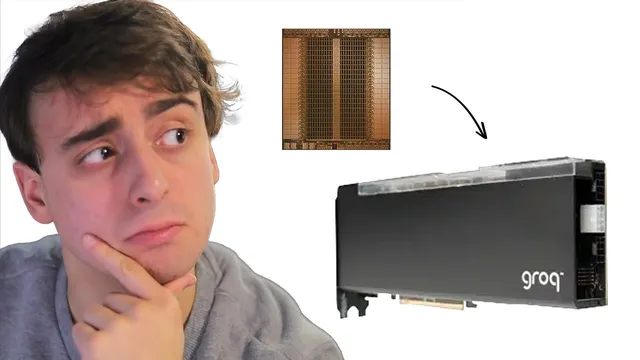
The First AI Processing Unit is a BIG Deal.
Based on MattVidPro's video on YouTube. If you like this content, support the original creators by watching, liking and subscribing to their content.
11 Labs is pushing text-to-sound-effect generation tied to OpenAI’s Sora ecosystem, with emphasis on unusually clear, detailed audio output from text prompts.
Briefing
AI’s momentum is accelerating on two fronts at once: richer generative media and purpose-built compute for running it. 11 Labs announced new audio generation capabilities tied to OpenAI’s Sora text-to-video push—specifically, the ability to describe a sound and generate it with AI. The emphasis is on sound effects that feel unusually clear and detailed, including stereo-like separation in a Sora trailer audio sample. The practical takeaway is that creators may soon be able to assemble video, voice, and sound effects from text prompts with far less manual editing than today, potentially collapsing multiple production steps into a single workflow.
That media leap is happening alongside a hardware shift that targets the bottleneck of AI inference. Instead of relying on general-purpose GPUs, Gro (spelled “Gro” in the transcript) is positioning its AI processing chips as purpose-built accelerators. The pitch is straightforward: custom hardware designed for AI can run faster and, as production scales, become cheaper—an inflection point that enables mass deployment of AI services. Gro’s approach centers on compiler technology that optimizes a minimalist, high-throughput chip architecture by removing unnecessary logic and focusing on parallel throughput. The company claims its chips can work with a wide range of large language models, adapting optimization over time via a custom compiler.
A live-style demo described in the transcript highlights performance and utilization. The system shows thousands of active requests, with input token throughput reported around 2,500 tokens per second and output around 406 tokens per second. The key detail is that end-to-end latency includes waiting for an available processing unit, while the actual model generation time is said to be only a little over a second. The transcript also stresses that the service is free to try using open-source models such as Meta’s Llama 270b and Mixol 8X 7B, with the caveat that open models still lag closed-source quality—though improvements are expected.
The compute story connects to a broader model race focused on context length and multimodality. Google’s Gemini 1.5 Pro is highlighted for handling up to 1 million tokens in a limited preview, with testing by Matt Schumer described as feeding multiple research papers and asking for future research directions in a structured format. Other examples attribute to Gemini 1.5 Pro the ability to locate a specific sentence speaker from an entire Harry Potter book and to summarize or operate on large codebases—capabilities framed as evidence of a recursive feedback loop where AI can help drive more AI development.
Finally, the transcript points to open-source competition. Mistral AI’s new model, Mistral Next, is presented as close to GPT-4 quality by some accounts, with strengths in being open and free, even if it may struggle with coding and needs better prompting for user friendliness. Overall, the throughline is clear: generative tools are getting more convincing, while specialized inference hardware and longer-context models are making large-scale AI cheaper, faster, and more capable—at home and in production systems alike.
Cornell Notes
The transcript links two major accelerations in AI: better generative media and faster, cheaper inference hardware. 11 Labs’ audio generation advances—described through a Sora trailer sound-effect sample—aim to let creators generate sound effects from text prompts with high clarity. On the compute side, Gro is presented as building AI-first chips that replace GPU-centric inference with purpose-built parallel throughput and compiler-based optimization, claiming low generation time once a processing unit is available. The hardware story matters because it supports mass-scale deployment by reducing cost and latency. The transcript also emphasizes model progress such as Gemini 1.5 Pro’s very large context window (up to 1 million tokens) and Mistral AI’s open-source Mistral Next as open alternatives to closed models.
What new capability from 11 Labs is treated as a meaningful step beyond earlier audio AI tools?
Why does the transcript argue that AI-first hardware could be cheaper and faster than GPU-only approaches?
How does Gro’s chip approach differ from typical GPU design, according to the transcript?
What performance details are used to illustrate Gro’s inference speed?
Why is Gemini 1.5 Pro’s long context window treated as a turning point?
What role does open-source model competition play in the transcript’s overall picture?
Review Questions
- Which parts of the transcript’s Gro performance numbers reflect queue/wait time versus actual model generation time?
- What specific examples are used to argue that Gemini 1.5 Pro’s long context window changes what the model can do?
- How does the transcript connect purpose-built AI hardware to the economics of large-scale AI deployment?
Key Points
- 1
11 Labs is pushing text-to-sound-effect generation tied to OpenAI’s Sora ecosystem, with emphasis on unusually clear, detailed audio output from text prompts.
- 2
Purpose-built AI chips like Gro’s are positioned as faster and potentially cheaper than GPU-only inference by optimizing for parallel throughput and removing unnecessary logic.
- 3
Gro’s compiler-based approach is presented as enabling the same hardware to adapt across different large language models over time.
- 4
A described Gro demo reports high token throughput and separates end-to-end latency (including waiting for an available processing unit) from the shorter actual generation time.
- 5
Gemini 1.5 Pro’s very large context window (up to 1 million tokens) is treated as enabling tasks like multi-paper reasoning, long-book question answering, and codebase understanding.
- 6
Matt Schumer’s tests are used as concrete examples of how long-context models can connect disparate information and produce structured research outputs.
- 7
Mistral AI’s Mistral Next is framed as an open, free alternative that may approach top closed-model quality while still showing weaknesses (including possible coding gaps).