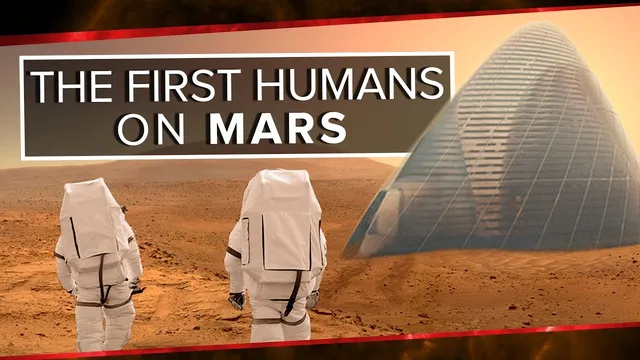
The First Humans on Mars
Based on PBS Space Time's video on YouTube. If you like this content, support the original creators by watching, liking and subscribing to their content.
SpaceX’s Mars settlement concept centers on reusability and staged fueling to enable roughly 100-person transport per trip, but the settlement’s success depends on more than getting there.
Briefing
A Mars settlement can’t be judged by spacecraft engineering alone; it hinges on whether a colony can become genuinely self-sustaining—mining, farming, manufacturing, and shielding people from Mars’s harsh radiation environment—while still being livable enough to attract multigenerational residents. The discussion begins with the headline-grabbing ambition: SpaceX’s plan for a spacecraft that could carry about 100 people to Mars per trip, aiming for settlement rather than a brief visit, with a timeline Musk frames as potentially as short as 10 years. The vehicle concept relies on reusability and a staged approach: a rocket booster launches the ship into orbit, returns for refueling, and then delivers fuel for the roughly four-month journey. Separating booster and ship in multiple launches is presented as the key enabler for scaling passenger capacity beyond NASA’s smaller Orion-style crew module.
Even if the transportation architecture is plausible, the harder question is whether a settlement can function without constant resupply from Earth. The colony vision described is explicitly existential: it should thrive even if Earth is lost, which means it must produce its own essentials. Early landings would likely bring habitats with them—potentially inflatable, modular structures similar to concepts like Mars One’s designs or Bigelow Expandable Activity Module (BEAM) heritage from the International Space Station. But the most critical design constraint is radiation. Mars lacks a protective global magnetic field and has a thin atmosphere, so shielding becomes central to any long-term settlement. The proposed solution is less about elaborate materials and more about geometry and mass: a very thick roof, achieved either by building underground or constructing dense shelters using local materials.
Water is treated as the linchpin resource. Mars contains abundant ice, which can be used for drinking and for growing food, but also for oxygen production. Mars’s atmosphere is about 96% CO2, with the remainder largely nitrogen and argon; after CO2 is scrubbed out, the remaining gas mixture can serve as a breathable buffer while oxygen is added to roughly 20%. Plant growth then becomes a systems problem: crops need water, air, and light. Transparent greenhouse enclosures are one route, but radiation risk makes artificial lighting and hydroponic farms attractive. Hydroponics can be far more water-efficient than soil-based agriculture and can also support oxygen generation.
Energy is framed as comparatively straightforward, with large solar arrays spanning the Martian surface as the default option. The remaining major unknown is gravity. Mars’s gravity is about 0.38 times Earth’s, and in microgravity astronauts lose around 2% of bone mass per month; the long-term effects of partial gravity are uncertain. To support a multigenerational civilization, the discussion points to artificial gravity via rotating centrifuges—either a rotating ring that creates a directional “down” effect, or, in a more speculative long-term concept, centrifuge cities that rotate on superconducting magnetic rails. Yet rotating habitats could introduce their own health issues, including motion sickness.
Finally, economics is presented as the gating factor. A colony would need to be self-sufficient or economically productive enough to justify continued support once the initial political and financial momentum fades. The same lessons—life support, radiation protection, agriculture, and manufacturing—would also transfer to other destinations in the solar system, with Mars positioned as the first major test case even as attention drifts toward more speculative targets like Venus’s cloud cities.
Cornell Notes
The central claim is that getting humans to Mars is only half the problem; a colony must become self-sufficient to survive and attract residents. The settlement plan described relies on prefabricated habitats for the first landings, then local production of essentials: water, oxygen, food, and building materials. Radiation protection is treated as a design driver, favoring underground living or dense shelters with thick “roofs” made from local material. Water from Martian ice supports drinking, agriculture, and oxygen generation after processing the CO2-heavy atmosphere. Long-term health may require artificial gravity through rotating structures because Mars’s 0.38g environment could still harm bones over years.
What makes a Mars colony “work” in this framework—transportation or sustainability?
Why are radiation shielding strategies so central to habitat design on Mars?
How does the plan use Martian water to support both life support and agriculture?
What role do hydroponics and greenhouses play, and why might hydroponics be favored?
What health risk is highlighted by Mars’s gravity, and what solutions are proposed?
Why does economics matter even if the technology exists?
Review Questions
- Which colony capabilities must be established locally for the settlement to be considered truly self-sufficient?
- How do radiation constraints influence the choice between underground habitats, dense shelters, and transparent greenhouses?
- What artificial gravity approach is proposed to address the uncertainty of long-term health under Mars’s 0.38g environment?
Key Points
- 1
SpaceX’s Mars settlement concept centers on reusability and staged fueling to enable roughly 100-person transport per trip, but the settlement’s success depends on more than getting there.
- 2
A viable Mars colony must mine, farm, process, and manufacture its own necessities to survive without ongoing Earth resupply.
- 3
Radiation protection is a primary design driver, favoring underground living or dense shelters with thick shielding built from local materials.
- 4
Martian ice is treated as the critical resource for drinking, agriculture, and potentially oxygen production after atmospheric processing.
- 5
Breathable air could come from scrubbing CO2 from Mars’s atmosphere and using the remaining nitrogen-argon buffer while adding oxygen to about 20%.
- 6
Hydroponic farming with artificial lighting is presented as a promising alternative to transparent greenhouses because it can reduce radiation exposure and improve water efficiency.
- 7
Long-term health may require artificial gravity via rotating centrifuges, since the effects of Mars’s 0.38g on bones over years remain uncertain.