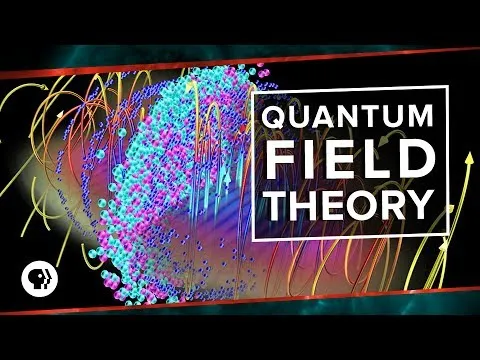
The First Quantum Field Theory
Based on PBS Space Time's video on YouTube. If you like this content, support the original creators by watching, liking and subscribing to their content.
Quantum electrodynamics (QED) is presented as the first true quantum field theory and the most precise, predictive quantum field theory formulation available.
Briefing
Quantum electrodynamics (QED) is presented as physics’ first fully realized quantum field theory—an approach that treats elementary particles as excitations of fields permeating all of space and time—and its unmatched precision is framed as evidence that quantum field theory captures deep truths about reality. QED is singled out as the most accurate and predictive formulation within quantum field theory, built to describe how the electromagnetic field behaves and how electrons behave, with the electron dynamics anchored in the Dirac equation.
The core conceptual move is to replace “particles” with “fields” that exist everywhere. In this picture, quantum field theory (QFT) describes elementary particles as vibrational nodes—localized patterns of excitation—within fundamental fields. For QED, the relevant field is the electromagnetic field, while the electron’s behavior is governed by the Dirac equation. Together, these two ingredients form the pillars of QED: the electromagnetic field’s behavior and the electron’s behavior.
To make the field idea intuitive, the discussion starts with classical vibrations. A stretched string supports oscillations characterized by frequency and amplitude; higher frequency and/or larger amplitude correspond to more energy. Every point along the string moves away from equilibrium by some displacement that changes over time as the string oscillates. The analogy is then extended: a two-dimensional membrane (like a drum skin) has up-down displacements across its surface, and a three-dimensional volume can be thought of as having displacements into an additional “imaginary” direction. Sound in a room becomes the example of a field in practice: air density varies from its equilibrium average as sound waves pass, so air density is treated as a field because it has a value at every point in space.
The quantum twist arrives when the vibrations are treated quantum mechanically. A quantum version of the vibrating string is said to require a minimum nonzero amplitude tied to the vibration’s frequency—no smaller-amplitude oscillations are allowed. Any larger vibration must come in discrete steps, as integer multiples of that smallest amplitude. The transcript links this quantization directly to how light behaves, using the idea that electromagnetic radiation comes in discrete quanta rather than arbitrary continuous energy values.
From there, the discussion begins to connect quantized field vibrations to the quantum rules that restrict how fermions (like electrons) can occupy states—hinting at the deeper statistical structure behind why electrons and other fermions follow “only one per state” constraints. Even with the transcript cutting off mid-sentence, the throughline is clear: QED’s success rests on quantized excitations of fields, with the electromagnetic field and electron dynamics combined into a framework capable of extremely precise predictions.
Cornell Notes
Quantum electrodynamics (QED) is described as the first true quantum field theory and the most precise, predictive formulation of quantum mechanics. QFT treats elementary particles as excitations—vibrational patterns—of fundamental fields that exist at every point in space and time. For QED specifically, the electromagnetic field’s behavior is paired with electron behavior governed by the Dirac equation. The transcript builds intuition using classical vibrations of strings and membranes, then shifts to the quantum rule that only discrete vibration amplitudes are allowed (a minimum amplitude and integer multiples above it), paralleling how light comes in quantized energy. This quantization sets up the later quantum constraints on fermions such as electrons.
What does quantum field theory change about the meaning of “particle”?
Why is QED singled out as the “first true quantum field theory”?
How do classical vibrations help build intuition for fields?
What quantum rule is introduced for vibrations, and how is it connected to light?
What role does the Dirac equation play in QED?
Review Questions
- How does the transcript’s “field” definition differ from thinking of particles as localized objects?
- What quantization rule is applied to quantum vibrations, and what physical phenomenon does it resemble?
- In QED, which two components are described as the theory’s main pillars?
Key Points
- 1
Quantum electrodynamics (QED) is presented as the first true quantum field theory and the most precise, predictive quantum field theory formulation available.
- 2
Quantum field theory (QFT) treats elementary particles as excitations—vibrational nodes—of fundamental fields that exist throughout space and time.
- 3
QED specifically pairs a description of the electromagnetic field with a description of the electron using the Dirac equation.
- 4
Classical vibration analogies (strings, membranes, and sound in air) are used to build intuition for what it means for a quantity to be a field with values everywhere.
- 5
When vibrations are treated quantum mechanically, only discrete amplitudes are allowed: a minimum amplitude for a given frequency and integer multiples above it.
- 6
The quantization of allowed vibration energies is connected to the observed quantized behavior of light.
- 7
The discussion begins linking these quantized field excitations to fermion constraints, foreshadowing rules that limit fermions like electrons in available states.