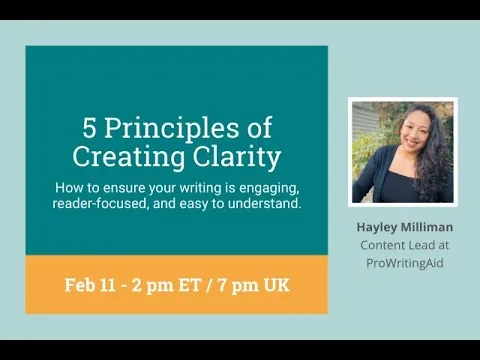
The Five Principles of Creating Clarity
Based on ProWritingAid's video on YouTube. If you like this content, support the original creators by watching, liking and subscribing to their content.
Clarity is shaped by the reader and is a sliding scale, not a one-size-fits-all standard.
Briefing
Clarity is the central job of storytelling: if readers can’t quickly understand what’s happening, they stop engaging and start decoding. The core takeaway is that clarity isn’t the same as simplicity. It’s a sliding scale shaped by audience needs, and it depends on two intertwined parts—how easily sentences can be followed and how rich, specific the language is. Clear prose should communicate meaning through strong, reader-friendly construction and vivid word choice, not through vague phrasing, showy complexity, or “dull but simple” writing.
Clarity begins at the sentence level because each sentence functions like a “mini movie” in the reader’s head. If the sentence lacks key details, readers can’t form the right picture; if the sentence is structured unclearly, readers can’t even interpret what’s going on. From there, clear sentences build clear paragraphs and clear stories—because unclear sentences make accurate interpretation impossible. The talk also draws a sharp line between what clarity is and what it isn’t: clarity doesn’t mean juvenile ideas, and it doesn’t require bland, uniform prose. Complex themes can be written clearly, and engaging writing can still be precise as long as the meaning lands accurately.
To make clarity actionable, five principles are offered. First, make subjects and verbs the stars by favoring active voice and reducing passive constructions that bury the doer. Passive voice is not “wrong,” but it should be used deliberately—such as when the subject is unknown, irrelevant, or intentionally obscured for mystery (including common headline style). Writers are also encouraged to eliminate hidden verbs—common nominalizations where action verbs are turned into nouns and replaced with weaker verbs (e.g., “make a decision” instead of “decide”). The goal is to restore force and directness to the sentence.
Second, prioritize working words over glue words. Working words carry essential meaning (nouns, verbs, key adjectives), while glue words (often prepositions, articles, and other common connectors) keep sentences stitched together but can make them clunky when overused. ProWritingAid frames this with a “glue index,” recommending roughly 40% glue words and 60% working words at the document level. Sticky sentences—often long (around 18+ words) and heavy with prepositions and conjunctions—are flagged for revision.
Third, match readability to the audience. Effective writing aims for accessible reading levels—often around a seventh-grade level for mass-market adult fiction and news—without dumbing down ideas. Readability is influenced by sentence length, vocabulary familiarity, jargon, passive voice, and overall wordiness. ProWritingAid’s readability report helps identify where paragraphs are harder or easier to read.
Fourth, choose specific and vivid words. Vague terms like “tall,” “good,” or “more” don’t let readers form the correct mental image. Specificity can require adding words, but the added words should be working words that make the “movie” accurate.
Fifth, show what’s happening rather than telling it. “Emotion tells” and abstract summaries (“she was embarrassed”) are less vivid than concrete actions and sensory details (“her cheeks flushed red,” “she crumpled the test,” “she hid it in her desk”). The camera test is used as a practical check: if a camera couldn’t capture the described emotion or situation, the writing is likely telling too much. Throughout, the principles are treated as guidance rather than rigid rules, with the emphasis on conscious, audience-aware revision.
Cornell Notes
Clarity is the main job of writing: readers engage when sentences are easy to follow and language is specific enough to form the right mental picture. Clarity isn’t the same as simplicity; it’s a sliding scale shaped by audience needs, and it depends on both sentence readability and rich, vivid word choice. The five principles are: (1) make subjects and verbs the stars (use active voice; reduce passive and hidden verbs), (2) cut glue words by prioritizing working words, (3) match readability to the audience, (4) replace vague language with specific, vivid wording, and (5) show actions and sensory details instead of telling emotions. ProWritingAid is presented as a tool to locate passive voice, hidden verbs, sticky sentences, readability issues, vague diction, and emotion tells.
Why does the talk treat clarity as more than “making sentences simple”?
How do passive voice and hidden verbs reduce clarity, and when can they be acceptable?
What is the “glue word” problem, and what does the glue index aim to measure?
How does readability guidance work without forcing writers to “write for seventh graders”?
What does “show, don’t tell” mean in practical terms?
Review Questions
- Which clarity principle would you apply first to fix a sentence that feels long, tangled, and hard to parse—and what specific signals (like word count or word types) would you look for?
- Give an example of a hidden verb (nominalization) and rewrite it using a stronger action verb. What changes in tone or directness should you expect?
- When is passive voice useful rather than harmful, and how can you tell whether it’s being used intentionally?
Key Points
- 1
Clarity is shaped by the reader and is a sliding scale, not a one-size-fits-all standard.
- 2
Clear writing prioritizes accurate meaning over showy language; each sentence should function like a “mini movie” the reader can picture correctly.
- 3
Favor active voice and reduce passive constructions when the doer (subject) should be the early focus; use passive deliberately when the doer is unknown, irrelevant, or intentionally obscured.
- 4
Cut glue-word clutter by identifying working words (meaning-carrying nouns/verbs/adjectives) and trimming excessive prepositions/articles/conjunctions; aim for about a 40/60 glue/working balance at the document level.
- 5
Match readability to audience expectations using readability scores as a guide, not a rule—accessible language can still carry complex, mature ideas.
- 6
Replace vague or subjective wording (“tall,” “good,” “more,” “worth more”) with specific, vivid details that make the reader’s mental picture accurate.
- 7
Show emotions and situations through observable actions and sensory details; use the camera test to detect abstract “emotion tells.”