The Future of Content Creation - One Day We Won't Need Cameras or Microphones
Based on MattVidPro's video on YouTube. If you like this content, support the original creators by watching, liking and subscribing to their content.
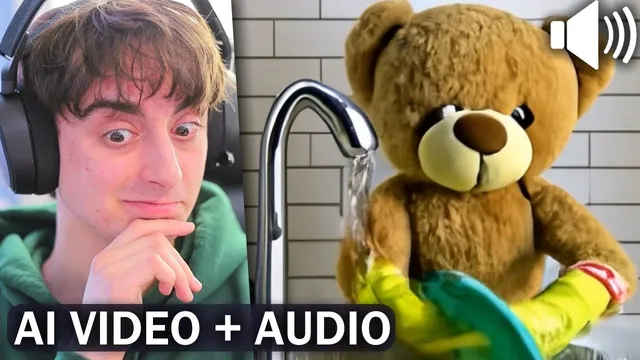
The demo combines Google’s Image and Video text-to-video generation with AudioLDM text-to-audio generation to create short clips with synthetic sound effects.
Briefing
Text-to-video and text-to-audio systems are already capable of producing short, fully synthetic clips—complete with synchronized sound effects—hinting that camera-and-microphone workflows may become optional for many kinds of content creation. A hands-on demo combines two separate generative pipelines: Google’s Image and Video model for visuals and AudioLDM for audio, resulting in clips where sounds like chewing, skating, growing, ocean waves, and even cathedral-like echoes are generated from text prompts rather than recorded from real sources. The output is still crude in places, but the key takeaway is how quickly the pieces are starting to fit together into a single, coherent audiovisual artifact.
The most compelling moments come from cases where the audio generation naturally matches the visual action. A chewing-and-microwave clip was prompted so the microwave hum appears in the audio, and the creator notes the hum is detectable on close listening. In another example, a bear skating on ice lands with striking realism because the generated audio aligns well with the motion implied by the visuals. Even when the match isn’t perfect—such as a can-crushing prompt that fails to produce a convincing “crush” sound—workarounds emerge: audio can be generated to approximate the intended effect, or separate layers can be combined manually.
AudioLDM’s strengths and limits show up in the details. It can handle certain background elements like wind effectively, but more complex layering sometimes requires extra steps. For a sprout-growing scene, the model needed a rubber-stretching-style sound to convey the dramatic growth effect. For a walking-and-ocean scenario, the ocean and footsteps were generated separately and then merged, producing a more convincing composite than relying on a single pass.
The demo also frames progress by comparing text-to-image/video quality across iterations of Midjourney: early versions looked noticeably worse, while later versions (especially Midjourney version 4 and version 5) show a sharp jump in realism and coherence. That realism is arriving fast enough to trigger policy changes—Midjourney ended its free trial amid concerns about deepfake misuse, even though many users arguing about the decision didn’t have access to the most realistic version.
Beyond visuals, voice cloning is already “deepfake-ready.” Using 11 Labs, the workflow described is simple: provide about 10 minutes of speech and the system replicates the voice with near-flawless fidelity. The implication is that synthetic audio will make it easier to generate convincing celebrity- or politician-style content, accelerating the spread of misinformation and synthetic media.
Taken together, the message is less about perfect movies today and more about the trajectory: audiovisual generation is improving in leaps, and the gap between “prompt” and “produced scene” is shrinking fast. Within the next decade, the likely shift is toward content tailored to individual tastes—generated on demand—while the risks of deepfakes and misinformation grow in parallel.
Cornell Notes
Short, fully synthetic clips are now possible by generating both visuals and sound from text prompts. The demo pairs Google’s Image and Video model for imagery with AudioLDM for audio, then does light editing to align audio lengths and actions. Several examples show strong prompt-to-sound matches—microwave hum, skating motion, sprout growth, and cathedral echoes—while harder effects (like can crushing) require creative prompting or layered audio work. Progress in text-to-image quality is described through Midjourney’s rapid jumps toward realism, alongside concerns that realism enables deepfakes. Voice cloning with 11 Labs further lowers the barrier to synthetic media, raising both creative potential and misinformation risk.
What makes the demo’s approach different from typical AI content creation workflows?
How does AudioLDM handle sound effects, and where does it struggle?
Why does the creator emphasize synchronization and editing?
What does the Midjourney comparison add to the argument about the future of generation?
How does voice cloning change the stakes beyond video generation?
Review Questions
- Which parts of the audiovisual pipeline are generated from text, and which parts require human alignment or compositing?
- Give one example where audio generation matched the visuals well and one example where it failed without extra work.
- What policy and safety concerns are raised as image and voice generation become more realistic?
Key Points
- 1
The demo combines Google’s Image and Video text-to-video generation with AudioLDM text-to-audio generation to create short clips with synthetic sound effects.
- 2
Audio synchronization matters because video and audio outputs differ in length; light editing is used to align sounds to actions.
- 3
When prompts are specific, generated audio can include context sounds (e.g., microwave hum) that appear to match the on-screen action.
- 4
More complex audio layering sometimes exceeds a single generation pass, so separate audio components (like ocean and footsteps) are generated and merged.
- 5
Progress in text-to-image quality is described as rapid and discontinuous, with Midjourney version 4 and version 5 marking major realism jumps.
- 6
Midjourney ended its free trial amid concerns that realistic deepfakes could fuel misinformation.
- 7
Voice cloning with 11 Labs lowers the barrier to convincing synthetic impersonation by replicating voices from roughly 10 minutes of input speech.