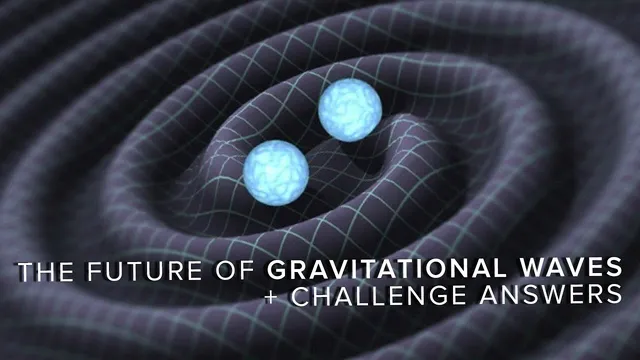
The Future of Gravitational Waves
Based on PBS Space Time's video on YouTube. If you like this content, support the original creators by watching, liking and subscribing to their content.
LIGO’s second detection reports a black-hole merger with masses around 14 and 8 solar masses, treated as highly reliable despite a weaker signal.
Briefing
LIGO’s second gravitational-wave detection is being treated as both a confirmation of the phenomenon and a stress test of the analysis pipeline—because the signal is weaker, shorter, and harder to see by eye, yet still lands with extremely low odds of being random noise. After the September 2015 merger of two black holes (about 30 solar masses each), LIGO reported another event on December 26: a merger of two different black holes with masses around 14 and 8 times the Sun. The core question is whether this December signal is real. The answer hinges on statistics, waveform duration, and cross-checking across detectors.
For the September event, the waveform matched general-relativity expectations: oscillating changes in the interferometer arm lengths that grow in amplitude and frequency as the black holes spiral together, then fade after merger. The same pattern appeared in both LIGO sites—Livingston, Louisiana and Hanford, Washington—making random vibration an implausible explanation. The analysis estimated that LIGO would need to observe for more than 200,000 years to see a similar signal by chance, translating to roughly a one-in-20-billion probability of a false match.
The December event is subtler: it produced arm-length changes about 1/1000 of the September signal—on the scale of a proton diameter—and looks less obvious visually. Still, the probability of a noise-only origin is about one in 10 billion. The key reason is that the signal lasted nearly a full second, compared with about a tenth of a second earlier. Smaller black holes take longer to coalesce as they approach each other closely, stretching the gravitational-wave “chirp” and giving the detection algorithms more time to lock onto the expected pattern. Two additional safeguards boost confidence: sophisticated signal processing (described as analogous to radar techniques) and exhaustive computer simulations that estimate how often the pipeline would mistakenly “find” a signal of this type.
Beyond detection confidence, the results reinforce general relativity. The observed waveforms line up with theoretical predictions, strengthening confidence in how spacetime behaves around black holes. The detections also help calibrate astrophysical expectations—suggesting estimates for how many binary black holes exist and what masses they have are at least roughly correct, which implies more mergers should be detectable.
Looking ahead, the catalog is expected to expand beyond black-hole pairs. Neutron-star mergers and neutron-star–black-hole systems should eventually appear, along with supernova-related signals, but those sources are rarer and generally farther away, so LIGO must wait for events close enough to be within its sensitivity volume. Sky localization is currently limited: direction estimates rely on the time difference between the two detectors, yielding a long “streak” across the sky. With Virgo coming online later, triangulation should improve dramatically, enabling rapid follow-up by telescopes.
The transcript also includes a physics challenge about quantum tunneling in radioactive decay: estimating the chance that an alpha particle escapes a polonium-212 nucleus within its 0.3-microsecond half-life. The calculation yields about a 50% decay probability over that interval and an approximate 10^-15 tunneling chance per encounter, with an extra-credit estimate placing the tunneling distance at roughly 20 femtometers (from about 7 to 27 femtometers from the nucleus center).
Cornell Notes
LIGO’s second gravitational-wave detection reports another black-hole merger, this time with masses around 14 and 8 solar masses, and treats it as highly reliable despite a weaker, less visually obvious signal. Confidence comes from the signal’s long duration (nearly a second), its match to general-relativity waveform predictions, and the fact that the same event is consistent with both LIGO detectors. The analysis also uses radar-like signal processing plus extensive simulations to estimate how rarely noise would produce a false detection of this type. The event strengthens general relativity and improves estimates of black-hole populations, while future detections should include neutron-star systems and better sky localization once Virgo joins.
Why is the December 26 gravitational-wave detection considered credible even though it’s weaker than the September 2015 event?
How do the two LIGO sites contribute to ruling out random vibrations?
What does the waveform agreement with general relativity change about scientific confidence?
Why are black-hole mergers expected to be detected more often than neutron-star events?
How will Virgo improve gravitational-wave astronomy beyond LIGO’s current localization limits?
In the tunneling challenge, what sets the per-encounter tunneling probability and the tunneling distance?
Review Questions
- What specific features of the December gravitational-wave signal reduce the likelihood that it is random noise?
- How does adding a third detector change sky localization compared with using only two LIGO sites?
- In the polonium-212 tunneling problem, how do the half-life, nuclear size, and alpha-particle kinetic energy combine to produce the decay probability?
Key Points
- 1
LIGO’s second detection reports a black-hole merger with masses around 14 and 8 solar masses, treated as highly reliable despite a weaker signal.
- 2
The December event’s credibility rests on a low false-alarm probability (~1 in 10 billion) supported by waveform duration (nearly a second) and strong agreement with expected chirp shapes.
- 3
Cross-detector consistency and statistical estimates make random vibration an extremely unlikely explanation for the September event, and the December event is similarly constrained by analysis and simulations.
- 4
Waveform matches to general relativity strengthen confidence in spacetime dynamics near black holes and help validate astrophysical estimates of black-hole populations and masses.
- 5
Future detections should expand beyond black-hole mergers to neutron-star and neutron-star–black-hole systems, but those require closer events due to smaller detectable volumes.
- 6
Current two-detector localization yields a long sky streak; Virgo’s addition should enable much tighter source localization and faster telescope follow-up.
- 7
The tunneling challenge estimates a ~50% decay probability over polonium-212’s 0.3-microsecond half-life by counting alpha-particle boundary encounters and using a per-encounter tunneling chance near 10^-15, with a tunneling distance of roughly 20 femtometers.