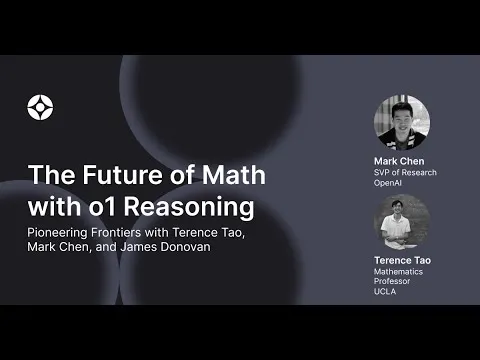
The Future of Math with o1 Reasoning with Terence Tao, Mark Chen, and James Donovan
Based on OpenAI's video on YouTube. If you like this content, support the original creators by watching, liking and subscribing to their content.
o-series reasoning models are designed to reduce shallow pattern-matching errors by encouraging more reflective “system two” behavior before answering.
Briefing
The central takeaway is that progress in “reasoning math” is less about making large language models magically correct and more about rebuilding the workflow around mathematics: modular collaboration, iterative verification, and formal proof layers that can catch mistakes at scale. Terence Tao frames the opportunity as a shift from mathematicians tackling one problem at a time to teams—human and AI—working in parallel on thousands of problems, with different roles handling vision (what to study), computation, proof writing, and checking. Mark Chen adds that today’s models like GPT-4 can be “smart but stupid,” often falling into pattern-matching errors, which is why OpenAI has emphasized o-series reasoning models designed to behave more like “system two” thinkers—slower, reflective, and less reliant on shallow priors.
A key mechanism in the discussion is formal verification. Both Tao and Chen argue that for complex mathematics, a proof assistant such as Lean is not optional: one wrong step can collapse an entire argument. The proposed workflow is iterative: an AI proposes a proof in a formal language (Lean), the system compiles it, and any failure returns an error message that guides the next attempt. This approach is described as already effective for smaller, homework-scale proofs, while large, PhD-level proof generation still demands more compute and doesn’t yet scale cleanly to “ask a high-level question, get a huge proof” automation.
Tao also emphasizes how AI changes the economics and organization of math. Mathematics currently bundles many tasks—posing questions, finding tools, reading literature, computing, checking, writing, presenting, and grant work—into a single person’s workload. AI and software tooling can decouple these tasks, enabling specialization: some contributors focus on conjecture and pattern discovery, others on formalizing theorems, others on running code and project coordination (with GitHub-style workflows), and still others on visualization and communication. He notes that large collaborations already exist in formalization projects, where verification is built in, and cites Lean’s mathlib as a major example.
The conversation repeatedly returns to what remains hard. Chen says AI struggles most when data is scarce and the next step requires strategic planning—new abstractions, taste, and reasoning in “negative space.” Tao agrees that models are weak at deciding what to ask and what abstractions to build, even if they can help with pattern recognition, conjectures, verification, and counterexample search. Both also warn that trust and oversight become central as model-generated insights grow in volume; scalable oversight is treated as an open problem, with math singled out as a domain where formal verification offers a rare path to automated trust.
Finally, the panel connects accelerated math to broader science and society. Faster foundational progress could expand citizen participation in math through interactive modeling and visualization, and it may make math “optional” for some scientific workflows by letting AI handle the calculations behind the scenes. Yet the speakers stress that human expertise still matters for supervision, interpretation, and steering—especially when models produce plausible but potentially wrong reasoning. The event ends with a practical message: the near-term value is compounding—accelerating parts of research, improving verification, and enabling new collaboration structures—rather than replacing mathematicians outright.
Cornell Notes
The discussion argues that accelerating mathematics with AI depends on changing the research workflow, not just increasing model size. o-series reasoning models are designed to reflect more before answering, addressing failure modes where faster pattern-matching leads to simple mistakes. For complex proofs, formal proof assistants like Lean provide an indispensable verification layer: AI can propose steps, the proof compiles or fails, and error feedback guides iteration. This modular, team-based approach can scale collaboration by splitting tasks such as computation, formalization, and project coordination. The payoff matters because it enables parallel progress on many problems while keeping trust high through machine-checkable correctness.
Why do the speakers treat formal proof assistants (e.g., Lean) as a “necessary intermediary layer” between AI outputs and trustworthy mathematics?
What does “reworking mathematics from the ground up” mean in practice—how does AI change collaboration?
What are the main limitations of current reasoning models highlighted by Mark Chen?
How do the speakers reconcile the fear that AI will reduce human intuition or “number sense”?
What does the panel say about scaling from Olympiad-level performance to PhD-level math?
Why is “scalable oversight” treated as a central challenge as AI-generated insights grow?
Review Questions
- What workflow changes are needed so AI can contribute to complex proofs without sacrificing correctness?
- Which specific failure modes (e.g., pattern-matching, reliance on priors, data scarcity) limit current reasoning models, and how do o-series models address them?
- How do the speakers use analogies like chess and calculators to argue that human skills may shift rather than erode?
Key Points
- 1
o-series reasoning models are designed to reduce shallow pattern-matching errors by encouraging more reflective “system two” behavior before answering.
- 2
Complex proofs require machine-checkable verification; iterative proof attempts in Lean can be validated by compilation and corrected using error feedback.
- 3
AI can decouple math work into modular roles—question selection, computation, formalization, and project coordination—enabling parallel progress across many problems.
- 4
AI is strongest when tasks generate lots of training-like data; it struggles more in data-scarce research settings that require strategic planning and abstraction “taste.”
- 5
Collaboration scales better in formalization ecosystems (e.g., Lean’s mathlib) because contributions can be verified in a shared formal language.
- 6
Trust and oversight become harder as model-generated insights increase; math is a rare domain where formal verification can provide scalable confidence.
- 7
Accelerated foundational math could broaden participation and speed scientific workflows, but human supervision and expertise remain important for steering and interpretation.