The Future of Space Telescopes
Based on PBS Space Time's video on YouTube. If you like this content, support the original creators by watching, liking and subscribing to their content.
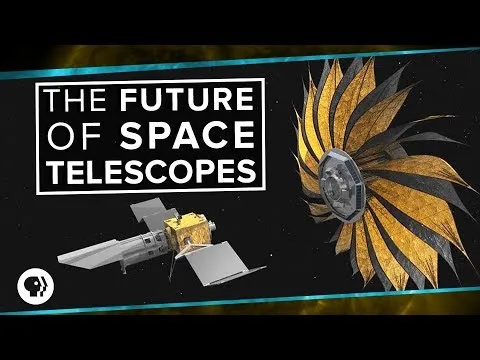
Star Shade targets the exoplanet “glare” problem by using an external, petal-shaped occulter that diffracts starlight away from the telescope’s optical axis.
Briefing
Space telescopes are moving beyond the old bottleneck of launching large, rigid mirrors and lenses by turning diffraction and even “impossible” materials into workable optical systems. The most ambitious path targets a long-standing exoplanet problem: Earth-size worlds are swamped by starlight, and internal coronagraphs can’t suppress glare enough because light diffracts around their edges. A proposed solution—NASA’s Star Shade—would be a separate spacecraft that flies tens of thousands of kilometers in front of a telescope and creates a carefully engineered “artificial eclipse.” Instead of a simple opaque disk, it uses a flower-like, petal-shaped structure designed so diffraction spreads starlight away from the telescope’s central axis. With the right alignment, glare suppression is projected to reach a factor of 10 billion at 50 milliarcseconds from the star, enabling direct imaging of an Earth-like planet around a Sun-like star from roughly 60 light-years away. That would open the door to using cameras and spectrographs to look for surface and atmospheric signatures—continents, oceans, ice caps, and cloud patterns—rather than relying only on indirect detection.
Star Shade is also positioned as a cost-and-instrumentation workaround. If it performs the high-contrast job externally, the telescope it serves may not need coronagraphs, wavefront correctors, or other internal high-contrast hardware. The first Star Shade could ride NASA’s WFIRST mission in the 2020s, with an estimated budget around $750 million and a five-year operational run. One design concept even allows a single Star Shade to serve multiple telescopes, potentially multiplying scientific return.
A second diffraction-driven concept, the Aragoscope, flips the usual complaint about diffraction into a focusing mechanism. Instead of using geometric optics (reflection or refraction), it imagines an opaque disk—100 meters to a kilometer across—suspended in front of a detector. Light diffracts around the disk and forms a sharp focus through constructive interference, producing resolution far beyond what a telescope like Hubble could achieve for the same “effective” aperture size. Scaling is the key advantage: a foldable plastic disk could be expanded far more easily than a monolithic mirror. The trade-off is severe: the Aragoscope blocks most of the light, leaving only a thin diffracted ring, so the received photon count can be no better than having no telescope at all. Potential fixes include adding mass-heavy optics or breaking the disk into concentric rings to create multiple diffraction edges, though aligning the light from each ring to the same focus is challenging. The concept is especially attractive for X-ray astronomy, where mirror surfaces must be extremely smooth; a mirrorless Aragoscope would place the diffraction element thousands of kilometers from the detector, potentially enabling views down to the event horizons of supermassive black holes.
Finally, “orbiting rainbows” proposes ditching rigid structures altogether. Inspired by how water droplets shape colorful arcs, researchers suggest using photon pressure to suspend a cloud of tiny reflective particles in Earth orbit—a laser-confined “glitter” mirror or lens. The particles, fractions of a millimeter wide, could be corralled into a large effective aperture (tens of meters) after launch, when the system fits into a small container. Because such granular optics are inherently noisy, the approach relies on multiple exposures and advanced algorithms to combine images and remove speckle. The payoff is scalability and lower launch risk: multiple telescopes could be deployed, each potentially delivering several times the light-collecting power of Hubble.
The broader takeaway is that constraints once treated as fundamental—mass, size, and optical imperfections—are being reframed as engineering problems solvable with new architectures, external occulters, diffraction optics, and data-driven imaging. The result is a roadmap toward sharper, higher-contrast observations that reach deeper into space-time.
Cornell Notes
Future space telescopes may achieve higher resolution and contrast without launching huge, rigid mirrors by using external occulters, diffraction as a tool, and even laser-shaped particle optics. Star Shade replaces internal coronagraphs with a separate spacecraft that hovers ~80,000 km in front of a telescope and uses petal geometry to diffract starlight away from the optical axis, targeting ~10 billion glare suppression at 50 milliarcseconds—enough to image Earth-like planets from ~60 light-years. The Aragoscope uses an opaque, foldable disk to focus light via diffraction rather than reflection/refraction, offering potentially much finer resolution but with a photon-starved trade-off that may be mitigated with ring segmentation or added optics. Orbiting rainbows proposes photon-pressure “glitter clouds” that act as scalable mirrors/lenses, with image reconstruction from multiple noisy exposures. Together, these ideas aim to overcome mass and contrast limits while expanding what telescopes can directly observe.
Why can’t internal coronagraphs fully block starlight when searching for Earth-like exoplanets?
How does Star Shade achieve the extreme glare suppression needed for direct imaging?
What is the core optical trick behind the Aragoscope, and what’s the main downside?
Why is the Aragoscope especially promising for X-ray astronomy?
How can a disordered “glitter cloud” produce usable images in orbiting rainbows?
Review Questions
- What contrast gap remains after internal coronagraphs, and how does Star Shade target the missing orders of magnitude?
- Compare the Aragoscope’s resolution mechanism with its photon-collection limitation—what would you change to improve signal?
- What role do data processing and multiple exposures play in orbiting rainbows, given that the optical element is noisy?
Key Points
- 1
Star Shade targets the exoplanet “glare” problem by using an external, petal-shaped occulter that diffracts starlight away from the telescope’s optical axis.
- 2
Projected performance for Star Shade is about 10 billion glare suppression at 50 milliarcseconds, enabling Earth-like planet detection from roughly 60 light-years.
- 3
Star Shade’s petal geometry is wavelength-optimized, and the petals fold for launch then open in space like a flower.
- 4
The Aragoscope uses diffraction focusing from an opaque, foldable disk, potentially boosting resolution without launching a heavy monolithic mirror.
- 5
The Aragoscope’s major trade-off is light loss: it blocks most photons and leaves mainly a diffracted ring, so throughput improvements are central to making it practical.
- 6
Orbiting rainbows replaces rigid optics with a laser-confined reflective particle cloud shaped by photon pressure, relying on multi-exposure image reconstruction to overcome speckle noise.