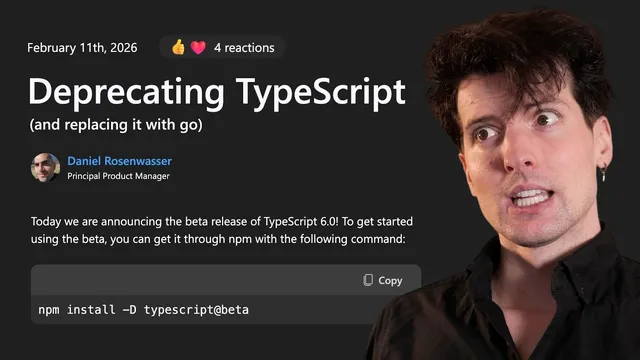
The Future of TypeScript
Based on Theo - t3․gg's video on YouTube. If you like this content, support the original creators by watching, liking and subscribing to their content.
TypeScript’s next major shift targets scalability: faster type checking, more reliable behavior, and better diagnostics as projects and agent usage grow.
Briefing
TypeScript’s next leap isn’t just about adding features—it’s about making type checking fast, predictable, and easier to debug as projects balloon in size and as AI agents increasingly rely on editor-grade feedback. The core shift comes from a major rewrite of the TypeScript compiler and language service: the TypeScript team is porting the system to Go, aiming for a faster “TypeScript 7” experience while using TypeScript 6 as a bridge. The payoff is meant to be practical: better defaults for both humans and agents, clearer error reporting, and dramatically improved performance for large codebases where today’s type checking can grind to a halt.
TypeScript’s popularity traces back to its role as a reliability layer over JavaScript. Microsoft built it to make JavaScript workable at scale, where correctness failures can cascade through massive weekly code output. Google’s Angular adoption helped the broader ecosystem “wake up” to TypeScript’s value, and the result is that most modern web code now uses TypeScript packages and tooling. Yet TypeScript still carries JavaScript-era baggage: non-strict defaults, inference quirks, and odd behaviors with recursive type definitions. The team has been iterating, but the bigger problem is structural—TypeScript apps have grown far beyond the small web projects that originally made the approach feel lightweight.
As TypeScript moved outside the browser and into full-stack and even exotic type-driven generation, compilation costs rose. The transcript highlights a concrete pain point: type checking can become dominated by enormous files—one cited example is a ~55,000-line TypeScript file that can overwhelm tooling like GitHub’s viewer. The slowdown isn’t about runtime JavaScript execution (V8 helps there); it’s about the compiler’s need to analyze and verify types before emitting code.
That’s why the roadmap emphasizes three priorities: stricter and more agent-friendly defaults, faster type checking, and better diagnostics when things go wrong (compiler errors, traces, and other signals that help both developers and automated systems correct type issues). The port to Go is framed as a deliberate choice: Go’s garbage collection and concurrency model are better suited to compiler workloads than Rust’s constraints around shared mutable memory. The rewrite is already usable via “TypeScript Go” previews, with editor capabilities like go-to-definition and rename expected to feel snappier because the language service can respond faster.
TypeScript 6 is positioned as the “cleanup” release—feature-stable, meant to align with the Go version and reduce drift from TypeScript 5. The transcript lists notable changes that also improve correctness and migration safety: strict mode finally defaults to on, module and target defaults shift toward modern ES behavior, and several flags that previously caused surprising behavior are tightened or removed. A standout migration tool is the “stable type ordering” flag, introduced to keep type IDs deterministic across parallel checking—at the cost of potential slowdown (up to ~25% in some codebases). The overall message is that TypeScript’s future is less about novelty and more about making the system dependable at scale, with faster feedback loops that agents can consume reliably.
Cornell Notes
TypeScript’s next phase focuses on scaling: faster type checking, clearer diagnostics, and safer defaults as codebases grow and AI agents increasingly depend on editor feedback. The TypeScript team is porting the compiler and language service to Go, with TypeScript 6 acting as a cleanup/compatibility bridge toward TypeScript 7. TypeScript 6 introduces stricter defaults (including strict mode), modernized module/target defaults, and migration aids like stable type ordering to keep behavior consistent under parallel checking. The goal is to reduce tech debt, align with the Go implementation, and make type errors easier for both humans and agents to fix quickly.
Why did TypeScript become the default choice for much of the web ecosystem, and what problem did it originally solve?
What’s the main reason TypeScript feels slow today—runtime or compilation?
What are the three headline priorities driving the TypeScript rewrite?
Why Go for the compiler port instead of Rust?
What does “stable type ordering” solve, and what tradeoff does it introduce?
How does TypeScript 6 function in the migration plan toward TypeScript 7?
Review Questions
- What specific kinds of problems does TypeScript aim to improve for AI agents—beyond raw type safety?
- How can type ID ordering affect emitted declaration files, and why does parallel type checking make that worse?
- What changes in TypeScript 6 defaults would most likely reduce “it compiles but behaves oddly” situations for new projects?
Key Points
- 1
TypeScript’s next major shift targets scalability: faster type checking, more reliable behavior, and better diagnostics as projects and agent usage grow.
- 2
The compiler and language service are being ported to Go, with TypeScript 6 positioned as a cleanup/alignment bridge toward TypeScript 7.
- 3
TypeScript 6 introduces stricter defaults (including strict mode) and modernizes module/target behavior to reduce common footguns.
- 4
Large codebases expose compilation bottlenecks—especially type checking dominated by very large files—rather than runtime performance issues.
- 5
Stable type ordering addresses nondeterminism from encounter order and parallel checking, but can slow type checking (up to ~25% in some cases).
- 6
The rewrite prioritizes agent-friendly feedback loops: clearer errors, traces, and faster editor actions like go-to-definition and rename.
- 7
Go is chosen for practical compiler engineering reasons, including concurrency and garbage-collection behavior that’s less problematic for compilation than for real-time request handling.