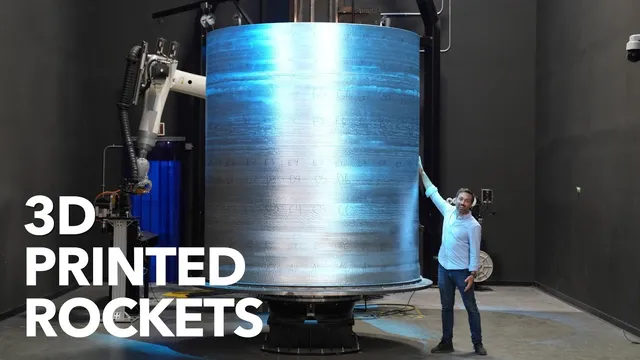
The Genius of 3D Printed Rockets
Based on Veritasium's video on YouTube. If you like this content, support the original creators by watching, liking and subscribing to their content.
Relativity Space’s Stargate printer uses wire-fed aluminum alloy and plasma/laser energy to fuse rocket metal incrementally, with deposition controlled on millisecond timescales.
Briefing
Relativity Space is building a rocket by replacing much of the traditional aerospace “tooling first” workflow with software-driven metal 3D printing—an approach aimed at printing an entire rocket structure, including propellant tanks and engines, on a roughly 60-day timeline. The centerpiece is Stargate, described as the world’s largest 3D metal printer, which uses a wire-feed system and a plasma arc discharge to melt aluminum alloy “wire” into place while controlling deposition on millisecond timescales. The result is a rocket that still shows visible layer lines on the outside, but is later machined at critical joint areas so the metal behaves like conventional machined components.
The core engineering case for 3D printing rockets rests on how rockets are built and why traditional manufacturing is slow. Rockets combine four major systems—payload, guidance, structural, and propulsion—but the propulsion side dominates the complexity. Cryogenic fuel and oxidizer are pumped into an injector, then burned in a combustion chamber; thrust depends on how fast exhaust exits the nozzle and how much mass flows through it. Historically, that has meant building specialized factories and fixtures before a single rocket can be assembled. The Space Launch System (SLS) is used as an example: before NASA could build the rocket, it had to develop enormous welding tooling like the 170-foot Vertical Assembly Center, a project that took more than a decade.
Relativity Space’s pitch is that 3D printing changes the economics and cadence of aerospace manufacturing. Instead of fabricating thousands of parts and then assembling them, the company prints large assemblies as fewer pieces. In injectors, for instance, a traditional bucket-style design can involve over a thousand individual components and months of work; the 3D-printed version is described as a single piece made in about two weeks at roughly one-tenth the cost. In combustion hardware, cooling is essential because temperatures can reach around 3,500 Kelvin—hot enough to melt most metals. 3D printing enables integrated cooling channels to be built directly into nozzles and chambers, avoiding labor-intensive pipe-and-braze workflows that once required thousands of tiny tubes.
A major concern—whether printed metal is strong enough—gets answered through materials and process control. The company develops custom aluminum alloys for 3D printing, leveraging rapid melt-and-solidification to produce strong material. Another practical challenge is distortion: printing can warp parts as they cool, so the system uses computational simulation to “reverse warp” the geometry before printing. The printer then follows a shape that looks wobbly in motion but lands within tight straightness tolerances once the material cools.
Beyond cost and speed, the approach is presented as a design revolution. With fewer constraints from fixed tooling, engineers can build smooth, curvy, bio-inspired structures and internal features that would be impractical with conventional manufacturing. Relativity’s rockets—Terran One for low Earth orbit and Terran R for missions toward the Moon and Mars—are framed as examples of how a fully 3D printed manufacturing paradigm could reshape what rockets look like and how quickly they iterate. The broader claim is not that every rocket will be printed forever, but that the technology positions Relativity as a manufacturing expert while pushing aerospace toward a “factory of the future,” potentially even enabling industrial infrastructure on Mars.
Cornell Notes
Relativity Space aims to manufacture rockets using software-driven metal 3D printing, with Stargate described as the world’s largest 3D metal printer. The approach targets fewer parts, faster production, and less dependence on bespoke tooling by printing major structures and engine components as integrated assemblies. Key propulsion pieces—like injectors and rocket nozzles—benefit from reduced part counts and built-in cooling channels, which matter because combustion hardware can see temperatures around 3,500 Kelvin. Strength and dimensional accuracy are addressed through custom alloys, rapid melt/solidification, and simulation-based “reverse warping” to counter distortion during cooling. If successful, the method could lower costs and enable rapid iteration, changing both rocket design and manufacturing cadence.
How does the Stargate printer physically build rocket metal, and what controls the melt-and-deposit process?
Why does 3D printing matter specifically for rocket propulsion hardware?
How do engineers prevent combustion chambers and nozzles from melting at extreme temperatures?
What addresses the concern that printed metal might be too weak or too distorted?
How does 3D printing change the rocket manufacturing workflow compared with traditional aerospace?
What design changes become possible when rockets are built with far fewer parts?
Review Questions
- What specific manufacturing bottlenecks in traditional rocket building are highlighted by the SLS tooling example, and how does 3D printing aim to bypass them?
- How do integrated cooling channels in printed nozzles reduce manufacturing complexity while addressing the thermal problem of ~3,500 K combustion?
- Which two engineering challenges—material strength and warping/distortion—are addressed by custom alloys and simulation-based reverse warping, respectively?
Key Points
- 1
Relativity Space’s Stargate printer uses wire-fed aluminum alloy and plasma/laser energy to fuse rocket metal incrementally, with deposition controlled on millisecond timescales.
- 2
Rocket propulsion manufacturing is dominated by complex, cryogenic-fed hardware; 3D printing targets injectors, combustion components, and nozzles where part count and cooling integration are major pain points.
- 3
Integrated cooling channels matter because combustion can reach roughly 3,500 Kelvin; printed designs route cryogenic propellants through channels built into the same part.
- 4
Custom aluminum alloys and rapid melt/solidification are used to counter the concern that printed metals are inherently weak.
- 5
Simulation-based reverse warping compensates for distortion during cooling, letting printed parts land within tight straightness tolerances after solidification.
- 6
Reducing fixed tooling and part counts enables faster iteration cycles, with engine redesigns described as printable on about a month timeline.
- 7
Relativity frames Terran One (low Earth orbit) and Terran R (Moon/Mars-capable) as demonstrations of a manufacturing paradigm that could reshape rocket design and cost curves.