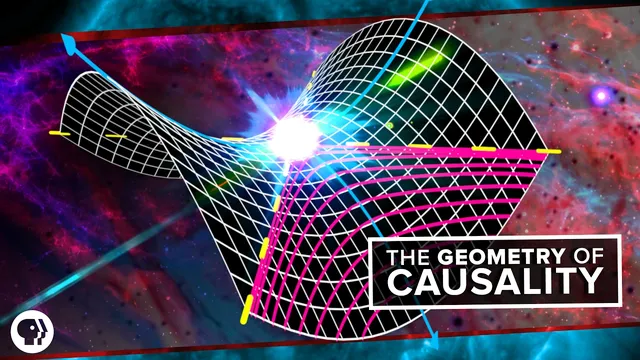
The Geometry of Causality
Based on PBS Space Time's video on YouTube. If you like this content, support the original creators by watching, liking and subscribing to their content.
The spacetime interval is the invariant quantity under Lorentz transformations, even though Δx and Δt vary between observers.
Briefing
Causality in relativity isn’t a vague philosophical idea—it becomes a precise geometric structure on spacetime diagrams. In special relativity, the invariant spacetime interval carves spacetime into hyperbolic “contours” that every observer agrees on, and those contours act like a causal geography: time evolution slides “downhill” along the steepest allowed paths, while “uphill” motion corresponds to reversing causality.
The episode starts by revisiting why time and distance can’t be treated as universal quantities. In special relativity, moving clocks tick slower and moving rulers contract, yet all observers can still agree on the spacetime interval between events. Proper time—the time measured by a traveler on their own clock—depends on the traveler, but the interval between events is invariant under Lorentz transformations. That invariance matters because it determines which events can influence which others.
Using a simplified spacetime diagram (one spatial dimension plus time), the program describes world lines: the paths that moving observers trace through spacetime. Travelers starting at the origin and moving at different speeds end up arranged on a hyperbola when their endpoints are connected at equal increments of their own proper time. These nested hyperbolas aren’t decorative. They represent the set of events that share the same spacetime interval value relative to the origin—meaning the same causal “distance,” even though the spatial and temporal separations differ from one observer to another.
To show why the hyperbolas are observer-independent, the episode switches perspectives. A different traveler’s axes are rotated relative to the original observer’s axes because simultaneity is frame-dependent. Building the new time and space axes requires collecting signals that arrive at different rates, reflecting time dilation and the relativity of simultaneity. Once the axes are “squared up,” the transformation between frames is recognized as a Lorentz transformation—implemented geometrically rather than algebraically. When the transformed intersection points are tracked, they still land on the same hyperbola, reinforcing that the spacetime interval is the invariant quantity.
The causal payoff comes next. Events that look close in both space and time can share the same interval as events that are far apart, because the interval encodes causal proximity for signals or particles that could carry an influence. The episode then interprets the interval like a valley: moving forward in time makes the interval decrease, and a particle naturally follows the steepest descent. The boundary of what’s reachable defines the forward light cone, while “uphill” motion is forbidden unless the cosmic speed limit is violated. In flat Minkowski spacetime, flipping the interval’s direction is equivalent to faster-than-light travel; inside a black hole’s curved spacetime, the geometry forces the causal direction to evolve in ways that will be explored further for sub-event-horizon intervals.
After the physics core, the transcript pivots to audience Q&A and recommendations, touching on topics like possible resolutions of black hole singularities via string theory “fuzzballs,” stable orbits near quasars (innermost stable circular orbits), gravitational redshift as time dilation, and whether accretion disks can host fusion. The episode closes with a reminder that learning the underlying astrophysics is harder than “easy credit” classes suggest—especially for newcomers.
Cornell Notes
Relativity turns causality into geometry: spacetime intervals form invariant hyperbolic contours that all observers agree on. Travelers with different speeds trace different world lines, but endpoints that share the same proper-time count lie on the same hyperbola relative to an origin. Changing reference frames rotates the spacetime axes (a Lorentz transformation), yet the intersection points still land on the same contour because the spacetime interval is invariant. Interpreting the interval as a “causal valley,” forward evolution corresponds to sliding downhill along the steepest allowed paths, bounded by the light cone. Attempting to go uphill would mean reversing causality, which in flat spacetime requires breaking the speed limit; black hole interiors complicate that picture by flipping roles of space and time.
Why do observers agree on the spacetime interval even when they disagree on time dilation and length contraction?
How do nested hyperbolas arise from world lines and proper time?
What changes when switching to another observer’s spacetime axes, and why does the hyperbola stay fixed?
How does the spacetime interval translate into a causal picture like a valley and light cones?
What role does black hole curvature play in causality compared with flat spacetime?
How do the Q&A segments connect back to relativity concepts like time dilation?
Review Questions
- What makes the spacetime interval invariant under Lorentz transformations, and why does that invariance matter for causality?
- How does the relativity of simultaneity force a rotated space axis when transforming to another observer’s frame?
- In the “valley” analogy, what defines the boundary of reachable events, and how does that relate to the light cone?
Key Points
- 1
The spacetime interval is the invariant quantity under Lorentz transformations, even though Δx and Δt vary between observers.
- 2
Proper time depends on the traveler, but equal proper-time increments map to observer-independent hyperbolic contours in spacetime diagrams.
- 3
Frame changes rotate spacetime axes because simultaneity is relative; constructing the new axes requires tracking when light signals arrive.
- 4
Hyperbolas represent constant spacetime interval values—equivalent causal proximity to an origin for any observer.
- 5
Forward causal evolution corresponds to moving “downhill” in the interval landscape, bounded by the forward light cone.
- 6
In flat spacetime, reversing the causal direction requires violating the speed limit (effectively “going uphill”).
- 7
Black hole interiors alter causal structure through spacetime curvature, setting up different behavior for intervals inside the event horizon.