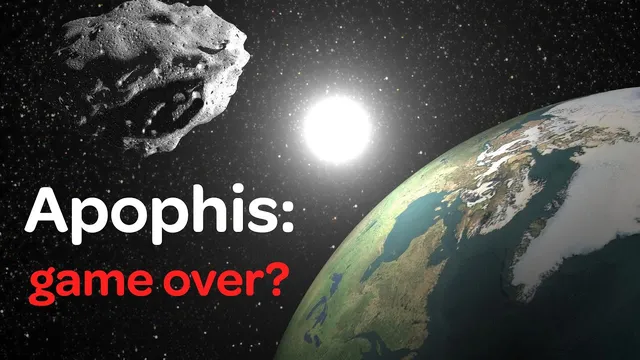
The "God of Chaos" Asteroid That Might Hit Earth
Based on Second Thought's video on YouTube. If you like this content, support the original creators by watching, liking and subscribing to their content.
Apophis is about 340 meters across and is classified as potentially hazardous because it is both large enough and passes within a defined proximity threshold of Earth.
Briefing
An asteroid named Apophis—about 340 meters across and nicknamed the “God of Chaos”—will pass extremely close to Earth in 2029, offering a rare scientific opportunity while also underscoring the stakes of impact risk. In cosmological terms, the flyby is a near miss: Apophis is expected to skim past Earth at roughly 19,000 miles away, a distance so tight that it will pass between weather satellites and the planet. The approach matters because it may be the best chance scientists get to study a potentially hazardous asteroid up close before its next, much farther visit in 2036.
Apophis is classified as “potentially hazardous” because it meets two criteria: it is large enough and it comes within a defined proximity threshold of Earth. At 340 meters wide—about 13% taller than the Eiffel Tower—it ranks among the largest objects predicted to pass so near. NASA scientists are preparing to use the 2029 close approach to refine knowledge of asteroid behavior and improve collision-prevention planning, since Earth’s gravity will alter Apophis’s trajectory during the encounter.
For the public, the 2029 flyby is also expected to be visible. The asteroid should shine about as brightly as surrounding stars and move across the sky roughly the distance of the Moon in about 60 seconds. Observers in Australia are expected to see it first as it travels across the southern hemisphere from east to west, then it becomes visible in the United States in the evening. At its estimated speed, Apophis should cross the Atlantic Ocean in about an hour before continuing on into space.
The transcript frames the danger by comparing Apophis to past impacts. Earth has been struck by far larger bodies, including the Chicxulub impactor—estimated at 11 to 81 kilometers wide—linked to the dinosaur extinction. Apophis is smaller, but even smaller objects have produced catastrophic effects. The 1908 Tunguska event involved a meteoroid roughly 50 to 190 meters across that exploded over sparsely populated Siberia, flattening about 2,000 kilometers of forest and causing damage and casualties far beyond the blast zone. The same kind of explosion today, if it occurred over a dense city like New York, is described as potentially devastating—flattening tens of millions of trees and releasing energy comparable to a 15 kiloton weapon.
Despite the fear factor, the stated collision odds are low: Apophis has about a one in 100,000 chance of hitting Earth. Still, that risk is presented as meaningfully higher than the chance of being struck by lightning. The core takeaway is a balancing act—an unusually close pass that could sharpen planetary defense capabilities, paired with a reminder that gravity-driven trajectory changes mean the future path must be monitored carefully.
Cornell Notes
Apophis, a 340-meter asteroid nicknamed the “God of Chaos,” is expected to pass Earth at about 19,000 miles in 2029—close enough to slip between weather satellites and the planet. It’s classified as potentially hazardous due to its size and proximity threshold, and Earth’s gravity will change its trajectory during the encounter. The 2029 flyby is likely the best opportunity to study Apophis up close, while the next predicted visit in 2036 is much farther away (about 36 million miles). Although the chance of impact is estimated at roughly 1 in 100,000, the transcript emphasizes that even smaller asteroid airbursts can cause large-scale destruction, making monitoring and prevention planning essential.
Why is Apophis considered “potentially hazardous” even though the collision odds are low?
What makes the 2029 flyby scientifically valuable compared with the 2036 return?
How can ordinary observers potentially see Apophis in 2029?
What historical impact events are used to illustrate the consequences of asteroid airbursts?
How does the transcript compare Apophis to the Chicxulub impactor?
Review Questions
- What two criteria make an asteroid “potentially hazardous,” and how does Apophis fit them?
- Why does Earth’s gravity during the 2029 encounter matter for predicting Apophis’s future trajectory?
- Using the Tunguska example, explain how an asteroid smaller than Apophis could still cause widespread damage.
Key Points
- 1
Apophis is about 340 meters across and is classified as potentially hazardous because it is both large enough and passes within a defined proximity threshold of Earth.
- 2
In 2029, Apophis is expected to pass roughly 19,000 miles from Earth, slipping between weather satellites and the planet.
- 3
Earth’s gravity during the 2029 flyby will change Apophis’s trajectory, making precise tracking and modeling critical.
- 4
The 2029 close approach is likely the best opportunity to study Apophis up close, while the next predicted visit in 2036 is much farther away (about 36 million miles).
- 5
Apophis may be visible to the public in 2029, shining about as brightly as nearby stars and moving across the sky in about 60 seconds.
- 6
The transcript estimates a one-in-100,000 chance of collision—low, but still meaningfully higher than the chance of being struck by lightning.
- 7
Historical events like Tunguska illustrate that even smaller objects can produce large-scale destruction, especially if an airburst occurs over populated areas.