The Graphical Abstract Revolution That Journals Now Expect
Based on Andy Stapleton's video on YouTube. If you like this content, support the original creators by watching, liking and subscribing to their content.
Graphical abstracts can increase reader engagement by translating dense abstracts into a visual snapshot that encourages paper clicks and scanning.
Briefing
Graphical abstracts are becoming a make-or-break expectation for journals, and AI tools can now generate first drafts from a paper’s abstract—fast enough to iterate toward submission-ready visuals. The core promise: a visual “snapshot” that replaces dense word-heavy abstracts with a clearer, more inviting entry point for readers, while still communicating key technical details and the work’s “so what.” The practical takeaway is that AI can produce strong layouts and include relevant concepts (like materials, performance metrics, and target applications), but it still makes scientific and formatting mistakes that must be corrected before publication.
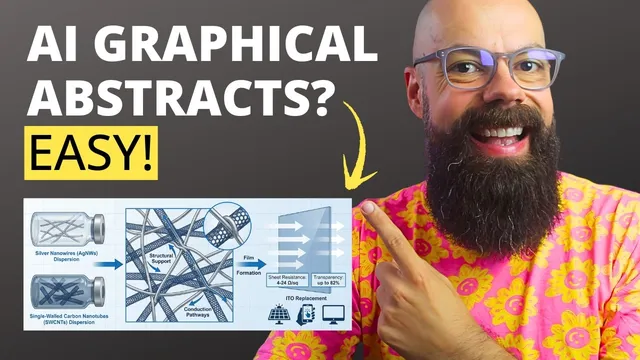
Three AI tools stand out for generating graphical abstracts from peer-reviewed text. Sizeace (used with an “agent mode”) produces a polished illustration that correctly captures elements such as silver nanowires, carbon nanot tubes, single-wall wording, and key outcome metrics like sheet resistance and transparency. Its main weakness in the demonstration is a scientific mismatch: it depicts “junction point” structures that imply silver nanowires pass through the atomic structure of carbon nanot tubes—an error that needs manual correction. Gemini (via “nano banana”) generates a different but often useful composition, grouping concepts like solution-phase entanglement and processing, film formation, and opto-electronic application. It also includes sheet resistance and transparency, but it misses some nuances of an actual device structure and places elements in ways that don’t fully match the real research layout (for example, the transparent electrode placement). ChatGPT 5.2 delivers editable output and can be steered by selecting parts of the image and rewriting specific regions; however, it can introduce odd or incorrect labels (including questionable terminology and metric phrasing) and may not always preserve the intended structure without guidance.
A major workflow improvement comes from aligning AI output with journal requirements. Many journals provide graphical abstract guidelines, and the demonstration shows using those constraints—especially aspect ratio/image size—to regenerate or reshape the artwork so it fits submission formats. Sizeace and Gemini respond well to aspect-ratio prompts, producing versions that better match the target journal layout, while still requiring scientific fixes (such as correcting how silver nanowires relate to carbon nanot tubes). ChatGPT 5.2 is more inconsistent here, sometimes failing to change the layout even when asked.
Finally, Canva is positioned as the control layer that turns AI drafts into publication-ready figures. After importing an AI-generated graphical abstract, Canva’s editing tools (including background removal/generation, magic eraser, and “magic grab” for selecting and moving elements) let users remove incorrect parts, reposition components, and even combine the best sections from multiple AI outputs. The overall message is pragmatic: AI makes graphical abstracts dramatically easier to draft, but the finishing work—scientific accuracy, journal formatting, and clear narrative structure—still belongs to the researcher.
Cornell Notes
AI tools can generate graphical abstracts from a paper’s abstract quickly, giving researchers a visual draft that’s easier for readers to engage with than word-only summaries. In side-by-side tests, Sizeace, Gemini, and ChatGPT 5.2 each produce usable layouts and often include key technical elements like silver nanowires, single-wall carbon nanot tubes, and performance metrics such as sheet resistance and transparency. None are reliably perfect: scientific relationships and some labels can be wrong, and device-layout nuances may be misplaced. The workflow improves when journal guidelines are used early—especially aspect ratio/image size—then refined further in Canva, where users can erase, grab, and reposition elements or merge the best parts from different generations.
Why do graphical abstracts matter more than traditional text abstracts for attracting readers?
What kinds of errors show up when AI generates scientific graphical abstracts?
How does using journal guidelines change the quality of AI-generated graphical abstracts?
What role does Canva play after AI generation?
Why is “select-and-edit” behavior important for tools like ChatGPT 5.2?
Review Questions
- Which specific journal formatting constraint (e.g., aspect ratio/image size) had the biggest impact on making AI-generated graphical abstracts more submission-ready in the demonstration?
- Compare the most common failure modes across Sizeace, Gemini, and ChatGPT 5.2: what kinds of scientific or layout mistakes still required manual correction?
- How can Canva’s “magic grab” and “magic eraser” workflow help merge strengths from multiple AI generations into one final graphical abstract?
Key Points
- 1
Graphical abstracts can increase reader engagement by translating dense abstracts into a visual snapshot that encourages paper clicks and scanning.
- 2
AI can generate first-draft graphical abstracts from a paper’s abstract, but scientific relationships and some labels often require verification and correction.
- 3
Sizeace produced a strong draft including silver nanowires, carbon nanot tubes, single-wall wording, and key metrics like sheet resistance and transparency, but it made a scientific junction-structure error.
- 4
Gemini generated a coherent structure with processing/film-formation concepts and included sheet resistance and transparency, yet it missed some device-layout nuances such as transparent electrode placement.
- 5
ChatGPT 5.2 offered strong editability via selecting regions, but it sometimes produced incorrect or oddly phrased labels and did not consistently preserve layout constraints.
- 6
Using journal graphical abstract guidelines early—especially aspect ratio/image size—improves fit and formatting, though scientific accuracy still needs human review.
- 7
Canva provides the final control layer: erasing incorrect elements, grabbing and repositioning parts, and combining the best sections from different AI outputs.