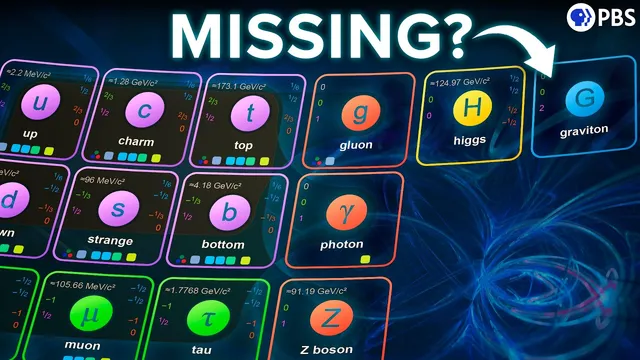
The Gravity Particle Should Exist. So Where Is It?
Based on PBS Space Time's video on YouTube. If you like this content, support the original creators by watching, liking and subscribing to their content.
Weak-field quantization of gravity yields a massless, spin-2 boson consistent with the graviton needed to reproduce Einstein’s equations in the classical limit.
Briefing
The graviton—the hypothetical quantum particle that would mediate gravity—remains the missing piece needed to connect quantum mechanics with general relativity, but the most straightforward way to derive it runs into a fundamental mathematical breakdown. In weak gravitational fields, physicists can treat gravity as a small perturbation of flat spacetime and quantize it much like electromagnetism. That calculation yields a massless, spin-2 boson, matching the properties required for gravity in the classical limit. The catch is that this “perturbative quantum gravity” approach stops working once gravity becomes strong, such as near black hole interiors or the earliest moments of the universe.
The reason is renormalization: in ordinary quantum field theories, infinities arising from higher-order corrections can be absorbed into a finite set of measured parameters. For electromagnetism, the structure of interactions limits how many problematic self-energy loops appear, making renormalization feasible. Gravity behaves differently because gravitons interact with themselves. That self-coupling allows an endless chain of virtual graviton processes, producing an infinite number of divergences that cannot be removed using only the finite experimental inputs that work for other forces. The result is labeled “non-renormalizable” perturbative quantum gravity—an indication that the naive method of quantizing gravity in the same way as other fields cannot produce a complete, predictive theory.
Still, the graviton isn’t dismissed. The massless, spin-2 boson that emerges from the weak-field calculation is widely viewed as a near-inevitable feature: any quantum theory that reproduces Einstein’s equations in the classical limit must effectively contain something with those characteristics. That inevitability has shaped major research programs. String theory, for instance, naturally produces a graviton-like excitation and avoids the runaway infinities by replacing pointlike particles with vibrating strings, which smear interactions at the smallest scales. Other frameworks, including loop quantum gravity, also incorporate a graviton in some form because reproducing classical gravity appears to require it.
Yet the failure of perturbation theory leaves open a more radical possibility: gravity might not be built from discrete graviton quanta at all. Some approaches instead aim to “gravitize the quantum”—embedding quantum mechanics into a fundamentally continuous spacetime—rather than quantizing gravity as a field on top of spacetime. In that view, spacetime could be smooth at the deepest level, and the graviton might be an emergent or even unnecessary concept.
Ultimately, confirming the graviton’s existence would settle whether gravity is fundamentally quantum and would help discriminate among competing quantum gravity theories. Direct detection is expected to be extraordinarily difficult because it would require energy scales far beyond current technology—potentially solar-system-sized accelerators. The path forward likely lies in indirect signatures, such as gravitational mediation of quantum entanglement or ultra-precise Cavendish-style experiments using extremely small masses. The central challenge is clear: find evidence that gravity carries quantum information in the way a graviton-based picture predicts, or else overturn the assumption that spacetime’s deepest structure is made of gravitons.
Cornell Notes
A massless, spin-2 boson—the graviton—emerges when gravity is treated as a small perturbation of flat spacetime and quantized like other fields. That calculation works for weak gravity and even reproduces known classical behavior, but it fails for strong gravity because the theory becomes non-renormalizable: graviton self-interactions generate infinitely many divergences that cannot be absorbed into a finite set of measured parameters. The breakdown doesn’t prove the graviton is impossible; it shows the naive perturbative route is incomplete. Many quantum gravity approaches still predict a graviton-like particle (notably string theory), while others argue spacetime may be fundamentally continuous and the graviton may be unnecessary or emergent. Proving the graviton’s existence will likely require indirect tests, since direct detection would demand extreme energies.
Why does quantizing gravity in a weak-field setting produce a graviton-like particle?
What exactly goes wrong when gravity becomes strong in perturbative quantum gravity?
How does renormalization succeed for electromagnetism but fail for gravity in this framework?
Why do string theory and loop quantum gravity still keep a graviton-like particle in their predictions?
What alternative to a graviton-based picture is proposed, and who is associated with it?
Why is direct detection of the graviton considered impractical, and what indirect strategies are suggested?
Review Questions
- What properties (mass, spin, statistics) must a graviton-like particle have to match the classical behavior of gravity?
- Explain why graviton self-interactions make perturbative quantum gravity non-renormalizable in this approach.
- What kinds of indirect experiments could provide evidence for quantum aspects of gravity without requiring solar-system-scale accelerators?
Key Points
- 1
Weak-field quantization of gravity yields a massless, spin-2 boson consistent with the graviton needed to reproduce Einstein’s equations in the classical limit.
- 2
Perturbative quantum gravity breaks down for strong curvature because graviton self-interactions generate infinitely many divergences.
- 3
Renormalization works in many quantum field theories because only a finite set of infinities appears and can be absorbed into measured parameters; gravity’s perturbative expansion does not share that property.
- 4
The failure of the simplest quantization method does not rule out the graviton; it indicates the perturbative route is incomplete.
- 5
String theory naturally produces a graviton-like excitation and avoids runaway infinities by replacing point particles with vibrating strings that smear interactions at tiny scales.
- 6
Some approaches favor a fundamentally continuous spacetime and aim to embed quantum mechanics into general relativity rather than quantizing gravity directly.
- 7
Because direct detection would require extreme energies, evidence may come from indirect tests such as gravitational mediation of entanglement or ultra-precise Cavendish-style measurements.