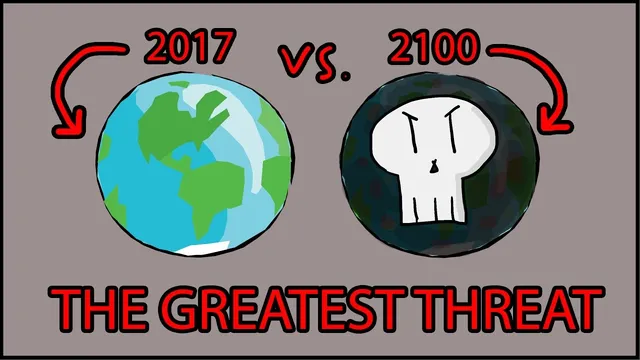
The Greatest Threat to Existence as We Know it
Based on Second Thought's video on YouTube. If you like this content, support the original creators by watching, liking and subscribing to their content.
Climate change is presented as a common cause behind diverse disasters—coastal destruction, crop failure, disease, and social breakdown—across different regions.
Briefing
Climate change is framed as a single, shared driver behind multiple worst-case futures—ranging from catastrophic coastal flooding and mass crop failure to disease outbreaks and large-scale social collapse—making it the “greatest threat to existence as we know it” within the next century. The scenarios span Japan, Kenya, and India, but the common thread is a warming world that disrupts rainfall, melts ice, and intensifies extremes. The stakes are presented as both biological (species loss and ecosystem breakdown) and societal (food and water shortages, displacement, and conflict).
A key early clarification targets a common public misconception: “global warming” is not about whether any particular place is experiencing colder weather at a given moment. Weather describes short-term, local conditions like rain, snow, and wind, while climate refers to long-term averages over years or decades. That distinction matters because climate change is assessed through trends, not isolated events.
The transcript then leans on scientific consensus to argue that human activity is the dominant cause. It cites that more than 97% of actively publishing climate scientists agree warming trends over the past century are extremely likely to be caused largely by human activity, rising to over 99% when including scientists who have not recently published scholarly articles. It also points to major scientific organizations worldwide that have issued public statements aligning with that view.
From there, the mechanism is laid out: burning fossil fuels—oil, coal, and natural gas—releases carbon dioxide, a greenhouse gas that traps heat in the atmosphere. The warming triggers feedbacks, including melting polar ice that releases additional greenhouse gases such as methane, amplifying the initial warming. The transcript treats this as a self-reinforcing cycle rather than a one-time shift.
The “where we stand” section emphasizes measurable changes by the end of 2016: carbon dioxide levels up nearly 405 parts per million (highest in 650,000 years), global temperatures up about 1.7 degrees Celsius since 1880, and the fact that nine of the last ten hottest years occurred since 2000. It highlights rapid Arctic ice loss (13.3% per decade) and land ice loss (281 gigatons per year), alongside rising seas—about seven inches over the past century.
Consequences are organized into categories. Melting polar ice threatens ice-dependent species such as polar bears and multiple seal species, with extinction risks projected for polar bears within about a century. Rising sea levels are described as accelerating in recent decades, increasing risks of erosion, flooding, and saltwater contamination of aquifers, with projections of 0.8 to 2 meters by 2100 and far higher outcomes under complete Greenland ice-sheet melt. Temperature rise is tied to droughts and heat waves, disease spread, coral bleaching (with the Great Barrier Reef already down about 50% over 30 years), and cascading impacts on food production, water scarcity, and economic output.
Finally, the transcript argues that while some changes are already “set in motion” and will continue for decades even if emissions stop, the worst outcomes are not guaranteed. It calls for two tracks: mitigation (cutting greenhouse gas emissions) and adaptation (preparing for impacts already underway). It lists actions from recycling and fuel-efficient vehicles to globally coordinated clean-energy agreements and local measures like sustainable city planning, public transportation upgrades, and energy efficiency—ending with an urgency to spread accurate climate information and resist normalization of climate denial.
Cornell Notes
The transcript links climate change to a range of future disasters—sea-level collapse, crop and livestock failure, disease spread, and social instability—arguing these outcomes share the same root cause: human-driven greenhouse gas emissions. It distinguishes weather from climate to address the “it’s cold somewhere” objection, then cites high scientific consensus that warming trends over the past century are extremely likely caused largely by human activity. It explains the mechanism: fossil-fuel burning raises CO2, which traps heat and triggers feedbacks like ice melt that can further increase warming. It quantifies observed impacts (CO2 levels, temperature rise, shrinking Arctic ice, and sea-level rise) and lays out category-by-category consequences for ecosystems, coasts, and human health and economies. It concludes that stopping emissions now can still limit some worst effects, but requires both mitigation and adaptation.
Why does “global warming” not depend on whether it’s cold in a specific place right now?
What evidence is used to support the claim that humans drive most recent warming?
How does fossil-fuel burning translate into broader climate impacts?
Which observed measurements are highlighted to show climate change is already underway?
What are the main consequence categories, and how are they connected?
If emissions stopped today, would warming still continue?
Review Questions
- How do weather and climate differ, and why does that distinction matter for interpreting cold snaps?
- What greenhouse-gas mechanism connects fossil-fuel combustion to ice melt and further warming feedbacks?
- Which three impact categories are used to organize the consequences, and what examples are given for each?
Key Points
- 1
Climate change is presented as a common cause behind diverse disasters—coastal destruction, crop failure, disease, and social breakdown—across different regions.
- 2
Weather describes short-term local conditions, while climate refers to long-term averages; isolated cold weather doesn’t negate long-term warming trends.
- 3
Human activity is cited as the dominant driver of recent warming, supported by high consensus among actively publishing climate scientists and endorsements from major scientific organizations.
- 4
Fossil-fuel burning increases atmospheric CO2, which traps heat and can trigger feedbacks such as ice melt that further intensify warming.
- 5
Observed indicators include rising CO2 concentrations, higher global temperatures, shrinking Arctic and land ice, and measurable sea-level rise.
- 6
Consequences are grouped into polar ice loss, rising sea levels, and temperature-driven extremes affecting ecosystems, health, food systems, and economies.
- 7
Limiting harm requires both mitigation (cutting emissions) and adaptation (preparing for impacts already in motion), including coordinated clean-energy and local resilience measures.