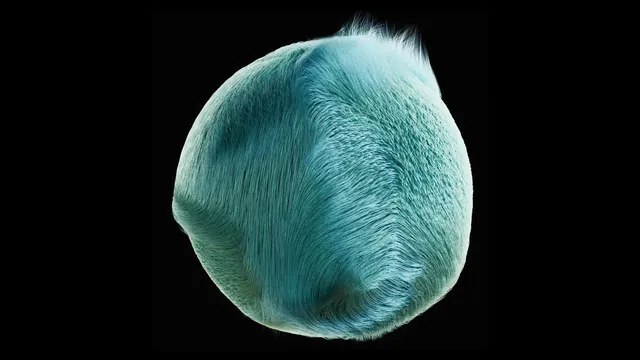
The Hairy Ball Theorem
Based on 3Blue1Brown's video on YouTube. If you like this content, support the original creators by watching, liking and subscribing to their content.
A continuous tangent vector field on a sphere must have at least one zero vector; you cannot comb the sphere smoothly without a stuck point.
Briefing
A continuous “comb-down” of a sphere’s directions is mathematically impossible: any continuous tangent vector field on a sphere must hit at least one point with zero length. That single constraint—no matter how cleverly the directions are chosen—explains why “hairy ball” swirls can’t be flattened without leaving a stuck tuft, and it also shows up in real engineering problems where smooth orientation choices are needed.
The intuition starts with a familiar picture: cover a sphere (or the back of a baby’s head) with hair and try to comb every strand to lie flat. If the hair directions are required to vary continuously over the surface, at least one point must resist the effort and remain “stuck up.” A more formal translation turns “hair directions” into a continuous vector field: at each point on the sphere, pick a tangent vector lying in the tangent plane. The hairy ball theorem then says that such a field cannot avoid at least one null vector (a point where the tangent vector has length zero).
Why does this matter beyond the joke? The transcript connects the theorem to 3D orientation in software. When a plane moves along a trajectory, its nose must align with the path’s tangent direction, but the model still needs a continuous choice for rotation about that axis—e.g., a consistent “wing direction” perpendicular to the velocity. Those perpendicular choices correspond to picking a continuous tangent direction over the unit sphere of possible headings. The theorem implies that any attempt to define this smoothly across all headings must fail somewhere, producing a discontinuity or “glitch” (like the poles in the example where a naïve rule spirals and breaks).
The same inevitability appears in other settings. A continuous wind field over Earth at a fixed altitude must contain at least one location where the horizontal wind velocity is exactly zero. And for radio signals that look identical in every direction, the electric and magnetic fields—each constrained to oscillate perpendicular to propagation—would each form a tangent-like vector field on a sphere; the theorem then forces at least one zero point, implying the only fully isotropic solution is the trivial one with no signal.
The proof strategy is a contradiction built around topology and orientation. Assume a continuous, nowhere-zero tangent vector field exists on the sphere. Use it to define a deformation that moves each point along a great circle determined by the vector at that point, sending every point p to its antipode −p. That antipodal map reverses the sphere’s orientation: outward-pointing unit normals end up pointing inward, meaning the surface has been “turned inside out.”
To show this can’t happen without violating continuity, the argument introduces a flux thought experiment: imagine an incompressible fountain at the origin producing a constant amount of fluid per second. For any closed surface that never crosses the origin, the net signed flux through it cannot change during a smooth deformation. But turning the sphere inside out would flip the sign of the outward normals, forcing the net flux to switch from +1 to −1—an impossibility if the surface never passes through the origin. The contradiction eliminates the original assumption, proving that a continuous tangent vector field on a sphere must have a zero. The transcript closes by hinting at a dimension rule: spheres in even dimensions can be combed, while those in odd dimensions cannot, tied to whether the antipodal map preserves or reverses orientation.
Cornell Notes
The hairy ball theorem says that any continuous tangent vector field on a sphere must vanish somewhere: at least one point has a zero-length vector. The transcript motivates this with a practical problem—choosing a smooth “wing direction” perpendicular to a plane’s heading—showing that continuous orientation choices across all headings inevitably break at least once. It then gives a proof by contradiction: assume a nowhere-zero field exists, use it to define a deformation that sends each point p to its antipode −p, which reverses the sphere’s orientation (turns it “inside out”). A flux argument with an incompressible fountain at the origin shows that such an orientation reversal cannot occur unless the surface crosses the origin, contradicting the construction. Therefore, a continuous nowhere-zero tangent field on the sphere is impossible.
How does “combing hair on a sphere” become a precise mathematical problem?
Why does the plane-orientation example force a hairy-ball-type obstruction?
What does the theorem predict about wind fields on Earth at fixed altitude?
How does stereographic projection show that “one zero” is achievable, even though “two” feels intuitive?
What is the core contradiction in the proof by deformation and flux?
Why does the antipodal map p → −p reverse orientation?
Review Questions
- What is the formal role of continuity in the hairy ball theorem, and what would break if the vector field were allowed to jump?
- In the deformation proof, why does mapping every point p to −p imply an orientation reversal?
- How does the flux argument use “signed” flux to prevent double-counting when the surface folds over itself?
Key Points
- 1
A continuous tangent vector field on a sphere must have at least one zero vector; you cannot comb the sphere smoothly without a stuck point.
- 2
Choosing a continuous “perpendicular wing direction” for all possible headings is mathematically equivalent to defining a continuous tangent vector field on the unit sphere, so a discontinuity is unavoidable.
- 3
The theorem predicts real constraints in physics-like settings: continuous wind patterns at fixed altitude must include a location with zero horizontal wind, and fully isotropic radio signals would force a trivial (zero) field.
- 4
Stereographic projection can construct a field on the sphere with exactly one null point, showing that “at least two zeros” is not the right intuition.
- 5
The proof by contradiction deforms the sphere using an assumed nowhere-zero field so that every point p moves to −p, which reverses orientation.
- 6
A signed flux argument with an incompressible fountain at the origin shows that reversing the sphere’s orientation cannot occur unless the surface crosses the origin, contradicting the deformation’s properties.
- 7
The dimension pattern (even-dimensional spheres combable, odd-dimensional spheres not) is linked to whether the antipodal map preserves or reverses orientation.