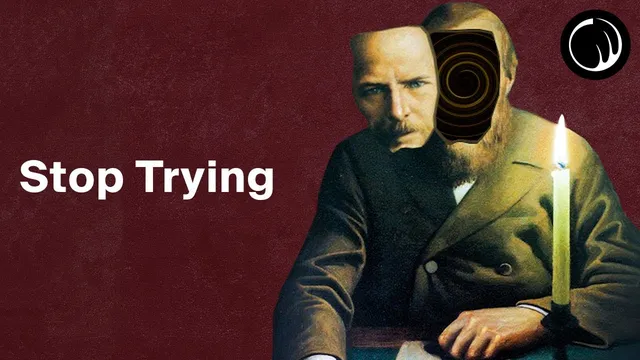
The Harder You Try, The Worse It Gets - The Philosophy of Fyodor Dostoevsky
Based on Pursuit of Wonder's video on YouTube. If you like this content, support the original creators by watching, liking and subscribing to their content.
Dostoevsky treats suffering as unavoidable in human life; progress can change suffering’s causes but not eliminate it.
Briefing
Fyodor Dostoevsky’s core warning is that the harder humanity tries to engineer perfect happiness—through reason, technology, and utopian social plans—the more likely it is to manufacture new suffering, because human beings can’t be reduced to rational machines. In Notes from Underground, an “underground man” insists suffering is unavoidable: no social or material arrangement can eliminate unhappiness, it can only shift what people suffer from. That premise turns modern progress into a trap. Even when societies chase prosperity and “perfect well-being,” people may still sabotage their own comfort, driven by irrational impulses, pride, spite, and a stubborn need for self-agency rather than bliss.
The transcript links this psychological realism to Dostoevsky’s life and its shocks. Born in 1821 in Moscow to a well-off Orthodox Christian family, he lost his mother to tuberculosis while he was away, and his father died under murky circumstances—reported as possible murder by serfs after abusive behavior. After studying military engineering and working as an engineer, he pivoted toward literature, publishing Poor Folk in 1846, which brought early success. Follow-on attempts struggled, and financial pressure pushed him toward a radical circle of utopian socialists. Arrest followed; in 1849 he was sentenced to death by firing squad, only to be pardoned at the last moment when a message arrived. The execution was later revealed as a mock-execution designed to terrify prisoners, and he was sent to Siberia for four years of brutal labor.
That experience helps explain the tonal shift after his return in 1860: less faith in utopian ideals, more focus on spiritual and psychological conflict. The transcript argues that Dostoevsky’s novels repeatedly dismantle the idea that morality and identity can be solved by rational calculation or self-interest. In Crime and Punishment (1866), Rodion Raskolnikov commits murder after adopting a nihilistic, atheistic worldview and a utilitarian logic: he believes extraordinary people can break rules if it produces the greatest good. Yet the rational justification collapses inside him. Guilt, horror, and a sense of being “not who he thought he was” torment him until he turns himself in, suggesting that reason cannot fully govern the self—and that doing “good” through violence can still destroy the person who tries to do it.
The same tension—between suffering’s inevitability and the possibility of redemption—threads through later works. The Idiot (1869) includes an anecdote mirroring Dostoevsky’s own mock-execution: the condemned man experiences time as both endless and unbearable, fixated on what might be lost forever. The transcript uses this to underline a paradox Dostoevsky returns to: purity and perfect goodness may be impossible, yet awareness, faith, compassion, repentance, and suffering can still open a path toward redemption. Even when the stories end in darkness, they leave room for transformation—an insistence that human beings are more than the systems built to manage them, and that chasing perfection without accounting for the irrational depths of the soul tends to worsen the very problems it aims to solve.
Cornell Notes
Dostoevsky’s central claim is that suffering is fundamental to human life, so no social or technological blueprint can abolish unhappiness—at best it changes its source. Notes from Underground attacks the modern faith that rationality and progress can deliver perfect happiness; the underground man argues people may sabotage their own comfort because they crave self-agency, not mechanical bliss. Crime and Punishment extends the critique by showing how rational, utilitarian justifications for crime collapse under guilt and self-contradiction in Rodion Raskolnikov. Across the novels, suffering is unavoidable, but faith, repentance, and compassion still leave open the possibility of redemption. The warning matters because it challenges the idea that human nature can be engineered into a stable, rational system of well-being.
Why does Notes from Underground treat suffering as inescapable rather than a problem to be solved?
How does Dostoevsky connect modern utopian ideals to nihilism, rationalism, and egoism?
What is Raskolnikov’s moral logic in Crime and Punishment, and why does it fail?
What does the mock-execution episode add to the understanding of Dostoevsky’s themes?
How does the transcript reconcile Dostoevsky’s darkness with the possibility of redemption?
Review Questions
- What reasons does the underground man give for why people may sabotage happiness even when it is provided?
- How does Raskolnikov’s utilitarian/rational justification for murder differ from the emotional and moral consequences he experiences afterward?
- What role does the experience of impending death (mock-execution) play in the transcript’s interpretation of Dostoevsky’s view of suffering and beauty?
Key Points
- 1
Dostoevsky treats suffering as unavoidable in human life; progress can change suffering’s causes but not eliminate it.
- 2
Utopian projects aimed at perfect happiness often intensify problems because human beings don’t behave like rational machines.
- 3
Modern worldviews that replace religious meaning with nihilism, rational calculation, and self-interest can become destructive when paired with flawed human nature.
- 4
Crime and Punishment shows that rational justifications for wrongdoing can collapse under guilt, self-contradiction, and the discovery that the self is not what it claimed to be.
- 5
Dostoevsky’s mock-execution experience helps explain recurring themes about terror, time, and the psychological weight of impending loss.
- 6
Despite pervasive tragedy, the novels leave room for redemption through suffering, faith, compassion, repentance, and acceptance.