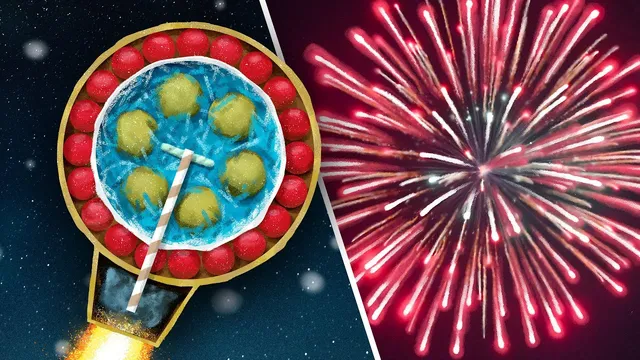
The Hidden Science of Fireworks
Based on Veritasium's video on YouTube. If you like this content, support the original creators by watching, liking and subscribing to their content.
Potassium nitrate supplies oxygen internally, charcoal provides fuel, and sulfur kick-starts the reaction at lower temperatures.
Briefing
Fireworks are built on a tight chain of chemistry and timing: gunpowder provides the initial push, fuses meter the delay so the shell bursts at apogee, and the “stars” use metal salts and quantum-driven electron transitions to emit specific colors. The result is a controlled explosion that turns stored chemical energy into light, sound, and—often—smoke, all while keeping debris and ignition hazards contained.
The story starts with early “firework” concepts in China, where heated bamboo filled with air and material would burst, and later black powder amplified the bang. From there comes a hands-on breakdown of gunpowder’s ingredients and why they behave the way they do. Potassium nitrate supplies oxygen in solid form (so the reaction doesn’t rely on ambient air), charcoal supplies fuel, and sulfur acts as kindling. Honey can ignite the mixture, but it slows combustion because it contains water; charcoal speeds mixing because its microscopic pores let reactants contact more effectively. Even with the right ingredients, coarse granules burn too slowly—store-bought powder works better because it’s ground finer, bringing reactants into closer contact.
To make gunpowder behave like an explosive rather than a slow burn, confinement matters. When black powder is exposed to air, it tends to deflagrate; when packed into a tube, heat and reaction products build pressure and force the chemistry to run faster. Doubling the mass in a more robust container increases the “bang,” and the basic firework architecture becomes clear: an outer shell holds black powder and burst components, while a lift charge beneath the shell launches it from a mortar.
Professional launching relies on more than just chemistry. Mortars, exclusion zones, and specialized materials help manage malfunction risks—especially when a shell fails to lift and instead detonates near the ground. The firing sequence also has two distinct bangs: one from the mortar firing and another when the aerial shell bursts. Inside the shell, fuses translate ignition into precise timing. Simple black match burns too slowly, while quick match accelerates because craft paper contains heat and reagents, dramatically increasing burn rate. Waterproofing is another engineering constraint: basic fuses fail underwater because water steals heat, but visco fuses use powder cores, fiber wraps, and coatings (like lacquer) to keep the reaction going.
Color and patterning come next. Stars are coated with primer black powder so they ignite reliably, then the main color composition burns hotter and emits light at specific wavelengths. The blue fireworks effect is tied to quantum mechanics: combustion excites electrons in metal ions, and only certain electron transitions are allowed, producing light at characteristic energies. The smoke is largely explained by solid combustion products; dyes can tint the smoke for additional color effects. For “ghost shells,” layered star coatings allow color changes mid-flight.
Finally, the physics becomes visible in real time. A drone flies FPV through a dark fireworks finale, showing how the burst geometry and timing create a dense, moving field of sparks and glowing fragments. The overall takeaway is that fireworks are not random spectacle: they’re engineered systems where particle size, confinement, fuse burn rates, and electron-level emission rules all have to line up for the show to look effortless.
Cornell Notes
Fireworks work because chemistry, confinement, and timing are engineered together. Gunpowder’s ingredients—potassium nitrate (solid oxygen), charcoal (fuel), and sulfur (kindling)—can burn, but it becomes truly explosive when reactants are finely ground and confined so heat and pressure build. Shells use lift charges and fuses (black match, quick match, and waterproof visco time fuses) to launch the shell and then ignite the burst at apogee. The colors come from metal salts whose electron transitions emit specific wavelengths of light, with blue often linked to copper ions. Patterns in the sky depend on how “stars” are arranged inside the shell, and some designs can even shift color mid-flight.
Why does gunpowder need confinement to explode rather than just burn?
What roles do potassium nitrate, charcoal, and sulfur play in gunpowder combustion?
Why did the homemade gunpowder burn slowly compared with store-bought powder?
How do quick match and visco fuses change burn rate and reliability?
How do fireworks produce specific colors, especially blue?
How do fireworks create patterns like domes and tentacles?
Review Questions
- What chemical function does potassium nitrate serve in gunpowder, and how does that differ from typical fires that rely on atmospheric oxygen?
- Explain how particle size and confinement each affect whether gunpowder behaves like a slow burn or a rapid explosive event.
- Describe how fuse design (black match vs quick match vs visco) changes burn rate and how waterproofing is achieved.
Key Points
- 1
Potassium nitrate supplies oxygen internally, charcoal provides fuel, and sulfur kick-starts the reaction at lower temperatures.
- 2
Finer powder burns faster because reactants contact each other more effectively through charcoal’s pores and reduced particle size.
- 3
Confinement increases pressure and heat retention, turning gunpowder from a deflagration into a more explosive event.
- 4
Fireworks rely on engineered timing: lift charges launch shells, while time-delay fuses ignite burst charges at apogee.
- 5
Fuse burn rate and waterproofing depend on construction—paper wrapping accelerates combustion, while visco fuses use coatings and fiber/powder cores to resist water cooling.
- 6
Firework colors come from quantum-level electron transitions in metal ions; blue is strongly associated with copper ions.
- 7
Sky patterns reflect how stars are arranged inside the shell, and layered designs can enable color shifts mid-flight.