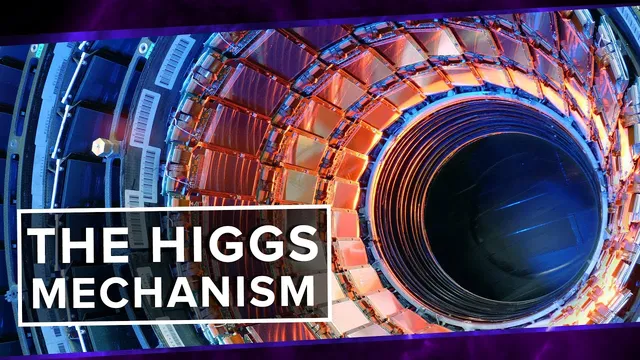
The Higgs Mechanism Explained | Space Time | PBS Digital Studios
Based on PBS Space Time's video on YouTube. If you like this content, support the original creators by watching, liking and subscribing to their content.
Mass is treated as an interaction effect: particles gain effective mass by interacting with a Higgs field that has nonzero strength everywhere.
Briefing
The Higgs mechanism matters because it turns “mass” into something more specific than a built-in property: particles gain effective mass by interacting with a pervasive Higgs field. In this picture, the Higgs field sits at a nonzero value everywhere in space, so particles are never completely free to move as if they were massless. That interaction is what lets otherwise massless quantum field theory predictions become consistent with the real, time-evolving behavior of particles like electrons.
Quantum field theory treats every elementary particle as an excitation of a corresponding field that fills the universe. In the simplest formulation used in the 1950s, the equations for these excitations come out massless—meaning such particles would move at the speed of light and experience no passage of time. But real particles do evolve. The electron, for instance, has intrinsic quantum spin described by chirality, which can be left-handed or right-handed relative to its direction of motion. That chirality flips back and forth, so the electron’s internal state changes over time, implying it cannot be strictly massless. Neutrinos provide another clue: their oscillations show they also have mass, a result recognized with the 2015 Nobel Prize.
The puzzle deepens when comparing electrons to photons. Photons are observed to be massless, traveling at light speed without internal evolution; their spin doesn’t flip, and they only change when they interact with something else. Since both electrons and photons are excitations of their own fields, the question becomes: why does one excitation behave as if it has mass while the other does not?
A central answer offered here is that electrons are constantly “bumped” by the Higgs field, while photons can traverse the universe without such hindrance. The mechanism is tied to a strange asymmetry in the weak nuclear force: the universe violates parity, caring about whether a particle is left- or right-handed. Left-handed electrons carry an extra quantity—weak hyper-charge—that allows them to feel the weak nuclear force, while right-handed electrons do not. The Higgs field is described as the source and sink of this weak hyper-charge. Unlike most fields that hover around zero in empty space, the Higgs field maintains a positive strength everywhere. In a quantum sense, it carries weak hyper-charge and can take on all possible values simultaneously, acting like an infinite reservoir that constantly trades the charge with particles.
Because the electron is continually exchanging weak hyper-charge with the Higgs field on extremely short timescales, it behaves as if it has mass: the field’s “buzz” prevents the electron from moving as a perfectly light-speed, timeless excitation. The Higgs boson then enters as the experimental signature of the Higgs field. When the Higgs field vibrates, the resulting excitation is the Higgs boson; observing that particle implies the field exists. The Large Hadron Collider’s 2012 detection of decay debris consistent with an unstable Higgs boson is presented as strong evidence that the mechanism is real, even though the Higgs boson itself decays in about 10^-22 seconds, making detailed study difficult. The story is framed as a major unification of quantum field theory with the observed origin of mass—while leaving open whether the Higgs field could also connect to larger mysteries like dark energy and inflation.
Cornell Notes
The Higgs mechanism reframes mass as an interaction effect: particles behave as if they have mass because they interact with a Higgs field that has a nonzero value everywhere in space. Quantum field theory normally predicts massless excitations, but real particles evolve internally—like electrons whose chirality flips—so they must effectively have mass. The key ingredient is parity violation in the weak force: left-handed electrons carry weak hyper-charge, and the Higgs field is described as the reservoir that can supply and absorb that charge. The Higgs boson is treated as the observable “vibration” of the Higgs field, and the Large Hadron Collider’s 2012 results are cited as evidence for that field. Even with strong support, the Higgs boson’s extreme instability limits what can be measured directly.
Why does quantum field theory’s early, massless prediction clash with what’s observed about particles like electrons?
What’s the key difference between photons and electrons in this framework?
How does parity violation connect to the Higgs field’s role?
What does it mean to say the Higgs field has a nonzero strength everywhere?
How does the Higgs boson provide evidence for the Higgs field?
Review Questions
- How does internal evolution (like electron chirality flipping) imply that a particle cannot be strictly massless in the massless quantum field theory limit?
- What role does weak hyper-charge play in linking parity violation to the Higgs field’s ability to generate effective mass?
- Why does observing the Higgs boson count as evidence for the Higgs field, and what experimental limitation arises from the boson’s extreme instability?
Key Points
- 1
Mass is treated as an interaction effect: particles gain effective mass by interacting with a Higgs field that has nonzero strength everywhere.
- 2
In basic quantum field theory, particle excitations can come out massless, but real particles evolve internally, contradicting a strictly massless picture.
- 3
Electron chirality flips over time, so the electron cannot behave like a timeless, light-speed excitation.
- 4
Parity violation in the weak force makes left-handed and right-handed chirality behave differently, tied to weak hyper-charge.
- 5
The Higgs field is described as carrying weak hyper-charge and acting as a continuous reservoir that can supply and absorb it.
- 6
The Higgs boson is the observable excitation of the Higgs field; the Large Hadron Collider’s 2012 decay signatures are cited as evidence for that field.
- 7
The Higgs boson’s lifetime is about 10^-22 seconds, limiting how precisely its properties can be studied directly.