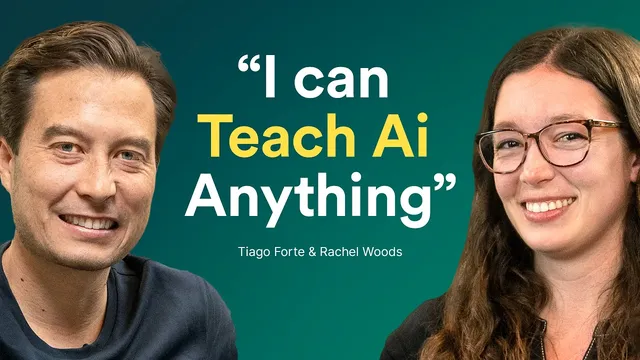
The High-Paying AI Job Nobody Knows About (Yet) ft. Rachel Woods
Based on Tiago Forte's video on YouTube. If you like this content, support the original creators by watching, liking and subscribing to their content.
AI operations succeeds when business workflows are translated into step-by-step, SOP-like instructions that AI can reliably execute.
Briefing
AI operations is poised to become the highest-leverage AI job because it turns business know-how into repeatable, executable processes—so teams stop treating AI like a one-off tool and start using it like an operating system. Rachel Woods argues that the biggest failure mode in AI adoption isn’t lack of prompts or insufficient technology; it’s missing the operational role that can translate messy, human workflows into clear instructions, then shepherd execution across teams.
Woods frames AI operations as a process-design discipline: define what should happen, break it into steps detailed enough for an AI system to follow, and then iterate based on feedback until the output matches the organization’s standards. She draws a close analogy between managing people and managing AI. Humans bring trust, relatability, and creativity to interactions, but “process” is still teachable—she claims she hasn’t encountered a business process she couldn’t operationalize for AI once it’s specified at the right level of detail. That’s why she rejects the idea that AI is a simple switch. Like hiring a top marketer for a small business, dropping AI into a workflow without mapping roles, requirements, and expectations leads to disappointment and blame.
A central contribution is a three-role model for AI transformation. First comes the AI visionary (typically an executive or owner) who sets strategy and prioritizes which workflows should be targeted. Second is the AI implementer, the technical “implementation” hat that plugs tools together—often too deep in technical weeds to notice process gaps. The third, and most undervalued, is the AI operator: a process-minded person—often with project management DNA—who interviews subject-matter experts, documents current workflows, converts them into checklists or SOP-style “AI playbooks,” and runs execution so AI can actually perform the work. Woods emphasizes that teams can learn AI at a basic level, but speed and ROI depend on having someone operationally accountable for process codification.
To make AI adoption practical, she lays out a repeatable five-step cycle called CRAFT: (C) get a clear picture of the current process and desired outcome, (R) design a realistic version of a single process (or a slice of it), (A) build the AI-enabled workflow, (F) collect feedback and refine prompts/instructions, and (T) roll out to the team—starting with an MVP rather than a full-scale deployment. She recommends scoping aggressively to avoid multi-month “perfect design” efforts that may fail. Feedback is treated as the engine of improvement: when outputs miss the mark, teams adjust prompts and rerun until the system reliably produces the intended structure, tone, and substance.
Woods also addresses organizational rollout and job displacement concerns. She argues that replacing people is a short-term framing; organizations that use AI to reduce execution bottlenecks can outcompete those that cut headcount, while humans remain essential for innovation, expertise, and human connection. The long-term payoff is “unlimited time” in the sense that once processes are defined, AI can execute them—freeing teams to iterate, improve, and pursue higher-value work. For those looking to get started, she points to the AI Exchange community and positions AI operations as a skill set that can be learned without deep technical backgrounds, using prompts and automation tools like Zapier as early building blocks.
Cornell Notes
Rachel Woods argues that AI operations (AI ops) is the highest-leverage AI job because it converts business processes into repeatable, AI-executable workflows. The key organizational gap isn’t technology—it’s missing an AI operator, a process-minded role that interviews subject-matter experts, documents workflows, and turns them into SOP-like “AI playbooks.” She proposes a three-hat structure: AI visionary (strategy), AI implementer (technical build), and AI operator (process shepherding). To operationalize AI, teams run the CRAFT cycle—Clear picture, Realistic design, AI build, Feedback iteration, and Team rollout—starting with MVP slices and improving through feedback. This matters because it speeds adoption, increases ROI, and reduces the time bottleneck that typically limits business execution.
Why does “AI operator” matter more than simply hiring an AI implementer or relying on executives to drive adoption?
What does it mean to “define a process” so AI can run it?
How does the CRAFT cycle reduce failure risk when integrating AI into operations?
What kind of feedback loop makes AI outputs improve quickly?
How should organizations structure AI roles across departments without turning everyone into an AI operator?
What does “unlimited time” mean in practice, and why does it change business decisions?
Review Questions
- What specific responsibilities distinguish an AI operator from an AI implementer in Woods’ three-role model?
- How does CRAFT’s “Realistic design” step prevent teams from getting stuck in overly ambitious planning?
- When AI outputs are wrong, what heuristics can help decide whether to adjust style versus substance in the prompt?
Key Points
- 1
AI operations succeeds when business workflows are translated into step-by-step, SOP-like instructions that AI can reliably execute.
- 2
Woods’ three-role model separates strategy (AI visionary), technical assembly (AI implementer), and process shepherding (AI operator) to avoid adoption bottlenecks.
- 3
The AI operator role is process-minded and often resembles a project manager; it focuses on interviewing SMEs, documenting workflows, and running execution.
- 4
The CRAFT cycle—Clear picture, Realistic design, AI build, Feedback, Team rollout—reduces risk by scoping to a single process slice and iterating through feedback.
- 5
Feedback is the improvement engine: teams adjust prompts based on whether failures are style/format issues or substance/understanding issues.
- 6
Woods recommends MVP-first rollout to earn real feedback from users before expanding to full-team deployment.
- 7
AI should be treated as a time-unlocking execution layer, not a cost-cutting replacement strategy; human expertise and innovation remain essential.