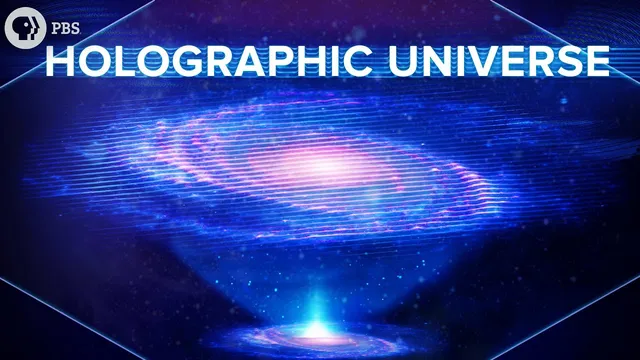
The Holographic Universe Explained
Based on PBS Space Time's video on YouTube. If you like this content, support the original creators by watching, liking and subscribing to their content.
Bekenstein’s black hole entropy formula ties maximum quantum information to surface area rather than volume, reshaping how “how much information fits” is quantified.
Briefing
Black holes forced physics to confront a startling fact: the maximum amount of quantum information inside a region scales with the region’s surface area, not its volume. Jacob Bekenstein derived an entropy formula for black holes that effectively turns entropy into a measure of information about everything that fell in. Steven Hawking then confirmed the bound indirectly through Hawking radiation—black holes leak energy and, in the process, appear to risk erasing the quantum information of what they swallowed. That collision between black hole evaporation and quantum mechanics sparked the information paradox.
A proposed way out came from Gerard ’t Hooft: information about infalling matter could be imprinted on the outgoing Hawking radiation, with the encoding tied to the event horizon. Yet that solution introduced a deeper puzzle. From outside the black hole, the interior’s contents behave as if smeared onto a two-dimensional surface; from the viewpoint of someone falling in, the same contents still experience a three-dimensional interior. The result is a first concrete glimpse of “holographic spacetime”: a lower-dimensional description that can reproduce the physics of a higher-dimensional world.
Leonard Susskind and ’t Hooft pushed the idea further into the holographic principle, suggesting that not only particle locations but the full set of degrees of freedom governing a volume can be represented on an appropriate boundary surface. The remaining question was practical and technical: how does a surface store information about an extra dimension, and how do interactions on that surface correspond to interactions in the bulk?
The transcript traces a path through string theory to a concrete realization. It starts with the notion of building an extra dimension from scale behavior in a conformal field theory. In a scale-invariant (conformal) setup, changing the resolution of a grid locally doesn’t alter the interaction rules, introducing an additional “scale” degree of freedom. Under certain conditions, that scale behaves like a spatial dimension, letting a 2-D system mimic the mathematics of a 3-D one.
String theory then supplies the machinery. Early string models hinted at scale invariance and even produced equations resembling gravity in unexpected ways, pushing the framework toward quantum gravity. In the 1990s, dualities linked different string theories, culminating in Juan Maldacena’s AdS/CFT correspondence (proposed in 1997). In this setup, a conformal field theory without gravity lives on the boundary of an anti-de Sitter (AdS) spacetime, while gravity in the higher-dimensional “bulk” emerges from the same underlying physics. When the boundary theory is strongly coupled, the bulk gravity becomes weak and calculable—and black hole information can be tracked without being destroyed, because the information is preserved in the dual description.
AdS/CFT doesn’t claim to describe our universe exactly—our cosmos doesn’t obviously match the specific AdS geometry or dimensionality used in the derivation. Still, it turns a hand-wavy intuition into a calculable example: a lower-dimensional theory on a boundary can encode a higher-dimensional gravitational world. The open challenge is whether the mathematical clues generalize to a universe like ours, where curvature appears close to flat and the dimensional bookkeeping differs.
Cornell Notes
Black holes revealed that the maximum quantum information in a region scales with surface area, not volume, forcing a rethink of how space and information relate. ’t Hooft and Susskind argued that a lower-dimensional boundary can encode the full physics of a higher-dimensional interior, creating the core idea behind holographic spacetime. The transcript then explains how scale invariance in conformal field theories can mimic an extra dimension, and how string theory provides a concrete framework for this. Juan Maldacena’s AdS/CFT correspondence realizes the holographic principle: a conformal field theory on the boundary (no gravity) is dual to a gravity theory in the bulk (with gravity). This duality also offers a route to resolving the black hole information paradox by preserving information in the lower-dimensional description.
Why did black holes push physicists toward the idea that information scales with area?
How does ’t Hooft’s proposal connect the event horizon to information recovery?
What does the holographic principle claim beyond “information fits on a surface”?
How can scale invariance in a conformal field theory mimic an extra dimension?
What is the core mechanism behind AdS/CFT correspondence?
How does AdS/CFT address the black hole information paradox?
Review Questions
- What does the Bekenstein bound say about how entropy/information scales with region size, and why was that surprising?
- Explain the conceptual tension between an outside observer and an infalling observer in the black hole interior description.
- In AdS/CFT, what lives on the boundary and what lives in the bulk, and how does coupling strength swap between the two descriptions?
Key Points
- 1
Bekenstein’s black hole entropy formula ties maximum quantum information to surface area rather than volume, reshaping how “how much information fits” is quantified.
- 2
Hawking radiation raised the black hole information paradox by suggesting evaporation could erase quantum information, conflicting with quantum mechanics.
- 3
’t Hooft’s horizon-based encoding implies a dual description: interior physics can appear smeared on a 2-D surface to outside observers while remaining 3-D to infalling observers.
- 4
The holographic principle extends this into a general claim that a boundary can encode the full set of degrees of freedom and interactions of a bulk region.
- 5
Conformal (scale-invariant) field theories introduce a local scale degree of freedom (Weyl invariance) that can behave like an extra dimension under suitable conditions.
- 6
AdS/CFT correspondence provides a concrete holographic example: a gravity theory in an AdS bulk is dual to a non-gravitational conformal field theory on its boundary.
- 7
AdS/CFT offers a mechanism for tracking black hole information by mapping it to preserved information in the dual lower-dimensional theory.