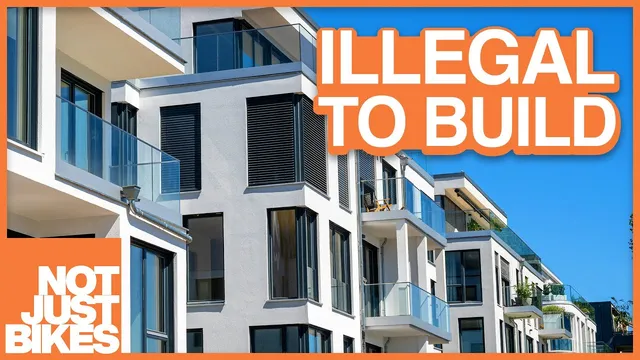
The Houses that Can't be Built in America - The Missing Middle
Based on Not Just Bikes's video on YouTube. If you like this content, support the original creators by watching, liking and subscribing to their content.
Strict Euclidean zoning and car-oriented rules like minimum parking often make duplexes, triplexes, and small apartment buildings illegal or impractical in most residential areas.
Briefing
American and Canadian cities have developed a harsh “either-or” housing landscape: strict zoning and car-oriented rules make it nearly impossible to build the “missing middle” (duplexes, triplexes, small apartment blocks, and other mid-density forms). The result is a skyline pattern where low-density sprawl of detached homes abruptly gives way to dense high-rises—often right next to the very neighborhoods that block anything in between. Urban planners call this the “missing middle problem,” and it shapes housing supply, affordability, and neighborhood livability across most of the U.S. and much of Canada.
The roots trace back to the 1940s, when cities increasingly promoted car-centric suburbanization and pushed detached single-family homeownership as the default ideal. Even when demand exists for other housing types, Euclidean zoning rules make it “almost impossible” to build anything besides single-family homes in many residential areas. Minimum parking requirements reinforce the same outcome by raising the cost and limiting the feasibility of walkable, transit-friendly development. In practice, residential land is often restricted so tightly that developers can’t respond to housing needs with mid-density options.
San Jose is cited as an extreme example: 94% of land zoned for housing permits only single-family homes. Similar constraints appear throughout North America, meaning developers face a double bind. They must build the only legally permitted product—typically single-family homes—or fight lengthy, expensive approval battles and neighborhood opposition (“NIMBY” resistance) for any alternative. That combination helps explain why condo towers become the default “workaround”: if a developer can’t build missing-middle housing, the only dense option that still pencils out is often a high-rise.
The transcript contrasts this with pre-1940s North American streets and with European planning. A Toronto street built in the 1920s shows a mix of detached houses, terraced homes that function as multi-unit buildings, small apartment blocks, and nearby commercial buildings within walking distance. That kind of mixed street—normal in earlier decades—has become rare under modern zoning. Even when variances might technically allow small multi-unit buildings, neighbors often oppose them, citing concerns about socioeconomic status and, in the transcript’s example, race.
Europe, by contrast, more commonly allows gradual transitions in building scale. In the Netherlands—near Amsterdam—mid-rise buildings (often five floors or fewer) and terraced homes sit alongside semi-detached houses and small apartment buildings in the same areas. This mix expands housing choice for different household needs, reduces reliance on driving, and supports walkable neighborhoods.
North America is beginning to move, but progress remains limited. Minneapolis abolished single-family zoning in 2019, allowing duplexes and triplexes citywide; Vancouver allows duplexes in all residential neighborhoods (but not triplexes). Portland can build housing types like fourplexes and cottage courts again. Still, other rules—setbacks, lot coverage limits, and minimum parking—can continue to block missing-middle construction. The core prescription is straightforward: undo car-centric housing policy, end single-family zoning, and then expand the legal menu of dense-but-livable housing so cities can rebuild the walkable neighborhoods they once built without forcing residents into either sprawl or towers.
Cornell Notes
North American housing policy often forces a binary choice: detached single-family homes in low-density sprawl or, at the other extreme, dense high-rise towers. That “missing middle” gap is largely produced by Euclidean zoning and car-oriented requirements like minimum parking, which make duplexes, triplexes, townhouses, courtyard buildings, and small apartment blocks illegal or financially impractical in most neighborhoods. The scarcity of legal options pushes developers toward the densest permitted product—often condo towers—because approval fights are costly and neighborhood opposition is common. Europe, especially the Netherlands, more often allows gradual transitions in building size, supporting walkable streets and broader housing choice. Limited North American reforms (Minneapolis, Vancouver, Portland) show what’s possible, but other regulations still restrict missing-middle development.
What exactly is the “missing middle,” and why does it matter for housing supply?
How did mid-century policy choices lock cities into single-family-only zoning?
Why do condo towers become a common alternative when missing-middle housing is blocked?
What evidence is used to show that mixed housing streets used to be normal in North America?
How does the Netherlands illustrate a different approach to neighborhood building scale?
What reforms in North America are cited as steps toward fixing the problem?
Review Questions
- Which zoning and parking mechanisms most directly prevent missing-middle housing from being built in many U.S. and Canadian neighborhoods?
- Why does blocking duplexes and triplexes often increase the likelihood of high-rise condo development instead?
- What kinds of housing forms are included in the “missing middle,” and how do European examples show them working together on the same street?
Key Points
- 1
Strict Euclidean zoning and car-oriented rules like minimum parking often make duplexes, triplexes, and small apartment buildings illegal or impractical in most residential areas.
- 2
The “missing middle” gap forces cities into a binary pattern: detached-home sprawl versus dense high-rise towers.
- 3
High approval costs and neighborhood opposition push developers toward the densest permitted product, frequently condo towers, when mid-density options are blocked.
- 4
North American streets that mixed housing types were common before the 1940s, but modern zoning has made that mix rare.
- 5
European planning—illustrated by the Netherlands—more often allows gradual transitions in building scale, supporting walkable neighborhoods and broader housing choice.
- 6
Some North American cities have begun reforming single-family zoning (Minneapolis, Vancouver, Portland), but setbacks, lot coverage limits, and minimum parking can still restrict missing-middle development.