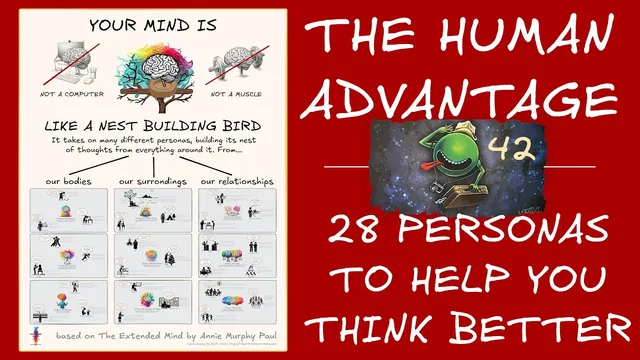
The Human Advantage - 28 Personas to Help You Think Better - A visual summary of The Extended Mind
Based on Zsolt's Visual Personal Knowledge Management's video on YouTube. If you like this content, support the original creators by watching, liking and subscribing to their content.
Treat cognition as context-sensitive rather than context-free computation; mood and environment change outcomes.
Briefing
The core claim is that better thinking doesn’t come from treating the mind like a standalone “computer,” but from designing the conditions around it—your body, your surroundings, your relationships, and (more recently) the tools you use. Instead of chasing intelligence through abstract mental drills, the framework treats cognition as distributed across “personas” that activate in different contexts, turning everyday environments into levers for focus, creativity, learning, and calm under pressure.
The transcript starts by dismantling common misconceptions. The brain isn’t a calculator that runs the same program regardless of weather; people are context-sensitive, so mood, attention, and outcomes shift with circumstances. Likewise, the mind isn’t a muscle that simply gets stronger through exercises. Growth comes from understanding how perception and emotion react to the environment—because the mind builds its “nest” of thoughts from what’s happening in and around you.
From there, the system lays out 28 personas grouped into four domains. First are body-based modes: an “Observer” who tracks internal feelings and notices what thrives; a “Detective” who assembles clues from sensation, observation, and logic; and a “Paramedic” that anticipates stress so performance stays calm. Movement-based personas include a “Sculptor” using self-referential gestures and activity to regulate thinking, an “Athlete” where low-intensity movement supports focus and high-intensity activity can quiet the frontal lobe by shifting energy toward sustaining muscles. A “Dancer” uses movement to mirror ideas and help both self and others think.
Communication and early cognition show up through gesture personas: a “Preverbal Communicator” who relies on gestures before speech, a “Conductor” for pacing attention, and a “Pantomime Artist” who acts out concepts so meaning lands through demonstration. Next come surroundings: the “Gazer” uses distance and nature to trigger awe and mindset shifts; the “Camper” draws on research that after about three days outdoors thinking becomes more creative; and the “Nurturer” brings nature indoors through plants or even green color cues. Built spaces add structure—monastic alternation between solitude and collaboration, office “nesting” through personal objects, and “architect” design that supports both collaboration and deep work.
Spatial cognition is then externalized through tools and artifacts: the “Cartographer” maps ideas with concept maps or mind maps; the “Outline/Viav” organizes information spatially (including “war rooms” with flip charts and project plans); and the “Chronicler” keeps logs and notes to spot patterns over time, echoing practices like Darwin’s journal.
Finally, relationships drive social cognition through 10 personas: learning by imitation, using checklists to capture expert reliability, and master–apprentice modeling with scaffolding and fading. Group dynamics include the “Conversationalist,” “Storyteller,” “Debater” (to avoid echo chambers), and “Tutor” (learning by explaining). The “Hive mind” and “Synchronizer” emphasize that coordinated attention and shared rhythm can make groups more powerful than individuals alone, while a “Knowledge Keeper” supports transactive memory—knowing who knows what and when to retrieve it.
The transcript closes by reframing the extended mind as a practical workflow: choose personas based on the task, then build cognitive loops with others and with technology. It also ties the framework to visual thinking practice—creating “book on a page” summaries and a fantasy narrative about defeating a “Monstrous AI” by incorporating technology as a fourth domain of extended cognition. The takeaway is straightforward: thinking improves when the environment and social system are engineered to match the kind of thinking required.
Cornell Notes
The extended mind framework argues that thinking improves when cognition is treated as distributed across body, environment, relationships, and technology—not as a standalone brain-in-a-vacuum. It rejects the idea that the mind is a computer or a muscle, emphasizing instead that people are context-sensitive and that intelligence grows by understanding how internal states interact with external conditions. The model organizes cognition into 28 “personas” that can be activated intentionally: observers and detectives for emotional tracking and problem-solving, movement-based roles for regulating attention, nature and built-space roles for creativity and focus, and social roles for learning, debate, tutoring, and group coordination. The practical message: pick the persona that fits the situation and design your surroundings and social loops to support it.
Why does the transcript reject the “mind as a computer” idea, and what replaces it?
How do the body-based personas connect emotion, attention, and performance under stress?
What’s the practical role of movement in the framework?
How do surroundings—especially nature and built spaces—change thinking patterns?
What do spatial tools and note-keeping add to cognition?
How do relationships and group dynamics fit into the extended mind?
Review Questions
- Which persona(s) would you choose for a high-stakes situation where stress tends to derail performance, and what specific behavior would you do to activate them?
- How would you redesign your workspace using the “nesting parent” and “architect” ideas to support both deep work and collaboration?
- What’s one concrete way to use transactive memory (knowledge keeper) in a team setting, and how would it change how decisions get made?
Key Points
- 1
Treat cognition as context-sensitive rather than context-free computation; mood and environment change outcomes.
- 2
Replace “mind as a computer” and “mind as a muscle” with a model where thinking is built from body signals, surroundings, and relationships.
- 3
Use the 28 personas as a menu: select the persona that matches the task (observation, problem-solving, stress readiness, creativity, communication).
- 4
Regulate thinking through movement: low-intensity activity supports focus, while high-intensity activity can quiet frontal-lobe-driven rumination.
- 5
Engineer surroundings to cue different cognitive modes—nature for creativity and awe, built spaces for alternating solitude and collaboration.
- 6
Externalize thinking with spatial tools (maps, outlines, war rooms) and durable records (journals) to surface patterns over time.
- 7
Build cognitive loops with people: imitation, tutoring, debate, and coordinated group rhythms can improve learning and decision-making.