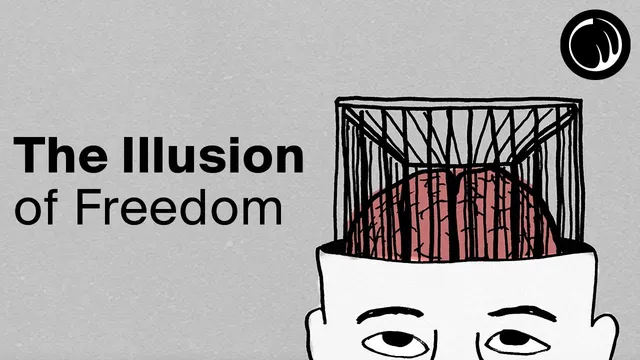
The Illusion of Freedom - Are You Really Free To Do What You Want?
Based on Pursuit of Wonder's video on YouTube. If you like this content, support the original creators by watching, liking and subscribing to their content.
Biological limits persist even when social and economic restrictions are removed, because the body dictates timing, needs, and vulnerability.
Briefing
The pursuit of “absolute freedom”—doing, feeling, and choosing without coercion—collides with a deeper claim: human beings can’t escape constraint because body, mind, and even the concept of freedom itself structure what’s possible. Even after removing social and material limits, the individual remains bound by biological timing, bodily fragility, and the automatic ways perception and thought are generated. Physical autonomy is real only within the limits of a particular organism; the body dictates when hunger, sleep, pain, and illness arrive, and the mind tends to “get in line” with those signals. The result is a daily routine that resembles captivity more than self-rule.
The argument then shifts from physiology to cognition. Thought is treated not as a free-floating power but as processing that runs on a specific “hardware” (the brain) with a specific “software” (concepts, language, and categories learned through experience). A person can imagine choices beyond immediate urges, but those imaginations still come through the mind’s built-in constraints—like levees and dams channeling the flow of mental life. A useful analogy frames this: being told you can make anything you want, but only on an Etch-a-Sketch, is freedom in name while the medium and its rules determine the outcome. In this view, “not being told what to do by other humans” doesn’t equal freedom; it can still be indoctrination by the mind’s own causal machinery.
From there, the discussion argues that the very desire for existential freedom may be incoherent. Absolute freedom would require a self that can stand outside all constraints and choose from nowhere. But the self is described as a delusion—an “optical delusion” of consciousness that experiences itself as separate from the whole universe. The speaker’s line of reasoning draws on religious and philosophical traditions to suggest that the only attainable peace comes from loosening the grip of the freedom-quest itself: freedom from freedom. Emil Cioran is cited for the idea that the closest thing to absolute freedom is escaping the constraints imposed by the concept of freedom; Einstein is invoked to support the notion that peace of mind comes through a different relationship to suffering and attachment.
The transcript also leans on contemplative metaphors: the Chinese finger trap, the Tao, Buddhist nirvana, and the “silence” associated with Wittgenstein. The core pattern is consistent—trying harder intensifies entanglement. Khalil Gibran’s imagery of people worshiping their own freedom “even as slaves” underscores the paradox: the pursuit of freedom can become another chain, especially when the desire to seek freedom becomes a harness. The practical takeaway is not a political program but a shift in stance—surrendering to a unified reality, stopping the attempt to escape what can’t be escaped, and treating the “goal” of freedom as the strongest link in the chain. A brief sponsorship for Blinkist appears near the end, offering condensed summaries and related audio content.
Cornell Notes
The transcript argues that “absolute freedom” is impossible because human life is constrained at multiple levels. Physical freedom is limited by the body’s needs and failures, and mental freedom is limited by how the brain processes experience through learned concepts and language. Even when no other people impose rules, thought and behavior still follow causal patterns—so autonomy can be an illusion. The deeper claim is existential: the self that would need to be “free from all constraints” may itself be a constructed delusion. Peace, it suggests, comes from “freedom from freedom”—loosening attachment to the idea of freedom as a goal and surrendering to a unified reality.
Why doesn’t removing social or political constraints produce true freedom in this account?
How does the transcript connect mental “choice” to hidden constraints?
What does “freedom from freedom” mean, and why is it presented as the closest attainable version of absolute freedom?
How does the transcript challenge the idea of a stable, separate self?
What role do the Chinese finger trap, Taoism, Buddhism, and related references play?
Why does the transcript say the desire to seek freedom can become a chain?
Review Questions
- What constraints does the transcript claim remain even after social and material shackles are removed?
- How does the Etch-a-Sketch analogy support the argument about mental freedom?
- Why does the transcript treat the concept of “a separate self” as central to the incoherence of absolute freedom?
Key Points
- 1
Biological limits persist even when social and economic restrictions are removed, because the body dictates timing, needs, and vulnerability.
- 2
Mental autonomy is constrained by how the brain processes experience through learned concepts, language, and categories.
- 3
Not being coerced by other humans doesn’t guarantee freedom if thought and behavior follow internal causal mechanisms.
- 4
Absolute existential freedom is framed as incoherent because it depends on a separate, stable self that can stand outside all constraints.
- 5
The transcript argues that peace comes from loosening attachment to the idea of freedom as a goal—“freedom from freedom.”
- 6
Contemplative traditions and paradox metaphors (finger trap, Tao, nirvana) are used to support the claim that resistance and striving can intensify entanglement.