The Illusion Only Some People Can See
Based on Veritasium's video on YouTube. If you like this content, support the original creators by watching, liking and subscribing to their content.
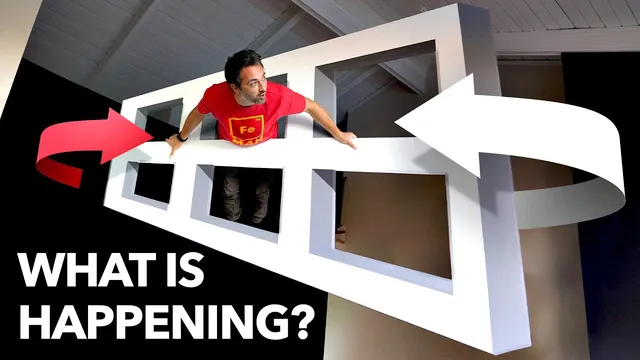
The Ames window illusion depends on a trapezoid “window” with shading that tricks the brain’s depth inference, even though the object rotates continuously.
Briefing
A trapezoid “window” that spins continuously can look like it’s oscillating back and forth—because the brain insists on interpreting the scene using the rules of a world built from right angles. That mismatch, known as the Ames window illusion, reveals how perception is less about direct measurement and more about fast, sometimes wrong, inference about depth.
In the setup, the “window” isn’t a true rectangle. It’s a trapezoid with one side shorter than the other, shaded to suggest three-dimensional form, and mounted on a turntable so it rotates without stopping. Most viewers initially report seeing the window reverse direction at the halfway point. But the object’s motion doesn’t actually change; the illusion comes from how the visual system maps the distorted geometry onto familiar expectations.
The illusion becomes easier to diagnose when tracking cues are added. A Rubik’s Cube attached to the short side appears to keep moving in a way that conflicts with the window’s apparent reversal, and a ruler passed through the middle produces physically impossible-looking interactions—clear evidence that perception is “choosing” an interpretation that fits prior assumptions. The core mechanism traces back to Adelbert Ames, who created the illusion in 1947. Ames argued that people live in a “carpentered environment” of rectangular rooms and 90-degree corners, so the brain expects rectilinear geometry. When the retinal image contains trapezoidal cues that should correspond to a rectangle at a certain depth, the brain’s depth inference goes off the rails.
Evidence for that hypothesis came from a 1957 study by Harvard psychologists who tested the Ames window in South Africa. Children in Durban—surrounded by rectangular buildings, doors, and windows—were far more likely to report oscillation than children from rural communities where round huts and fewer prominent right angles dominated. Yet the story doesn’t end there: when the viewing conditions changed (greater distance and one eye closed), both groups became similarly susceptible, implying that experience with rectangles isn’t the only factor.
The same perceptual trick can appear even without straight lines. The de Heer circle—an object rotating continuously—can also seem to oscillate, pointing to a broader role for anamorphosis: distorted projections that only look “correct” from a specific viewpoint or under specific viewing conditions. Artists have used this for centuries, from Hans Holbein the Younger’s anamorphic skull in “The Ambassadors” (1533) to earlier side-view distortions attributed to Leonardo da Vinci.
Ames’s work extends beyond windows. The Ames Room uses a carefully warped geometry so that, from a “privileged” viewpoint, a distorted room looks normal—until motion reveals the mismatch. Across these examples, the brain faces ambiguity: multiple external realities can produce the same retinal input. Motion and depth cues help resolve the uncertainty, but they can also be manipulated to produce confident-looking errors.
The practical takeaway is philosophical as much as perceptual: the world we “see” is an interpretation constrained by assumptions, not a perfect readout of external reality. Even a simple rotating picture can fool the mind spectacularly, suggesting humility when drawing conclusions from limited sensory evidence.
Cornell Notes
The Ames window illusion shows how continuous rotation can look like back-and-forth oscillation when the brain applies assumptions from a right-angle world. The “window” is actually a trapezoid with shading designed to trigger depth inference, so the visual system misinterprets the geometry and flips the perceived direction. Experiments found that children with more exposure to rectangular environments were more likely to report oscillation under certain conditions, but susceptibility can converge when viewing conditions change. Similar effects arise in other anamorphic designs, including the de Heer circle and the Ames Room, reinforcing that perception often resolves ambiguity by choosing the most plausible interpretation rather than the physically correct one.
What physical details of the Ames window create the illusion of oscillation?
Why do added tracking objects (Rubik’s Cube, ruler) make the illusion feel “physically impossible”?
How did the 1957 South Africa study test the “carpentered environment” idea?
What is anamorphosis, and how does it relate to the Ames window and other illusions?
How does the Ames Room illustrate the same perceptual ambiguity?
What does the illusion suggest about scientific certainty and everyday belief?
Review Questions
- In what ways do the trapezoid shape and shading of the Ames window work together to trigger the wrong depth interpretation?
- How do changes in viewing distance and eye conditions alter susceptibility to the Ames window illusion in the South Africa study?
- What role does anamorphosis play in connecting the Ames window, the de Heer circle, and the Ames Room?
Key Points
- 1
The Ames window illusion depends on a trapezoid “window” with shading that tricks the brain’s depth inference, even though the object rotates continuously.
- 2
Viewers often perceive oscillation because the visual system expects rectilinear, right-angle geometry from a “carpentered environment.”
- 3
Tracking devices like a Rubik’s Cube and a ruler expose contradictions between perceived motion and the object’s actual continuous rotation.
- 4
A 1957 study found urban children (more rectangle exposure) reported oscillation more often at 10 feet with both eyes open, but the difference vanished at 20 feet with one eye closed.
- 5
The illusion fits a broader category of anamorphosis, where distorted projections look normal only from specific viewpoints or under specific conditions.
- 6
The Ames Room demonstrates the same ambiguity: a warped geometry can look normal from one privileged viewpoint but becomes obviously distorted when motion changes the cues.
- 7
Perception is an inference under uncertainty, so the same sensory input can support multiple interpretations—an idea used to argue for humility in conclusions.