The Infinite Pattern That Never Repeats
Based on Veritasium's video on YouTube. If you like this content, support the original creators by watching, liking and subscribing to their content.
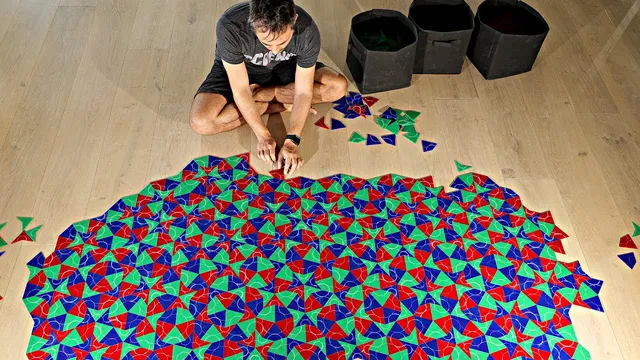
Penrose tilings prove that a plane can be tiled forever with strict matching rules while never repeating the same pattern.
Briefing
A centuries-old obsession with “regular” geometry turned into a real-world materials breakthrough: Penrose tilings—made from just two shapes—can fill the plane forever without ever repeating, and that same kind of long-range order helped explain quasi-crystals that nature had been producing all along. The core insight is that strict periodicity isn’t required for order. Instead, the plane can be governed by precise matching rules that force an aperiodic pattern, producing symmetries (like five-fold) that seemed incompatible with crystal structure.
The story starts with Johannes Kepler’s search for cosmic harmony in Prague. Kepler first framed planetary motion using nested spheres separated by the five Platonic solids, treating geometry as a kind of spacetime “spacer” that could fit astronomical measurements. He also made claims about how spheres pack most efficiently—hexagonal close packing—later known as Kepler’s conjecture, which took about 400 years to prove. Then Kepler turned to snowflakes, arguing that falling crystals reliably form six-cornered patterns, and to tilings: regular hexagons tile the plane perfectly, while regular pentagons do not. Still, he experimented with five-fold patterns, publishing a design in *Harmonices Mundi* that hinted at a deeper possibility—structures with pentagonal symmetry that might not behave periodically.
That possibility matured into a mathematical challenge in the 20th century. Wang studied edge-matching square tiles and proposed that any tiling that works at all must be periodic; Robert Berger disproved it by finding a finite set of 20,426 tiles that can tile the plane only non-periodically. The quest for smaller “aperiodic tile sets” continued: Berger reduced it to 104, Donald Knuth to 92, Raphael Robinson to six, and Roger Penrose to just two. Penrose’s breakthrough came from subdividing pentagons into a hierarchy of shapes, ultimately distilling the tiling rules into two rhombi—often described as “thick” and “thin”—that can extend to infinity while never repeating.
Penrose tilings also reveal why the golden ratio keeps showing up. The kite-and-dart version of the tiling has a ratio of kites to darts that approaches 1.618 (φ), and the spacing along the tiling’s straight-line “rulers” follows Fibonacci counts (like 13 and 21). Those irrational relationships are a tell: a truly periodic tiling would force rational ratios tied to repeating blocks, but the tiling’s structure resists that.
The leap from math to matter came when Paul Steinhardt and collaborators modeled atomic arrangements and found that locally favored structures can be globally constrained in ways that produce five-fold diffraction signatures. Dan Shechtman’s electron-scattering experiments on aluminum-manganese alloys produced matching patterns, confirming quasi-crystals. The key mechanism wasn’t just edge matching; it was stronger vertex rules that prevent local mistakes from ever compounding—allowing an aperiodic pattern to persist “to infinity.” The result overturns the old assumption that crystals must repeat, showing that nature can build ordered structures that look impossible to the eye.
Cornell Notes
Penrose tilings demonstrate that a plane can be filled forever with order but without repetition. Starting from Kepler’s geometric instincts—planetary “spacers,” efficient sphere packing, and early thoughts about five- and six-fold patterns—mathematicians eventually proved the existence of aperiodic tilings using finite tile sets. Roger Penrose reduced the problem to two shapes (thick and thin rhombi, or equivalently kites and darts) whose matching rules enforce a non-repeating pattern across infinite space. The tilings also encode the golden ratio through Fibonacci-like spacing and kite-to-dart ratios, offering a mathematical reason periodicity can’t occur. That same style of long-range constraint helped motivate quasi-crystals, materials with five-fold diffraction signatures that were once thought physically impossible.
Why did Kepler’s work matter to the later discovery of aperiodic order?
How did mathematicians move from “tilings exist” to “tilings can be forced to never repeat”?
What makes Penrose’s two-tile system special?
Where does the golden ratio show up, and why does it matter for periodicity?
How did quasi-crystals connect to Penrose tilings?
Review Questions
- What is an aperiodic tiling, and how does Berger’s counterexample to Wang’s conjecture establish that periodicity is not guaranteed?
- Explain how Fibonacci numbers and the golden ratio φ arise in Penrose tilings, and why irrational ratios argue against periodicity.
- In quasi-crystals, why are vertex-matching rules more effective than edge-matching rules for maintaining the pattern indefinitely?
Key Points
- 1
Penrose tilings prove that a plane can be tiled forever with strict matching rules while never repeating the same pattern.
- 2
The search for smaller aperiodic tile sets progressed from Wang’s conjecture to Berger’s 20,426 tiles, then down to Penrose’s two-tile construction.
- 3
Penrose’s kite-and-dart (or thick/thin rhombus) tilings encode five-fold symmetry through Fibonacci-based spacing and tile-count ratios approaching φ.
- 4
The golden ratio’s irrationality supports the non-periodic claim: a periodic tiling would force rational ratios tied to repeating blocks.
- 5
Quasi-crystals provide a physical analogue of aperiodic order, producing five-fold diffraction signatures despite the lack of periodic unit-cell repetition.
- 6
Strong vertex rules can prevent local tiling mistakes from ever compounding, allowing a non-repeating structure to persist to infinity.