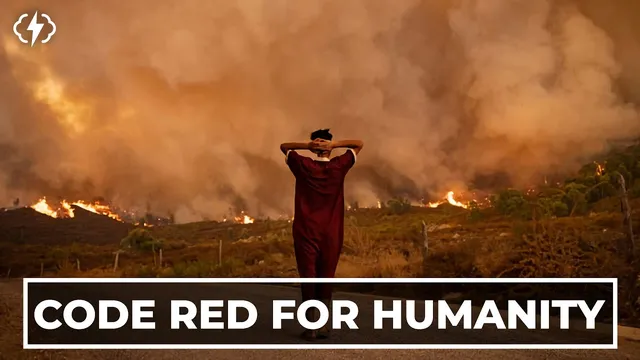
The IPCC's New "CODE RED" Climate Report
Based on Second Thought's video on YouTube. If you like this content, support the original creators by watching, liking and subscribing to their content.
The “CODE RED” framing emphasizes that climate risk is escalating quickly and the effective window for action is shrinking.
Briefing
A new “CODE RED” climate assessment from the IPCC is framed as a decisive warning: the world is running out of time to prevent severe, escalating impacts, and the window for effective action is narrowing fast. The report’s core message centers on how rapidly greenhouse-gas emissions translate into warming, and how that warming then locks in risks across weather extremes, ecosystems, and human health.
The discussion emphasizes that climate change is not a distant threat but a present driver of harm. Rising temperatures are linked to more frequent and intense heat, shifting rainfall patterns, and greater strain on water systems. Those physical changes cascade into social and economic consequences—damaging agriculture, increasing disaster risk, and worsening conditions for vulnerable communities. The “CODE RED” framing is used to stress urgency rather than uncertainty: while details vary by region, the overall direction and magnitude of risk increase with continued emissions.
A major focus is on the role of fossil-fuel burning and the scale of emissions. The transcript repeatedly ties warming to combustion and industrial activity, arguing that current trajectories are incompatible with stabilizing climate impacts. It also highlights that mitigation is not just about long-term targets; near-term choices—energy, transport, buildings, and land use—determine how quickly emissions fall and how much warming can be avoided.
The assessment is also presented as a call for coordinated policy and investment. The conversation points to the need for rapid deployment of low-carbon technologies and stronger implementation of existing commitments. It suggests that countries and institutions must align incentives, accelerate infrastructure transitions, and reduce barriers that slow adoption.
Beyond mitigation, the transcript gestures toward adaptation—preparing for the impacts that are already underway. That includes planning for extreme weather, protecting water supplies, and reducing health risks from heat and other climate-linked hazards. The underlying logic is that adaptation alone cannot substitute for emissions cuts, but it can reduce damage while mitigation ramps up.
Overall, the “CODE RED” label is treated as a shorthand for a specific reality: the climate system responds to emissions in ways that make delay costly. The report’s significance lies in turning climate science into a time-critical roadmap—one that connects emissions today to outcomes tomorrow, and makes the case that decisive action is required now to limit the worst-case scenarios.
Cornell Notes
The IPCC’s “CODE RED” climate assessment is presented as a time-critical warning that continued greenhouse-gas emissions are driving escalating climate risks. The central linkage is direct: fossil-fuel burning increases emissions, emissions raise temperatures, and higher temperatures intensify hazards such as heat extremes and disrupted water systems. The discussion stresses that mitigation choices made in the near term determine how quickly emissions can fall and how much warming can be avoided. It also notes that adaptation matters—planning for extreme weather and health impacts—but cannot replace emissions reductions. The “CODE RED” framing underscores narrowing timelines and the need for rapid, coordinated policy and investment.
What does “CODE RED” imply about timing and risk?
How does the transcript connect fossil-fuel use to climate impacts?
Why are mitigation and adaptation both mentioned, and what’s the relationship between them?
What kinds of actions are implied as necessary for mitigation to work?
What consequences does the transcript associate with climate change beyond weather?
Review Questions
- How does the transcript describe the cause-and-effect chain from emissions to warming to impacts?
- What does it suggest is the role of adaptation compared with mitigation?
- Why does the transcript treat near-term policy and investment as especially important?
Key Points
- 1
The “CODE RED” framing emphasizes that climate risk is escalating quickly and the effective window for action is shrinking.
- 2
Fossil-fuel burning is presented as a primary driver of greenhouse-gas emissions, which translate into higher temperatures.
- 3
Higher temperatures are linked to more intense and frequent hazards, including heat extremes and disrupted water systems.
- 4
Mitigation requires rapid, near-term emissions reductions through energy and infrastructure transitions, not just distant targets.
- 5
Adaptation is portrayed as necessary to reduce harm from impacts already occurring, but it cannot replace emissions cuts.
- 6
Coordinated policy and investment are treated as key to accelerating low-carbon deployment and implementation.