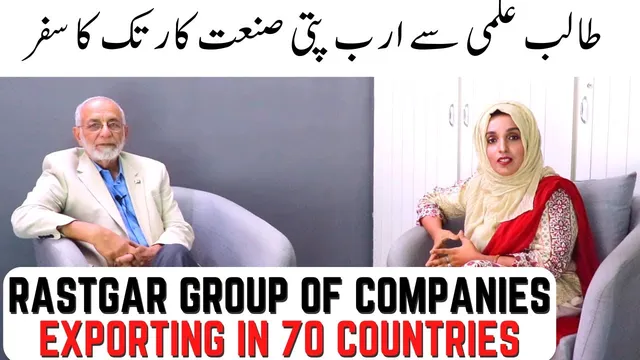
The Journey from Student to Billionaire Industrialist || Imtiaz Ali Rastgar With Dr Rizwana
Based on Dr Rizwana Mustafa's video on YouTube. If you like this content, support the original creators by watching, liking and subscribing to their content.
Raza Gar Engineering’s growth is attributed to pairing metal casting expertise with business fundamentals like cost accounting, accounting processes, and commercial law.
Briefing
A metal-casting entrepreneur’s rise from student to CEO is framed as a practical blueprint: technical education matters, but mindset, self-driven learning, and the ability to market and manage a product matter more. Imtiaz Ali Rastgar, CEO of Raza Gar Engineering Company, credits his path to early exposure to business ideas, hands-on experimentation, and a deliberate shift from chasing jobs to building a customer-backed enterprise—despite capital shortages and limited institutional support.
The story begins with a family influence and a turning point in thinking about work. Rastgar recalls reading books that questioned job-seeking during periods of recession and unemployment, arguing that entrepreneurship offers “breakthrough” opportunities. That idea stuck as he studied at Hailey College of Commerce in Lahore, where he spent time in libraries and observed entrepreneurship flourishing in the city’s industrial neighborhoods—outside formal business schools. He started a small venture from his hostel room using a PO box for correspondence, leveraging language skills and a typewriter to begin operations.
After completing BCom Honors, he moved into metal casting, initially starting small but realizing he needed deeper technical training. An advertisement for a diploma in foundry and metal casting techniques led him to formalize his skills, and the craft became a lifelong focus. Yet technical skill alone didn’t create money. He learned that metallurgy and casting could not “make money” without market access—branding, product positioning, and selling to industries that would pay for performance.
Rastgar describes building a foundry enterprise—Raza Gar Engineering—by teaching workers his processes and combining practical engineering with business fundamentals like cost accounting and commercial law. He also highlights professional networks, including membership in the Institute of British Foundry Men, which helped connect him to materials and industry knowledge. The biggest obstacles were structural: banks and lenders typically required existing capital and assets, leaving early-stage growth constrained.
The breakthrough came through product performance and customer value. During a 17–18 year period, his company began producing grinding balls for the cement industry under the “Rest Layi” brand. He contrasts prior industry sourcing—imported Russian grinding balls with a wear factor around 1100 grams per ton—with his locally supplied product, which delivered a much lower wear factor (about 35 grams per ton). That efficiency reduced downtime and improved customer economics, which in turn generated profits and supported further growth.
Beyond his own company, the discussion turns into career guidance for science students and youth. Rastgar argues that GPA and degrees can’t substitute for social skills, etiquette, networking, and the ability to interact effectively in teams—skills he says education systems often fail to reward. He warns against “Plan B” thinking that keeps people anchored to job security; instead, he urges focused effort, belief in self-ability, and readiness to work hard beyond the 9-to-5 mindset.
He also pushes a modern approach to learning: today’s students can research industrial processes online, study existing products and control systems, and then adapt ideas rather than waiting for local mentorship. The core message is that applied science becomes valuable only when paired with marketing, financing, labor management, taxation know-how, and people skills—turning technical knowledge into an enterprise that can compete in real markets.
The closing message adds a cultural and ethical layer: trade is framed as a Sunnah, entrepreneurship as a form of freedom, and business income as something that should be halal—paired with hard work and the willingness to pay the price for success.
Cornell Notes
Imtiaz Ali Rastgar’s path from student to CEO is presented as a mindset-and-execution model for science students: technical training is necessary, but entrepreneurship succeeds when applied knowledge is paired with business planning, branding, and customer value. He describes starting small from a hostel, formalizing metal casting skills through a foundry diploma, and then building Raza Gar Engineering by teaching workers his processes while adding cost accounting and commercial law to his skill set. The decisive growth lever was product performance—his grinding balls for Pakistan’s cement industry delivered far lower wear than imported alternatives, winning customers despite early capital constraints. He argues that youth should avoid “Plan B” job-only thinking, develop social and networking skills, and use online resources to understand industrial processes and compete globally.
Why does Rastgar treat “mindset” as the foundation of entrepreneurship rather than credentials alone?
How did he move from technical interest in metal casting to a scalable business?
What role did customer value and product performance play in overcoming early capital barriers?
Which skills does he say education systems often neglect, even for high-GPA students?
How does he suggest modern students learn industrial processes without waiting for local mentorship?
Why does he warn against relying on “Plan B” and job security while starting a business?
Review Questions
- What specific combination of skills (technical plus business plus people skills) does Rastgar say is required to turn applied science into profit?
- How did the grinding balls’ wear-factor difference function as a business strategy, not just a technical improvement?
- What does Rastgar mean by “Plan B” thinking, and why does he believe it undermines entrepreneurial commitment?
Key Points
- 1
Raza Gar Engineering’s growth is attributed to pairing metal casting expertise with business fundamentals like cost accounting, accounting processes, and commercial law.
- 2
Rastgar frames entrepreneurship as a mindset choice: avoid split attention between building a business and relying on job security as a fallback.
- 3
Product success came from measurable customer value—his grinding balls achieved a far lower wear factor than imported Russian alternatives, reducing cement-industry downtime.
- 4
Early-stage financing was a major constraint because banks typically require existing capital or assets, making customer-driven traction more important.
- 5
Social skills—communication, etiquette, networking, and teamwork—are treated as essential career tools that high grades alone do not guarantee.
- 6
Modern students can learn industrial processes by researching existing products and control systems online, then adapting what they find to local execution.
- 7
Applied science becomes commercially meaningful only when paired with marketing, financing, labor management, taxation know-how, and the ability to deal with people.