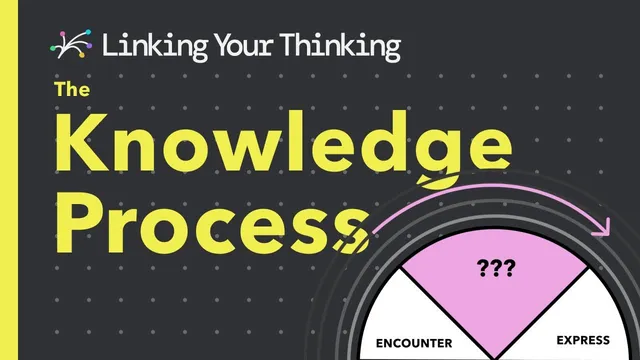
The Knowledge Process - A primer
Based on Linking Your Thinking with Nick Milo's video on YouTube. If you like this content, support the original creators by watching, liking and subscribing to their content.
The highest leverage in knowledge work is the deliberate space between encountering information and expressing a response.
Briefing
In an era of information abundance, the biggest differentiator isn’t collecting more inputs—it’s creating a deliberate “space” between encountering something and responding to it. That gap, often skipped when people default to fast reaction, is where thinking happens and where real value gets generated. The core claim is that knowledge work should be redesigned around this middle moment rather than treated as a simple loop of input → processing → output.
The framework starts with a basic knowledge loop: information enters, people process it, they express it, and that expression feeds back into the next round of information. A second way to view the same cycle is the back-and-forth between encountering and expressing. Historically, for many people—like a 1500s farmer in rural France—daily life may have involved fewer opportunities to iterate on ideas. Today, though, many knowledge workers spend their time wrestling with concepts in a “knowledge creator economy,” where the volume of information is high and the old model of constant cycling isn’t enough.
A key reference point is a well-known idea: between stimulus (encountering) and response (expressing) there is a space. That space is always present, even in modern workflows. The practical implication is straightforward: people don’t have to be reactive. Instead, they can use the gap to think—organize information, generate ideas, and decide what to express. In the “PKM planet” diagram, the loop is drawn as a circle with encounter and expression on the outer edges, while the center is reserved for thinking. The instruction is explicit: don’t “cheat the middle.” Most value is created in that central thinking phase, with some additional value also occurring elsewhere, but the highest leverage is the deliberate pause.
From there, the framework is extended into a knowledge process with phases. Encounter something new, express yourself, and—crucially—use an “acting phase” in between where thinking and internal processing happen. A further phase exists as well, described as partly subconscious, but the immediate takeaway is that once the process is understood, it becomes easier to improve how knowledge is encoded and turned into output.
Ultimately, the goal is a sustainable loop that nurtures richer thinking over a lifetime. By generating space instead of racing from input to reaction, people can produce better expression, which then changes the kinds of encounters they get next—creating a positive feedback cycle rather than a frantic one. The message lands as an invitation: try building that middle space into everyday knowledge work and see whether it changes what you create and how you respond.
Cornell Notes
The framework centers on a simple but high-impact idea: between encountering information and expressing a response lies a “space” where thinking happens. In an age of information abundance, repeatedly cycling through input and output isn’t enough; value depends on using that gap intentionally. The “PKM planet” model places encounter and expression on the outside while reserving the middle for thinking, warning against skipping or rushing through it. Once the knowledge process is understood—especially the acting/thinking phase—people can improve how they encode information and turn it into meaningful output. Over time, better thinking leads to better expression, which reshapes future encounters and supports a sustainable, enriching loop.
Why does information abundance change what “good knowledge work” looks like?
What does “don’t cheat the middle” mean in the PKM planet model?
How does the stimulus–response “space” relate to avoiding reactivity?
What are the two ways the knowledge loop is described?
What is the role of the “acting phase” in the knowledge process?
How does better thinking lead to a “positive, nurturing” loop over time?
Review Questions
- How would you redesign a typical knowledge workflow to ensure the “thinking space” isn’t skipped?
- What practical signs would show that someone is “cheating the middle” in their knowledge process?
- In what ways could improved expression change the future inputs (encounters) a person receives?
Key Points
- 1
The highest leverage in knowledge work is the deliberate space between encountering information and expressing a response.
- 2
Information abundance makes reactivity more tempting, but it also makes thinking quality the main differentiator.
- 3
The PKM planet model places thinking in the center of the loop; protecting that middle phase is essential for creating value.
- 4
A stimulus–response gap exists in everyday life, and using it helps people avoid default reactive behavior.
- 5
A knowledge process can be treated as phases: encounter, a thinking/acting phase in between, then expression.
- 6
Better thinking improves expression, which then reshapes future encounters and supports a sustainable feedback loop.