The LAST Eclipse in History
Based on minutephysics's video on YouTube. If you like this content, support the original creators by watching, liking and subscribing to their content.
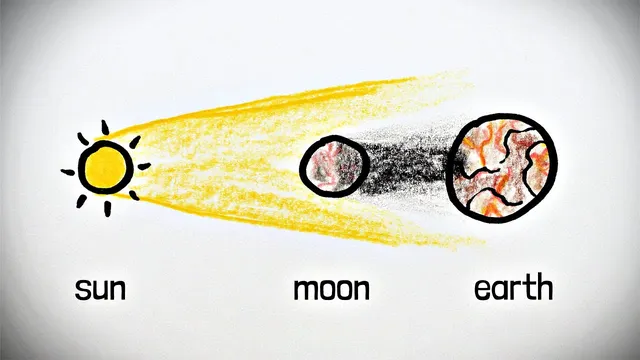
Total solar eclipses are defined by the Moon fully covering the Sun, which reveals the corona and produces a deep-blue, 360° horizon glow.
Briefing
Solar eclipses are entering a long decline: Earth’s “golden age” of total eclipses is already past its peak, and annular eclipses are steadily taking over as the Moon drifts farther away. The shift matters because it changes what eclipse observers can see—total eclipses produce the deep-blue twilight, 360° sunrise/sunset glow, and the Sun’s corona as a bright ring around the Moon, while annular eclipses leave a persistent ring of sunlight and never fully reveal that corona spectacle.
Current eclipses feel special for several reasons: they temporarily block the Sun at midday, creating darkness and a chill; the Moon’s shadow is small enough that sunlight still filters the atmosphere near the horizon, producing a deep blue sky and a golden horizon glow all around; and total eclipses uniquely expose the Sun’s corona, normally drowned out by the Sun’s glare. Totality is also rare—any location on Earth gets a total solar eclipse only about once every several hundred years—and brief, typically lasting only a few minutes, which makes the experience feel even more fleeting. Finally, eclipses come in two main types. Total eclipses occur when the Moon fully covers the Sun; annular eclipses happen when the Moon appears smaller than the Sun, leaving an “annulus” (ring) of the solar disk visible. Because annular eclipses don’t fully block the Sun, they don’t deliver the deep-blue sky or naked-eye corona view that define total eclipses.
The reason the balance is tilting toward annularity is orbital geometry driven by long-term tidal evolution. The Moon formed billions of years ago and likely started much closer to Earth, making it appear larger in the sky. In that earlier era, eclipses would have been overwhelmingly total, with longer durations and a darker, more “normal night” feel—less of the dramatic blue-and-gold horizon effect. The Moon would also have covered more of the Sun’s corona, and Earthshine would have made the Moon brighter, further reducing the sense of cosmic strangeness.
Over time, Earth’s faster rotation than the Moon’s orbital period created tidal forces that transferred rotational momentum from Earth to the Moon, pushing the Moon outward. Until roughly 700 million years ago, the Moon was close enough that it always appeared larger than the Sun, so total solar eclipses dominated. As the Moon receded, it began to appear smaller than the Sun during parts of Earth–Moon–Sun geometry, producing annular eclipses instead of total ones. At first, total eclipses remained more common, but as the Moon continued drifting away, annular eclipses became increasingly frequent. In the last several hundred million years, the average apparent size crossed a threshold where annular eclipses became more common than total eclipses—today by about 20%.
That trend continues. As tides keep moving the Moon farther away, annular eclipses will become more common and total eclipses rarer, until the last total solar eclipse occurs roughly half a billion to a billion years from now. For observers in North America, the next total solar eclipse is Monday, April 8, 2024—an important reminder that the era of totality is finite, and the sky’s most dramatic eclipse signature depends on the Moon’s distance.
Cornell Notes
Earth’s era of frequent total solar eclipses is already past its peak. Total eclipses depend on the Moon appearing larger than the Sun so it can fully cover the solar disk, revealing the deep-blue sky and the Sun’s corona. As tidal forces transfer Earth’s rotational energy to the Moon, the Moon slowly recedes, making it appear smaller over time and increasing the share of annular eclipses. Around the last several hundred million years, annular eclipses became more common than total eclipses, and today there are about 20% more annular than total eclipses. In roughly 0.5–1 billion years, the last total solar eclipse will occur, ending the “golden age” of totality on Earth.
What makes a total solar eclipse visually distinct from an annular eclipse?
Why do eclipses feel rare and fleeting even when they happen often somewhere on Earth?
How do Earth and Moon orbital shapes affect whether an eclipse is total or annular?
What long-term process is pushing the Moon farther from Earth?
What timeline explains the shift from mostly total eclipses to mostly annular eclipses?
When is the last total solar eclipse expected to happen, and why?
Review Questions
- How do tidal forces change the Moon’s distance from Earth, and how does that distance change the type of solar eclipse?
- List at least three observational features that appear in total eclipses but not in annular eclipses.
- What threshold in lunar apparent size marks the transition from total-eclipse dominance to annular-eclipse dominance?
Key Points
- 1
Total solar eclipses are defined by the Moon fully covering the Sun, which reveals the corona and produces a deep-blue, 360° horizon glow.
- 2
Annular eclipses happen when the Moon appears smaller than the Sun, leaving a visible ring of sunlight and preventing the signature deep-blue totality conditions.
- 3
The Moon’s outward drift is driven by tidal transfer of Earth’s rotational momentum to the Moon.
- 4
About 700 million years ago, the Moon’s distance evolution began allowing annular eclipses during some orbital configurations, ending an era of always-total eclipses.
- 5
In the last several hundred million years, annular eclipses have become more common than total eclipses; today they outnumber total eclipses by roughly 20%.
- 6
The last total solar eclipse is projected to occur in roughly 0.5–1 billion years as the Moon continues receding.
- 7
The next total solar eclipse in North America is Monday, April 8, 2024 (as referenced in the transcript).