The Least Effective Weapons in History
Based on Second Thought's video on YouTube. If you like this content, support the original creators by watching, liking and subscribing to their content.
The double-barreled cannon’s chain weapon depended on near-perfect simultaneous firing; tiny timing differences could send projectiles off course or back toward the shooter.
Briefing
Several failed weapons share a common pattern: bold engineering ideas collided with messy reality—timing errors, training mistakes, terrain physics, and even absurd “temperature control” plans—turning intended battlefield advantages into dead ends.
The most striking example is the double-barreled cannon, an idea traced to Italian gunmaker Antonio Tirri in 1642 and later funded and built by Georgia mechanic John Gilland in 1862. The concept was to fire two cannonballs at once, linked by a chain meant to snap taut between the projectiles—cutting through infantry as the chain scythed like a massive trap. In practice, simultaneous firing proved nearly impossible. If one barrel fired even a fraction of a second earlier, the balls would launch off course; worse, one cannon could misfire and swing the remaining ball back toward the shooter. Gilland’s tests reportedly ended with destruction of a cornfield, trees, and even the death of a cow—an outcome that captured the weapon’s core flaw: it couldn’t reliably do what it was designed to do.
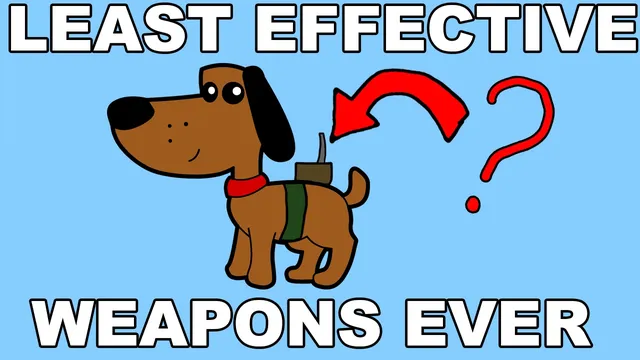
World War II brings a different kind of failure: the Soviet “anti-tank mines on dogs” concept. The plan relied on dogs crawling under German tanks and triggering explosives when a detonating rod contacted the tank’s underside. Training was attempted by hiding treats under T-34 tanks, but battlefield conditions undermined the premise. German tanks used gasoline engines and had different smells and noise than the diesel-powered T-34s. Instead of seeking German targets, many dogs ran back to Russian lines, where they could accidentally trigger devices or “play dead,” turning the system into a liability rather than a weapon.
The Russian Zar tank from World War I was built to solve a real problem—traditional tracked tanks getting stuck in mud and craters—by using enormous wheels, about 9 meters in diameter. The design aimed to cross obstacles that would stop smaller vehicles, but weight distribution proved fatal. During trials the tank crushed obstacles at first, yet when it reached uneven terrain, the rear wheel became hopelessly stuck. With a 60-ton mass distributed in a way that prevented recovery, it never saw action and eventually rusted away.
The bleakest punchline comes from the British “blue peacock” nuclear mine, a 1950s plan to bury ten 10-kiloton nuclear mines in North Germany ahead of a Soviet invasion. The mines were meant to deny occupation by destroying facilities and contaminating areas, with detonation options including remote wiring, an eight-day timer, or automatic triggers via anti-tamper devices. The project’s Achilles’ heel was electronics reliability in extreme German winter cold. The proposed fix—bury live chickens with the bombs so their body heat would keep the electronics warm—was ultimately scrapped in 1958 due to fallout and political risks.
Across these cases, the failures weren’t just bad luck. They were predictable mismatches between design assumptions and real-world constraints: timing tolerances, animal behavior under battlefield cues, terrain and mass distribution, and environmental limits on sensitive electronics.
Cornell Notes
Across four examples, ambitious weapons fail because real-world conditions break the assumptions behind their designs. A double-barreled cannon meant to fire two linked shots simultaneously collapses under timing synchronization problems, leading to dangerous misfires. A Soviet anti-tank dog mine scheme depends on dogs identifying German tanks, but differences in engine noise and smell cause dogs to run under Russian vehicles or back to their handlers. The Russian Zar tank solves mud-sticking with giant wheels, yet weight distribution leaves the rear wheel trapped on uneven terrain. Even the British blue peacock nuclear mine—planned to deny occupation—gets derailed by winter electronics reliability, prompting an absurd “keep it warm with live chickens” proposal before the project is scrapped.
Why was the double-barreled cannon’s chain-linked concept so hard to make work in practice?
What went wrong with the Soviet idea of using dogs to trigger anti-tank mines?
How did the Zar tank’s wheel-based approach fail despite promising early trial results?
What was the central technical problem behind the British blue peacock nuclear mine, and why did the proposed solution sound so extreme?
Across these weapons, what pattern links the failures more than any single technical detail?
Review Questions
- Which design assumption was most critical to the double-barreled cannon’s effectiveness, and how did small timing errors undermine it?
- What battlefield cues caused the dog-based anti-tank mine concept to misfire in practice?
- Why did the Zar tank’s wheel design still leave it immobilized, and what terrain condition triggered the failure?
Key Points
- 1
The double-barreled cannon’s chain weapon depended on near-perfect simultaneous firing; tiny timing differences could send projectiles off course or back toward the shooter.
- 2
The Soviet dog-mine concept failed because dogs trained on T-34 cues (smell and diesel noise) did not reliably identify German tanks (gasoline engines).
- 3
The Zar tank’s giant wheels solved some obstacle-crossing problems but failed on uneven terrain due to rear-wheel mud entrapment and unrecoverable weight distribution.
- 4
The British blue peacock nuclear mine aimed to deny occupation using contamination and multiple detonation methods, but winter electronics reliability became a showstopper.
- 5
The proposed “live chickens to keep electronics warm” solution for the blue peacock mines highlights how environmental constraints can derail even high-level strategic weapons.
- 6
Several of these failures turned on practical tolerances—timing, sensory cues, terrain physics, and temperature—rather than on the overall idea alone.