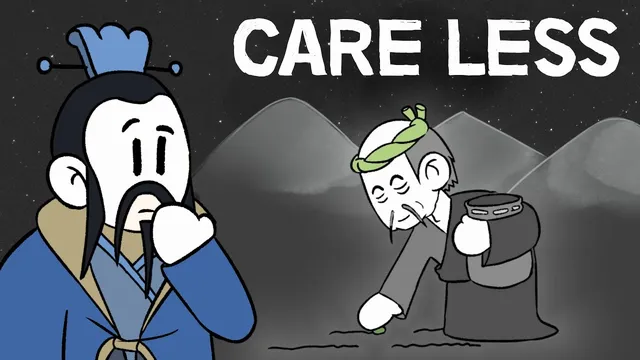
The Less You Care, The Happier You’ll Be | Taoist Wisdom For An Overly Serious World
Based on Einzelgänger's video on YouTube. If you like this content, support the original creators by watching, liking and subscribing to their content.
Treat outcomes labeled as “loss” as potential sources of hidden benefit rather than automatic evidence of failure.
Briefing
A Taoist hermit’s calm joy—despite poverty and isolation—turns on a single pivot: treating what looks like “loss” as a source of hidden gain. When Confucius’s student Tzu-Kung assumes the old man must be miserable, the hermit flips the logic. He laughs and sings not because life is easy, but because he didn’t spend his youth competing for status; aging has left him healthy, and having no wife or children means no worries about their lives either. The takeaway is blunt and practical: happiness doesn’t come from getting the “right” outcomes, but from reading outcomes differently—especially when society labels them failures.
That reframing becomes the backbone of three Taoist insights aimed at an achievement-obsessed, distraction-heavy modern world. First comes Zhuangzi’s critique of fame, wealth, and status as the yardsticks of worth. Pursuing external honors creates a treadmill: once a person secures a car, a better one becomes the next target; once a dream house is owned, novelty fades into routine while obligations like mortgages remain. The result is not only dissatisfaction but self-exhaustion—burnout, anxiety, and depression framed as symptoms of a lifestyle built to impress others. Social media fame and consumer luxury are treated as especially corrosive because they convert personal life into a performance for approval.
Second, Taoist sages challenge the fear of being “irrelevant” or “a nobody.” Zhuangzi argues that right and wrong can’t be judged by the crowd’s standards, even if “everyone agrees.” People chase promotions and display ambition because they’re terrified of being seen as unambitious, yet that anxiety locks them into constant self-monitoring. The alternative is “doing nothing” (wu wei) in the sense of stopping forced striving—letting serenity arise from non-coercion. Happiness, the argument goes, often appears when the frantic attempt to manufacture it stops.
Third, Taoist parables invert conventional value. The “useless tree” stands as a warning against equating worth with immediate utility. A crooked oak draws admiration for its size, but a carpenter calls it worthless because it can’t be used for boats, doors, or closets. That night the tree answers: fruit trees are exploited for their productivity—branches are broken, people abuse them when ripe, and they’re cut down when they stop producing. The tree’s “uselessness” spared it from that fate, allowing it to grow old. Another story, about Pei-kung-tzu and Hsi-men-tzu, sharpens the point: social success doesn’t prove virtue, and social failure doesn’t prove lack of it. A village sage attributes outcomes to luck rather than moral ranking, urging Pei-kung-tzu to stop treating misfortune as a verdict on his worth.
Across these stories, the core prescription is consistent: cultivate an attitude that accepts fate’s limits, loosens attachments to status, and focuses on how to navigate whatever comes. In a world that rewards constant chasing, Taoism holds up a different metric—contentment over comparison, peace over performance, and the possibility that the “loser” life may contain the conditions for a calmer mind.
Cornell Notes
Taoist stories argue that happiness and inner peace depend less on external outcomes than on how people interpret them. A hermit laughs despite poverty because he avoided status competition and gained health and freedom from family worries. Zhuangzi criticizes fame and wealth as a never-ending treadmill that exhausts people and turns them into cogs in a consumerist approval system. Other parables—like the useless tree and the contrasting fates of Pei-kung-tzu and Hsi-men-tzu—undercut society’s standards of worth, suggesting that “usefulness” can be a trap and that success or failure often reflects luck. The practical aim is to loosen attachments, stop frantic striving, and let serenity arise as life unfolds.
Why does the hermit treat poverty and isolation as reasons to sing rather than reasons to despair?
How does Zhuangzi describe the emotional cost of chasing fame, wealth, and status?
What does “doing nothing” (wu wei) mean in this Taoist framing?
Why does the “useless tree” treat being “worthless” as a form of protection?
What lesson does the Pei-kung-tzu and Hsi-men-tzu story deliver about virtue and success?
How do these stories connect acceptance of fate to inner peace?
Review Questions
- Which specific “hidden gains” does the hermit cite, and how do they directly undermine Tzu-Kung’s assumptions?
- What mechanisms make the pursuit of status a “treadmill” rather than a path to lasting happiness?
- In the useless tree and Pei-kung-tzu stories, how does Taoism redefine what counts as value or worth?
Key Points
- 1
Treat outcomes labeled as “loss” as potential sources of hidden benefit rather than automatic evidence of failure.
- 2
Status competition can trade away health, peace, and contentment; avoiding it can be a direct route to well-being.
- 3
External metrics like wealth and fame create a never-ending cycle of wanting, where satisfaction fades but obligations remain.
- 4
Fear of social judgment drives people to conform—chasing promotions and approval even when it harms mental health.
- 5
“Doing nothing” (wu wei) is framed as stopping forced striving so enjoyment and serenity can arise naturally.
- 6
Parables challenge conventional definitions of usefulness and virtue, arguing that luck and fate often shape results beyond moral ranking.
- 7
Inner peace comes from loosening attachments and focusing on how to navigate life as it unfolds, not from controlling every outcome.