The Less You Seek, The More You’ll Find | The Happiness Paradox
Based on Einzelgänger's video on YouTube. If you like this content, support the original creators by watching, liking and subscribing to their content.
Trying to suppress negative emotions can intensify them by keeping attention on the feeling and adding distress about not being able to remove it.
Briefing
Happiness tends to slip away when it becomes the thing people chase. Trying to force a positive state—or suppress a negative one—often backfires: attention to the target increases pressure, raises the odds of disappointment, and can worsen the very feelings being managed. The core insight is simple but counterintuitive: happiness is more likely to appear as an unintended byproduct of other pursuits, while direct striving and intense expectations make it harder to reach.
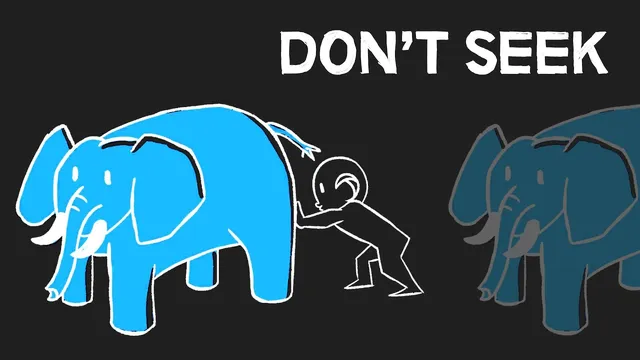
The transcript uses a “blue elephant” thought experiment to show how unwanted mental states persist when people fight them. If someone tries not to think about a blue elephant, the image grows more persistent because the effort itself keeps the thought active. The same dynamic applies to anxiety, sadness, and negative thinking: suppressing mild anxiety can escalate into panic, and forcing oneself not to be sad can intensify the sadness. Thoughts and emotions, the argument goes, are not fully controllable; attempting to eliminate them can also create a second layer of distress—awareness of failure to get rid of the feeling.
A parallel “happiness paradox” follows. The more people wish to be happy, the less likely they are to feel it. Happiness is likened to a butterfly: the harder someone tries to catch it, the more it escapes. But if the pursuit stops, happiness may show up unexpectedly—“sitting on your shoulder” when no one is actively hunting for it.
Philosophical framing supports the claim. Nathaniel Hawthorne is quoted from a 19th-century notebook: happiness arrives incidentally, and making it an object of pursuit turns it into a “wild-goose chase.” Henry Sidgwick’s “paradox of hedonism” is invoked as well: conscious pursuit of pleasure interferes with experiencing it, and treating happiness as the sole goal can crowd out other aims. Viktor Frankl’s view sharpens the prescription: happiness cannot be pursued directly; it must “ensue.” Frankl argues happiness can arise as a byproduct of dedication to a cause beyond oneself or surrender to a person beyond oneself—an idea reinforced by his experience in concentration camps, where meaning helped transform suffering.
Academic research is then used to explain the mechanism. A 2021 study, “The paradox of pursuing happiness,” by Felicia Zerwas and Brett Ford, reports that valuing happiness intensely predicts negative outcomes in both the short term (less positive emotion) and the long term (worse well-being). Using a goal-pursuit model, the transcript describes how people set a “happiness goal,” use “emotion regulation” strategies to increase happiness, and then monitor progress. When the current emotional state fails to match the desired state, people can re-enter regulation and also experience “meta-emotions” such as disappointment—an emotion about an emotion—that further worsens mood. Monitoring hedonic experiences can itself interfere with them.
The model also highlights why expectations matter. If the happiness goal is too high, it becomes unreachable, increasing disappointment. A field example compares New Year’s Eve plans: those with the biggest expectations were least happy afterward. The practical takeaway is to keep happiness expectations low and avoid treating happiness as the primary target.
Instead of seeking happiness directly, the transcript recommends doing activities that may generate it while keeping happiness as a minor goal—or not a goal at all. Stoics pursue virtue (wisdom, moderation, justice, courage), leading to eudaimonic well-being as a consequence rather than a direct objective. Frankl similarly emphasizes meaning-making through actions like helping others. Even if happiness doesn’t arrive, the actions still produce something worthwhile; if it does arrive, it comes as an unexpected bonus.
Cornell Notes
Happiness becomes harder to obtain when people treat it as a direct target. Attempts to suppress negative feelings or to force positive ones can intensify the very states being resisted, partly because attention and monitoring keep the target salient and can trigger disappointment. Philosophical views—from Nathaniel Hawthorne, Henry Sidgwick, and Viktor Frankl—argue that happiness arrives incidentally or as a byproduct of meaning, virtue, or other goals. Research cited from Felicia Zerwas and Brett Ford (2021) provides a mechanism: setting a “happiness goal,” regulating emotions to reach it, and then monitoring progress can produce meta-emotions like disappointment when expectations aren’t met. Lowering expectations and pursuing other aims can reduce disappointment and make satisfaction more likely.
Why does trying not to think about something (like the “blue elephant”) make it more persistent?
What is the “happiness paradox,” and how is it different from ordinary goal pursuit?
How does the Zerwas and Ford model explain the mechanism behind the paradox?
Why do high expectations make happiness harder to reach?
What does it mean to pursue happiness indirectly, and what examples are given?
Review Questions
- How does the transcript connect thought suppression to the persistence of unwanted mental states?
- In the goal-pursuit model, what role do monitoring and “meta-emotions” play in reducing happiness?
- What practical strategies follow from the claim that happiness should be treated as a byproduct rather than a goal?
Key Points
- 1
Trying to suppress negative emotions can intensify them by keeping attention on the feeling and adding distress about not being able to remove it.
- 2
Directly chasing happiness often increases pressure and monitoring, which can reduce the likelihood of experiencing it.
- 3
Happiness is framed as arriving incidentally or as a byproduct of other aims—meaning, virtue, or dedication to causes beyond oneself.
- 4
A cited 2021 study links intense valuing of happiness to worse outcomes, including less positive emotion short term and worse well-being long term.
- 5
In the goal-pursuit model, disappointment arises when current emotional state fails to match a “happiness goal,” and that meta-emotion worsens mood.
- 6
High expectations make happiness goals harder to reach, increasing the chance of disappointment after events like New Year’s celebrations.
- 7
Pursuing other goals with low or no expectations for happiness can reduce disappointment while still allowing satisfaction to emerge unexpectedly.