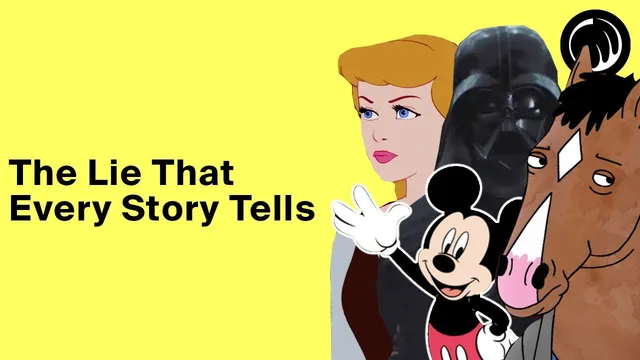
The Lie That Every Story Has In Common - Kurt Vonnegut On The Shapes of Stories
Based on Pursuit of Wonder's video on YouTube. If you like this content, support the original creators by watching, liking and subscribing to their content.
Vonnegut’s fortune-axis model describes stories as trajectories of good and ill fortune from start to finish, often ending with protagonists higher than they began.
Briefing
Kurt Vonnegut’s central claim about storytelling is that most stories don’t tell the truth about life: they follow tidy emotional curves that imply events reliably lead to clear “good” or “bad” outcomes. By plotting a protagonist’s movement along an axis of fortune—starting in a good, bad, or neutral situation, then rising and falling as events unfold, and ending with a visible shape—Vonnegut found that many popular narratives share consistent patterns across cultures. The common result is that protagonists often finish higher on the fortune axis than where they began, giving audiences the comforting sense that narrative momentum tends to reward the character in the end.
Vonnegut’s more provocative move is to call those shapes lies. A more realistic story shape, he argues, would be a straight line: events would still happen and characters would still change, but the story would preserve ambiguity about whether what occurs is conclusively good or bad. Shakespeare’s Hamlet becomes the touchstone for this idea. The play advances through action and consequence, yet it refuses to deliver a clean moral ledger of outcomes. That uncertainty—audiences not being told what counts as “good news” versus “bad news”—is presented as closer to how life actually feels, where people rarely get full information about the consequences of their choices.
The discussion then connects this narrative ambiguity to television series structure. TV episodes are engineered to keep viewers watching: each installment must be engaging enough to hold attention while also leaving enough unresolved threads to sustain season-long and series-long plots. That design pressure discourages final peace or definitive resolution for main characters. Even when a show eventually ends, it spends its life trying to avoid closure, because the format depends on ongoing conflict and partial resolutions that feed the next episode. In that sense, the series format forces a kind of “straight line” truth about knowledge: neither characters nor viewers can be sure that what looks beneficial in one episode won’t produce trouble later.
From there, the argument broadens into a philosophy of meaning. Stories can train perception and help people recognize micro-moments—small instances of decency, connection, and happiness—without requiring a guarantee that everything will culminate in triumph. Joseph Campbell’s “hero journey” is invoked to frame life as repeated calls to adventure, each with risk and the possibility of fulfillment or fiasco. The danger comes when people treat story templates as if they map perfectly onto real life—expecting a perfectly right decision that guarantees a noble ending. That expectation can freeze action through fear.
The takeaway is a call for forward motion without certainty: understand that life can only be interpreted in hindsight, but must be lived with choices made under uncertainty. Even if the larger picture never reveals which events were truly “good” or “bad” in advance, people can still look for what feels genuinely nice, keep adapting, and find “good fortune” in the continuation of change itself—staying alive to experience, learn, and persist.
Cornell Notes
Kurt Vonnegut argues that many stories share a misleading emotional pattern: protagonists typically rise on a “fortune” axis and end better than they began. He calls that pattern a lie about life and proposes a more honest alternative—a straight-line story where events happen and characters change, but outcomes remain ambiguous. Hamlet is used as an example of narrative movement without clear moral accounting, leaving audiences unsure what counts as “good news” or “bad news.” The discussion then links this ambiguity to the mechanics of TV series, which rely on unresolved arcs to keep viewers watching and therefore avoid definitive closure. The practical conclusion: people should act without demanding guaranteed “right” outcomes, and find meaning in ongoing adaptation and in noticing genuinely good moments along the way.
What does Vonnegut mean by the “shape” of a story, and what pattern does he find across cultures?
Why does Vonnegut call common story shapes “lies,” and what would a more realistic shape look like?
How does Hamlet fit Vonnegut’s “straight line” idea?
What does TV-series structure have to do with narrative truth?
How do Campbell, Kierkegaard, and the “template trap” connect to the practical advice at the end?
Review Questions
- How does the “fortune axis” model distinguish between Vonnegut’s typical story curves and his proposed straight-line alternative?
- What specific features of TV series format make definitive resolution difficult, and how does that mirror the ambiguity Vonnegut describes?
- Why does the discussion warn against treating story templates as life plans, and what alternative mindset is offered?
Key Points
- 1
Vonnegut’s fortune-axis model describes stories as trajectories of good and ill fortune from start to finish, often ending with protagonists higher than they began.
- 2
Vonnegut argues that these common narrative curves misrepresent life by implying outcomes are reliably legible as “good” or “bad.”
- 3
A more realistic story shape, in Vonnegut’s view, is a straight line: events and character change continue, but the narrative preserves ambiguity about ultimate value.
- 4
Hamlet is used as an example of forward motion without conclusive moral accounting, leaving audiences uncertain about which events are truly “good news” or “bad news.”
- 5
TV series mechanics—episode-by-episode retention and unresolved arcs—naturally sustain uncertainty and discourage final closure for main characters.
- 6
The discussion links meaning to ongoing adaptation: people can still recognize “nice” moments and persist through change even without knowing the larger outcome in advance.
- 7
Expecting a perfectly right decision that guarantees a noble ending can create fear and paralysis; the recommended approach is to act anyway and learn from consequences.