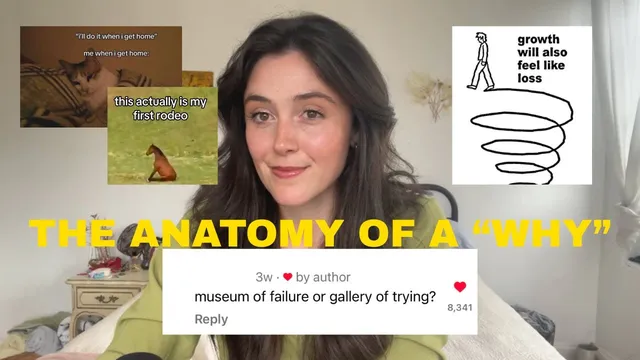
the life design process that changed my art (& actually, changed everything)
Based on Anna Howard's video on YouTube. If you like this content, support the original creators by watching, liking and subscribing to their content.
Clarify your “why” before obsessing over “how,” because purpose determines what actions actually matter.
Briefing
Creative momentum starts with a “why,” then gets sustained through a repeatable quarterly planning ritual that turns big intentions into daily, energy-aware actions. The core claim is blunt: people get stuck not because they lack ideas, but because they chase “how” (productivity tactics, perfect setups, copycat success paths) before they’ve clarified what the work is for. Once the purpose is clear, the project selection becomes less mysterious—and finishing becomes a skill built through practice rather than a personality trait.
The process centers on Lexi Merritt’s “Big Paper Planning Day,” a quarterly group exercise that helps participants design an “experiment with the design of your own life.” The method begins with listing desired outcomes—material goals, experiences, or even feelings. From there, participants repeatedly ask “I want X so that I can…” until the concrete desire dissolves into an abstract “why.” That abstraction matters because it opens room for divergent thinking: a goal like “travel abroad” might ultimately serve a deeper need such as learning, connection, or heritage. Abstract goals also reveal shifting values in real time; the values become the compass for what to pursue next.
With a small set of abstract goals chosen (typically two, with four as an upper bound), the next step is building an “action menu”—a menu of small actions tailored to low-, mid-, and high-energy days. The emphasis is on identity and consistency, not on forcing a single heroic schedule. Lexi’s “gold star” approach is used to reinforce the identity of someone who keeps promises to themselves. Instead of waiting for a finished podcast, essay, or craft project to feel proud, the system rewards daily participation in the underlying purpose.
The creative work itself follows a practical rhythm: “slow preparation, fast execution.” Preparation is the small, methodical daily work; execution is the bounded moment when output happens—recording, drafting, or making. Even when execution is fast, the process doesn’t require forcing everything into one day; the creator highlights the reality of mixed conditions (like returning the next day to continue filming) as proof that multiple truths can coexist.
Midway through any project, three emotional traps tend to appear: fear (not enough to say, not able to make something beautiful and useful), boredom (novelty wears off), or suspicious ease (the work feels too effortless, triggering guilt about “real” effort elsewhere). The prescription is to treat these states as signals rather than stop signs. Boredom, for example, is reframed as a progress indicator—evidence that someone has moved beyond the shiny beginner phase and is approaching mastery.
Finally, finishing requires accepting loss. Drawing on advice from Selene S. Gian and other writing craft reflections, the creator argues that drafts and projects only become whole when unnecessary pieces are cut—“killing” favorite ideas that don’t serve the thesis or purpose. Creation is described as betrayal to the original vision: the finished work will not match the perfect picture in the head, and that mismatch is part of the process. The takeaway is that finishing is built by returning to purpose, choosing manageable actions, and continuing through fear, boredom, and the inevitable trimming required to reach a finish line.
Cornell Notes
The creative process becomes manageable when “why” comes first. Big Paper Planning Day turns scattered interests into a quarterly system: list what you want, ask “I want X so that I can…” until concrete desires become abstract values, then choose a small number of goals to pursue. Those goals feed an “action menu” of daily actions scaled to low-, mid-, and high-energy days, reinforced with gold-star credit so identity and consistency grow before the big project is finished. During execution, people should expect fear, boredom, or unexpected ease—and treat them as signals to keep going. Finishing also demands cutting: drafts become whole by removing what doesn’t serve the purpose, even when it’s attached to earlier ideas.
Why does clarifying a “why” come before choosing a “how” or a specific project?
How does Big Paper Planning Day transform a list of wants into actionable direction?
What is an “action menu,” and why is it designed around energy levels?
What emotional patterns show up mid-project, and how should they be interpreted?
Why does finishing require cutting, even when ideas feel personal?
Review Questions
- What does the repeated “I want X so that I can…” questioning reveal, and how does it change what gets pursued?
- How would you design a low-, mid-, and high-energy action menu for one abstract goal you care about?
- What are the three mid-project emotional traps described, and what specific reframe or response is suggested for each?
Key Points
- 1
Clarify your “why” before obsessing over “how,” because purpose determines what actions actually matter.
- 2
Use repeated “I want X so that I can…” prompts to convert concrete wants into abstract goals tied to values.
- 3
Limit priorities: focus on about two abstract goals (with four as an upper bound) to avoid juggling too many projects.
- 4
Build an action menu with low-, mid-, and high-energy options so daily progress continues even when motivation or health dips.
- 5
Reward identity-building with consistent credit (gold-star style) so pride doesn’t depend on finishing the whole project.
- 6
Expect fear, boredom, and suspicious ease mid-process; treat them as signals rather than reasons to quit.
- 7
Finish by cutting: drafts become whole when unnecessary ideas are removed, even if they were once attached to the original vision.