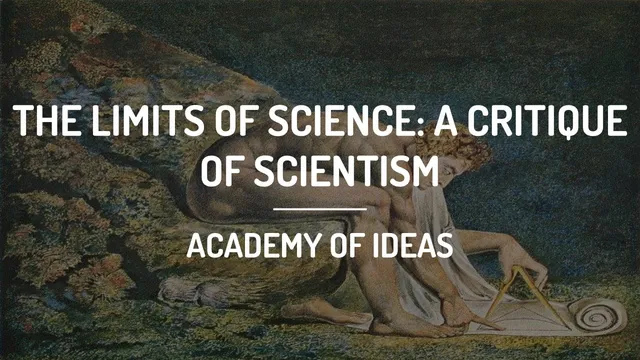
The Limits of Science - A Critique of Scientism
Based on Academy of Ideas's video on YouTube. If you like this content, support the original creators by watching, liking and subscribing to their content.
Scientism is challenged on the grounds that scientific inquiry depends on assumptions that the scientific method cannot itself validate.
Briefing
Scientism—the idea that science is the only legitimate source of knowledge about the world—collapses under scrutiny because scientific inquiry depends on assumptions that science cannot prove. While science’s methods are powerful for testing hypotheses against observation, the foundations that make those methods possible rest on prior commitments about how reality is structured.
The argument begins by separating faith from reason. Faith is framed as arriving at knowledge claims through belief, assumption, or suspended disbelief; reason moves from premises to conclusions through argument and logic. Using that distinction, the critique targets a common claim that scientists “take nothing on faith.” Instead, it argues that science must begin with presuppositions that cannot be established by the scientific method itself. Two central examples are (1) confidence in sense experience as a reliable gateway to evidence and (2) belief in the uniformity or regularity of nature—namely that the laws discovered in one time and place will hold everywhere and at all times.
These presuppositions are portrayed as necessary starting points. If sense experience is denied, experimental observations lose their evidential role. If regularity is denied, there is no stable basis for discovering laws at all. The critique leans on the idea that science does not start from scratch; it begins from where inquiry already stands, using inherited commitments to make further investigation coherent.
A more specific presupposition is then introduced: the “species-individual structure” of nature. For science to classify phenomena, it must assume that individual things can be grouped into kinds (species) based on shared characteristics, and that members of the same kind behave similarly under comparable conditions. The examples are straightforward: wood pieces are treated as belonging to a “wood” kind that burns, and water droplets are treated as belonging to a “water” kind that freezes. The key point is not merely that science uses classification, but that the truth of such classificatory assumptions cannot be derived from scientific testing; without them, induction and the linking of past observations to future expectations become impossible.
The critique also rejects a common escape route: claiming that presuppositions are justified by science’s success. Success, the argument says, does not entail truth. Tycho Brahe’s geocentric model of the solar system is used as a cautionary example: it predicted planetary motions well, yet it was not an accurate depiction of reality. Prediction can work without validating the metaphysical assumptions behind the model.
Finally, scientism is argued to be self-refuting. The claim that only science can provide knowledge asserts a substantive truth about the world—one that only science can deliver—yet that truth is not itself obtained through scientific method. If scientism requires scientific validation for knowledge claims, then its own central thesis lacks the kind of support it demands. The conclusion is that science remains indispensable, but scientism overreaches: it treats as scientific what must be assumed before science can even begin.
Cornell Notes
The critique argues that scientism fails because scientific practice depends on presuppositions that science cannot prove. Science requires confidence in sense experience and in the uniformity of nature—assumptions needed to make observation and law-discovery possible. It also relies on the “species-individual structure” of reality, treating individuals as members of kinds that behave similarly under the same conditions. The argument further claims that scientific success does not automatically validate underlying assumptions, illustrated by Tycho Brahe’s model predicting planetary motions while being factually wrong. Scientism is then framed as self-refuting because its central claim (“only science yields knowledge”) is not derived from science’s own methods.
Why does the critique say scientists must rely on “faith” even if they use rigorous methods?
What is the “uniformity or regularity of nature,” and why is it treated as a presupposition?
How does the “species-individual structure of nature” function in scientific inquiry?
Why does the critique argue that scientific success does not prove the truth of presuppositions?
What makes scientism “self-refuting” in this argument?
Review Questions
- What presuppositions does the critique say science must assume before experiments can even begin, and how does it argue they cannot be proven by the scientific method?
- Explain the “species-individual structure of nature” and why the critique treats it as necessary for classification and induction.
- How does the Tycho Brahe example support the claim that scientific success does not guarantee truth?
Key Points
- 1
Scientism is challenged on the grounds that scientific inquiry depends on assumptions that the scientific method cannot itself validate.
- 2
Science requires trust in sense experience as a reliable evidential basis for observation and experiment.
- 3
Science also presupposes the uniformity/regularity of nature, so laws discovered in one setting apply across time and place.
- 4
Scientific classification relies on the “species-individual structure” of reality, assuming individuals can be grouped into kinds with stable behavior.
- 5
Scientific success (accurate prediction) is not equivalent to truth about underlying assumptions or metaphysical structure.
- 6
The claim that only science yields knowledge is framed as self-refuting because it asserts a substantive truth not derived from science’s own methods.