The Longest-Running Evolution Experiment
Based on Veritasium's video on YouTube. If you like this content, support the original creators by watching, liking and subscribing to their content.
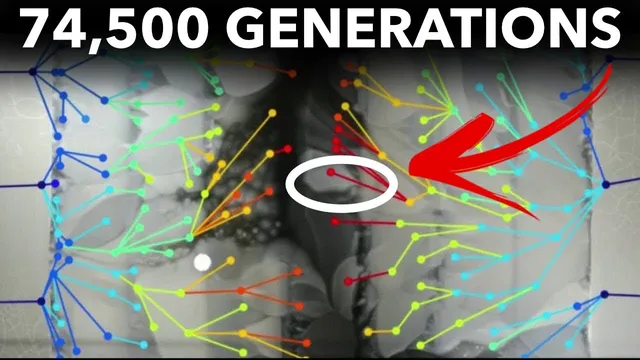
Twelve independent E. coli lineages descended from one ancestor evolved under identical lab conditions for ~33 years, accumulating about 74,500 generations.
Briefing
Bacteria in Richard Lenski’s long-running lab experiment have evolved, over 33 years and roughly 74,500 generations, to withstand antibiotic concentrations up to a thousand times higher than what would have killed their ancestors—an unusually direct, measurable demonstration of natural selection producing major functional change. The work matters because it shows adaptation can keep compounding in a stable, simplified environment, and it does so across multiple independent lineages rather than a single lucky strain.
The experiment maintains 12 separate E. coli populations descended from a single common ancestor in 1988. Each day, the bacteria are diluted into fresh medium: about 1% of the culture is transferred to a new flask, effectively giving the survivors a hundred-fold reduction in density and a fresh supply of limited glucose. The remaining 99% is destroyed in an autoclave, preventing the culture from simply accumulating biomass and instead forcing repeated cycles of growth, selection, and turnover. With bacteria dividing six or seven times per day, the lines rack up enormous numbers of generations quickly—far faster than typical multi-year breeding experiments.
Mutation supply is high even though individual cells are relatively conservative. Lenski’s team estimates that only about 1 in 100 to 1 in 1,000 cells carries a mutation at any given time, but each flask contains billions of cells, so the daily population still generates a large pool of new variants. Many mutations are neutral or harmful in this controlled setting, yet a small fraction improves competitiveness under the specific conditions. Once a beneficial mutation rises in frequency, it can sweep through the population because the daily dilution favors faster growers, compounding small fitness gains exponentially.
Fitness is measured using a “fossil record” created by freezing samples from each lineage every 500 generations. Because the frozen bacteria remain viable, researchers can thaw older generations and directly compete them against later ones, then count relative growth by plating. A color-marker system—red versus white colonies—lets scientists distinguish evolved strains from their ancestor during mixed competitions.
The most famous twist came in 2003, when one lineage acquired the ability to consume citrate, a second carbon source present throughout the experiment but not usable by the ancestral E. coli. The trait’s late arrival suggests it required more than a single simple change: it likely depended on a sequence of genetic steps that made citrate use possible. Follow-up work tested whether the trait was constrained by rare, specific genetic events or by a multi-step pathway where earlier mutations unlock later possibilities; both mechanisms appear to contribute.
Other surprises complicate expectations about evolutionary trajectories. Instead of simply increasing in number, some populations decreased in abundance while individual cells grew larger. Several lineages evolved hypermutability—mutation rates up to 100 times higher than ancestors—then later acquired additional mutations that reduced those rates again, balancing faster exploration with the risk of accumulating too many deleterious changes. Perhaps most striking, the long-term fitness gains did not level off into a plateau. A power-law model that assumes improvement slows without reaching an asymptote fit better than a model predicting an upper bound, and it even projected future gains accurately.
The episode ends with a separate, household demonstration: fluorescent powder spread across a kitchen shows how dishcloths can transfer contamination to surfaces like taps, handles, and dishwashers—an everyday reminder that microbes move easily even when conditions seem clean.
Cornell Notes
Lenski’s 33-year experiment runs 12 independent E. coli lineages in identical, simplified conditions, repeatedly diluting cultures into fresh medium and destroying most cells each day. Over ~74,500 generations, selection drives large fitness gains, including survival against antibiotics up to 1,000× stronger than the ancestral baseline. Researchers track adaptation using frozen “fossil” samples and direct competition assays against older generations, with red/white markers to distinguish strains. A key milestone occurred in 2003 when one lineage evolved the ability to consume citrate, likely requiring a multi-step genetic pathway. Long-term fitness increases did not plateau; a power-law model fit the data better and predicted future improvement, suggesting evolution can keep progressing even without environmental change.
How does daily dilution and destruction create strong selection in the Lenski experiment?
Why does the experiment generate lots of new genetic variation even if mutations are rare per cell?
How do researchers measure fitness across tens of thousands of generations?
What made the citrate-eating breakthrough in 2003 so informative?
What findings challenged expectations about how evolution should progress over time?
Review Questions
- What mechanisms in the protocol (dilution, glucose limitation, and autoclaving) determine which mutations persist from day to day?
- How does freezing samples every 500 generations enable “time travel” fitness comparisons, and why is that crucial for interpreting adaptation?
- Why might citrate metabolism take thousands of generations to evolve even when citrate is continuously present in the medium?
Key Points
- 1
Twelve independent E. coli lineages descended from one ancestor evolved under identical lab conditions for ~33 years, accumulating about 74,500 generations.
- 2
Daily ~100-fold dilution plus autoclaving of the remaining 99% creates repeated selection cycles that amplify small growth advantages.
- 3
Even with low mutation rates per cell, billions of cells per flask generate enough new variants each day for selection to act.
- 4
Frozen samples taken every ~500 generations let researchers compare fitness across time by directly competing older and newer populations.
- 5
The 2003 emergence of citrate utilization in one lineage likely required a multi-step genetic pathway, not a single change.
- 6
Some lineages evolved higher mutation rates (hypermutability) but later acquired mutations that lowered those rates again to reduce harmful mutation load.
- 7
Long-term fitness gains followed a power-law pattern without an apparent plateau, implying evolution can keep improving even in a constant environment.