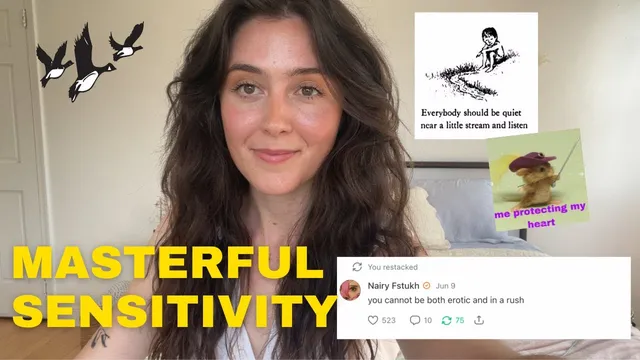
The Lost Art of Sensuality
Based on Anna Howard's video on YouTube. If you like this content, support the original creators by watching, liking and subscribing to their content.
Sensuality is presented as bodily receptivity and “masterful sensitivity,” not merely a synonym for sexiness.
Briefing
Sensuality isn’t just a route to sexiness—it’s a practice of “masterful sensitivity” that depends on staying open to the full range of sensation, including pain and shame. The episode ties that idea to poetry, arguing that spoken-word craft and everyday attention work the same way: they train people to notice what’s already present in the body and in ordinary life, rather than chasing a curated feeling through purchases or distractions.
The host begins with a personal experiment in slowness. After listening to music on a train, she walks deliberately slower than usual and feels “very sexy” from the combination of sound and bodily pacing. That moment becomes a springboard for a definition: the word “sensual” traces to late Latin roots tied to feeling and the body, distinct from spirit or intellect. Sex and sensuality can overlap—sexuality can be a powerful entry point—but sensuality also includes experiences with no sexual content.
That broader view is anchored by Andrea Gibson, a poet and spoken-word figure the host credits with teaching her to stay tender through heartbreak. Gibson’s poem “Royal Heart” is used as a touchstone for embracing brokenness rather than avoiding it. The host contrasts poetry with self-help consumption, saying that reading or hearing poetry can seep into belief and perception in a way that advice alone often doesn’t. She also recalls a formative moment from her mother—urging her not to protect herself from heartbreak—framing it as wisdom delivered outside formal poetry but arriving with the same message: vulnerability is part of learning how to live.
To explain why sensuality requires more than the classic five senses, the episode expands the sensory map. It highlights thermosception (heat), noception (pain), equilibrioception (balance), and proprioception (body awareness). A key claim follows: pleasure becomes fuller when pain is treated as a sense rather than something to shut out. Gibson’s “counterintuitive” mental-health-style guidance—stop trying to keep yourself safe, welcome grief, stop controlling everything, and choose love—supports the episode’s central theme: letting down the guard.
The episode then critiques a common marketing version of sensuality: buying new stimuli to “add” sensation. Headphones, perfume, lingerie, and other upgrades can become barriers that drown out the world. The host describes how constant audio can make city life feel unbearable without it, cutting off birds, conversations, and ambient detail.
Instead, she offers an exercise called “poetry watching,” inspired by a TikTok about hearing poetic turns of phrase in everyday talk. The practice is essentially intentional people-watching for accidental pros—catching lines that land like lyrics, from a “nacho night” quip to a child’s “JP and Peter, did you finish your OJ?” The host adds that children often pull attention back into the present, and she connects this to sensuality: presence, slowness, and the courage to enjoy being in one’s body.
Finally, the episode links sensuality to shame and to practices that rebuild sensory contact: pretending daily actions are movie scenes to heighten sound and sight, taking smaller bites to taste more, and reading Gibson’s “Tincture,” a poem written during Lyme disease that imagines the soul missing the body’s sensations—hands, throat, hunger, fever, and the awe of shame. The closing message is practical and personal: honor the life of others by “savoring” one’s own, and share exercises that help access sensuality.
Cornell Notes
Sensuality is framed as “masterful sensitivity,” a way of living that depends on staying receptive to the body—not just chasing pleasure or sexiness. The episode argues that sensuality and poetry are intertwined because both train attention: they help people notice what’s already happening in ordinary moments. It broadens the idea of “senses” beyond sight, sound, taste, smell, and touch by adding thermosception (heat), noception (pain), equilibrioception (balance), and proprioception (body awareness). A central claim follows: pleasure becomes more complete when pain and grief are allowed in, rather than treated as threats to safety. “Poetry watching” is offered as a concrete practice for cultivating this attention, using accidental poetic language and sensory detail in everyday life.
How does the episode distinguish sensuality from sexiness, and why does that distinction matter?
What role does Andrea Gibson’s work play in the episode’s view of sensuality?
Why does the episode expand the list of senses beyond the traditional five?
What is “poetry watching,” and how is it supposed to change attention?
How does the episode connect sensuality to shame?
What practical exercises does the episode suggest for cultivating sensuality?
Review Questions
- What does the episode claim is lost when sensuality is reduced to the five traditional senses?
- How does “poetry watching” function as a training method for presence, according to the host’s examples?
- Why does the episode argue that letting down the guard (including around grief and pain) is necessary for a fuller experience of pleasure?
Key Points
- 1
Sensuality is presented as bodily receptivity and “masterful sensitivity,” not merely a synonym for sexiness.
- 2
Sexuality can open the door to sensuality, but sensuality also includes nonsexual experiences grounded in feeling and attention.
- 3
Pain is treated as a sense (noception), and the episode argues that pleasure becomes fuller when pain and grief are allowed in.
- 4
Marketing-style “sensuality” that relies on buying new stimuli can become a barrier that replaces real sensory contact with the world.
- 5
“Poetry watching” is offered as a practice for noticing accidental lyricism and sensory detail in everyday conversations and scenes.
- 6
Intentional sensory games—like treating daily actions as movie scenes—can help people hear and see more clearly, especially in noisy city life.
- 7
Shame is framed as a major obstacle to sensuality; confronting it may be part of learning to enjoy being in one’s body.