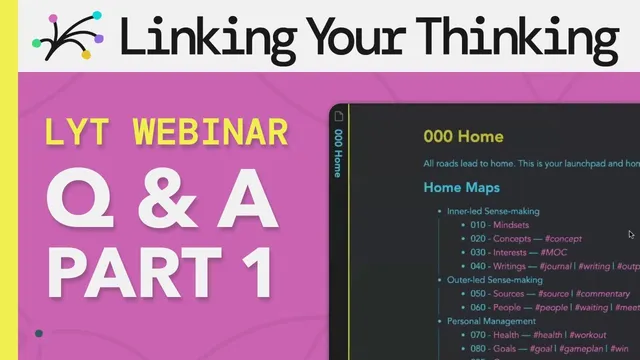
The LYT Framework - Q&A Part 1: Zettelkasten, Folgezettel, and PARA
Based on Linking Your Thinking with Nick Milo's video on YouTube. If you like this content, support the original creators by watching, liking and subscribing to their content.
A map of content (MOC) is built to be flexible and reworkable, not a fixed index, even though it overlaps with structure-note hubs in linking notes together.
Briefing
A “map of content” (MOC) is less like a static index and more like a flexible, link-driven workspace for sharpening ideas—especially when paired with frameworks such as LYT’s “light kit.” The core distinction raised in the Q&A is that a regular note is simply a container of thought, while MOCs and structure-note hubs (along with outlines, Zettels, and similar formats) are notes whose primary job is to connect to other notes. The overlap is real—both assemble links—but MOCs are designed to be more fluid: they let users reorganize the same set of relationships in multiple ways depending on the goal at hand, rather than serving as a single fixed map.
That flexibility matters because it changes what happens after the links exist. Instead of treating an MOC as a mere directory, the approach aims to bring related notes “into a room” so they can be compared, refined, and forced into clearer arguments. The payoff is twofold: the end product becomes sharper, and the process itself strengthens recall because the user has actively worked through the relationships. In this framing, the “middle-out” role of an MOC is central—an MOC informs the notes above it and the notes below it, turning linking into an iterative thinking workflow rather than passive organization.
Tags enter the discussion as a practical tool for “weak links”—relationships that aren’t meant to be rigidly defined. The Q&A pushes back on the idea that tags are either useless or everything. Instead, tags can represent actionable states, such as marking notes as “develop” while they’re being improved, then removing the tag once the work is done so the note no longer clutters the graph. The speaker also notes that some tools (citing Rome) reduce reliance on tags, but the newer graph features in Obsidian are making the value of tags more apparent.
Several questions then connect these ideas to common PKM workflows. For Evernote-to-Markdown conversion, the advice is blunt: conversions done years ago were painful, and better methods likely exist now, with an attendee expected to share the best approach. On combining LYT concepts with “focal zettelkasten” (and “folgezettel”), the answer is that MOCs can support focal zettel elements while avoiding its rigidity—by enabling a “fluid” version of focal zettel where the same ideas can be arranged in different orders.
Backlinks and automation also come up. The Q&A emphasizes that when a concept MOC is used, linked mentions and backlinks can populate automatically—so users don’t always need to manually place every note into a map. A concrete example is “Gold’s law,” which appears in a concept MOC because it was linked there.
Finally, the discussion addresses how notes get built before mapping. The workflow described is bottom-up: take literature notes with sources and quotes, then create new concept notes when an idea emerges. Those concept notes can later be surfaced through linked mentions back to the original literature. Compared with PARA, the stance is that PARA’s folder-based model loses value once the mindset shifts to links; PARA may fit project management, but the focus here is managing ideas, memories, and sense-making rather than tasks and people.
Cornell Notes
The Q&A draws a sharp line between “container” notes and link-centric framework notes. A map of content (MOC) overlaps with structure-note hubs because both connect notes, but MOCs are built to be more fluid—supporting multiple ways to reorganize the same relationships based on what the user is trying to do. That flexibility is meant to improve both the final arguments and the thinking process, since the user actively forces related notes to interact. Tags are treated as “weak links,” useful for actionable states (e.g., marking notes as “develop” until they’re ready). The workflow is bottom-up: capture literature notes first, then create concept notes when new ideas emerge, and rely on linked mentions/backlinks to surface connections automatically in the MOC.
How do MOCs differ from structure notes if both are “notes with links”?
Why does the Q&A treat an MOC as more than an index node?
What role do tags play, and why are they called “weak links”?
How can backlinks or linked mentions reduce manual work when building a concept MOC?
What is the described bottom-up workflow for literature notes and concept notes?
How does this approach compare with PARA?
Review Questions
- What design choice makes an MOC “more fluid” than a structure-note hub, even though both connect notes?
- Give one example of how a tag could function as an “actionable weak link,” and explain what happens when the work is complete.
- Describe the bottom-up process for moving from literature notes to concept notes, including how attribution is maintained.
Key Points
- 1
A map of content (MOC) is built to be flexible and reworkable, not a fixed index, even though it overlaps with structure-note hubs in linking notes together.
- 2
MOCs are meant to sharpen ideas by forcing related notes into active comparison, improving both outputs and recall.
- 3
Tags work best as “weak links” for actionable states (e.g., marking notes as “develop” and removing the tag when finished).
- 4
Linked mentions and backlinks can populate concept MOCs automatically when notes are linked, reducing manual placement.
- 5
A bottom-up workflow starts with literature notes (sources and quotes), then creates concept notes when new ideas emerge, keeping attribution tied to the original literature.
- 6
PARA may fit project management, but a link-first mindset shifts attention toward idea development and sense-making rather than folder-based organization.