The Magnetic Shadow Effect
Based on minutephysics's video on YouTube. If you like this content, support the original creators by watching, liking and subscribing to their content.
The “touching shadow” and “shadow blister” effects are produced by ray geometry, not by magnetism or surface tension.
Briefing
“Touching shadow” and “blistering” effects aren’t caused by magnetism or any special force between shadows. They come from ordinary light geometry: when two objects sit at different distances from an extended (non-point) light source—or when a camera lens or eye is focused slightly off—overlapping shadows or overlapping lens blur (bokeh) can make one object’s dark region appear to grow toward the other.
The classic case starts with a light source shining on two posts at different depths. The farther post casts a shadow, while the nearer post casts its own. As the nearer post moves to shade the farther one, the nearer shadow blocks portions of the farther shadow. With a point light, the merge would be sharp; with a real light source that has area (like the sun), different parts of the light create slightly different shadow edges. Those edges overlap, producing a blurred “touching” region. The core dark part of the shadow corresponds to light blocked from every part of the light source; the fuzzy edge corresponds to light blocked from some parts but not others; and the region outside corresponds to light reaching the surface from all parts.
The key visual trick is that the blur edge doesn’t behave like a rigid boundary. As the nearer object advances, it first intercepts the rays that would have formed the inner dark edge of the farther object’s blur. Then it intercepts rays farther out, step by step, until the two blurred shadows effectively merge. That sequence makes the farther object’s shadow look like it “grows” outward from the inside until the contact point.
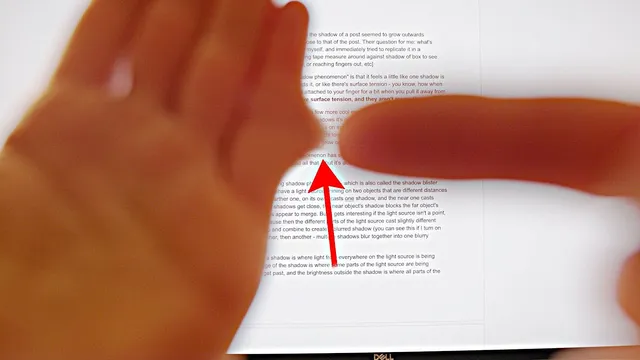
A parallel explanation comes from lenses. A camera or eye turns a point light source into a bokeh circle when the sensor/retina is placed in front of or behind the focus point. If another object blocks the light, it removes the outermost rays that would have formed part of that bokeh circle. The bokeh shrinks—but because lenses flip images, the shrinkage appears on the opposite side relative to the blocker. When an extended blurry object like a finger overlaps another object, the combined bokeh shrinkage can make the closer finger seem to blister outward toward the other shape.
Color observations reinforce the geometry. In demos with colored textbooks, the “blister” on the nearer object carries the color of the farther object’s location, not the nearer object’s own color. That happens because the light reaching the lens is always coming from the farther scene through the lens blur; the nearer object merely blocks some of those rays, revealing a mirage-like boundary determined by where the bokeh is being cut.
The same logic explains why focusing too near versus too far flips the apparent direction of the blister: shrinkage of bokeh can occur on opposite sides depending on whether the sensor is too close or too far from the lens’s focus plane. Against bright backgrounds, the blur and overlap create the illusion of attraction or repulsion; against dark backgrounds, the effect largely disappears because there’s less competing bokeh. In short: shadows and bokeh don’t stick like water. They just overlap in a way that looks “magnetic” when light source size and lens focus are slightly off.
Cornell Notes
The “touching shadow” (shadow blister) effect comes from overlapping blur, not from forces between shadows. When light has area (not a point) and objects are at different distances, the nearer object blocks parts of the farther object’s shadow at different angles, creating a blurred merge that looks like the farther shadow grows outward. A lens produces an analogous effect: out-of-focus point lights become bokeh circles, and a foreground blocker removes outer rays, shrinking the bokeh on a side determined by lens geometry (including image inversion). Because the blocked rays originate from the farther scene, the blister can inherit the farther object’s color, producing a mirage-like boundary. The apparent direction of blistering flips depending on whether the camera/eye focuses too near or too far.
Why does a “touching shadow” look like one shadow is pulling the other?
What changes when the light source is a true point versus a real extended source like the sun?
How does the lens version of the effect relate to bokeh?
Why can the blister color match the farther object instead of the nearer one?
How does focusing too near versus too far change whether the far or near object seems to blister?
Why does the effect look stronger against bright backgrounds than dark ones?
Review Questions
- In the shadow blister effect, what role does the light source’s finite size play in creating a blurred merging region?
- How does lens image inversion affect which side of a bokeh circle appears to shrink when a foreground object blocks light?
- Why does the blister in a colored-textbook demo inherit the farther object’s color rather than the nearer object’s color?
Key Points
- 1
The “touching shadow” and “shadow blister” effects are produced by ray geometry, not by magnetism or surface tension.
- 2
A non-point (extended) light source creates overlapping shadow edges, turning a sharp shadow boundary into a blurred merge.
- 3
As a nearer object shades a farther one, it blocks rays that contribute first to the inner edge of the farther blur, then progressively farther outward.
- 4
Out-of-focus lenses transform point lights into bokeh circles; foreground blockers shrink those bokeh circles by removing outer rays.
- 5
Lens inversion means bokeh shrinkage appears on the opposite side relative to the blocking object.
- 6
Blister colors can match the farther scene because the rays that define the bokeh originate from the farther object’s location.
- 7
Focusing too near versus too far flips the apparent direction of blistering by changing where the image plane sits relative to the lens focus.