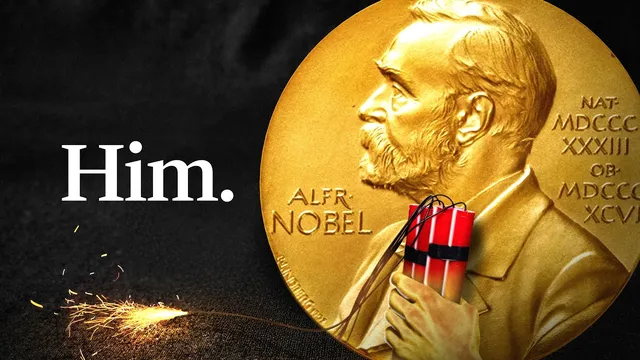
The Man Who Fooled The World
Based on Veritasium's video on YouTube. If you like this content, support the original creators by watching, liking and subscribing to their content.
Nobel’s most consequential technical leap was making nitroglycerin reliably detonable on command through the blasting cap, which accelerated industrial and military adoption.
Briefing
Alfred Nobel’s legacy was forged by a chain of chemical breakthroughs that made explosives both more controllable and more widely usable—then later repackaged into a moral afterlife through the Nobel Prize. The turning point came in 1888, when Nobel read a newspaper obituary mistakenly calling him the “Merchant of Death.” Even if the wording was exaggerated, the shock was real: public memory had already started to treat his work as butchery rather than invention. That moment mattered because it crystallized the central irony of his life—efforts to reduce explosive accidents helped scale up industrial and military destruction.
Nobel’s path began with family hardship and a father’s brief success. Immanuel Nobel, an inventor who helped develop sea mines for Russia, went bankrupt and left Alfred to grow up in poverty in Stockholm. Alfred’s early sickness and depression gave way to obsession with chemistry after he learned about nitroglycerin—an explosive discovered by Ascanio Sobrero during medical research. Nitroglycerin’s power came from unstable “nitro” groups that can be triggered into a rapid decomposition chain reaction, producing a detonation that propagates faster than sound. But handling it was deadly: it could detonate from shock, drops, or even bumps, and workers died trying to tame it.
The breakthrough that changed everything was not just a better explosive, but a reliable way to set it off. Nobel built a blasting cap using mercury fulminate to trigger nitroglycerin on command, turning a volatile liquid into a practical industrial tool. That reliability accelerated tunneling and mining, doubling excavation rates in some contexts and outperforming gunpowder in manpower efficiency. Yet the same practicality also multiplied risk. A catastrophic explosion in 1864 killed Emil Nobel and others, prompting Nobel to pursue “safety” again—this time by addressing nitroglycerin’s sensitivity to trapped bubbles and shock-induced hotspots.
Nobel’s solution became dynamite. By soaking nitroglycerin into diatomaceous earth (kieselguhr), he separated molecules within microscopic pores so impacts alone wouldn’t trigger detonation. Dynamite’s stability improved, but moisture and formulation issues still caused failures, leading Nobel to keep iterating. Later, a cut on his hand sparked another leap: nitrocellulose (gun cotton) could absorb and immobilize nitroglycerin, producing gelignite—a moldable explosive that resisted “sweating” and could be shaped for more controlled blasts. Combining nitroglycerin and nitrocellulose also enabled smokeless propellants; Nobel’s ballistite helped solve battlefield problems tied to black powder’s smoke and visibility.
As Nobel’s factories expanded across Europe and beyond, the social consequences followed. Dynamite fueled political violence and bombings in the United States, including anarchist campaigns that drew Theodore Roosevelt’s attention. The scale of destruction shifted again with later attacks such as the Bath, Michigan school bombing, where dynamite killed children and adults in a mass-casualty assault. Nobel could not foresee every misuse, but he did see the human cost—especially after his brother’s death and his own declining health.
In 1895, Nobel rewrote his will, dedicating most of his fortune to prizes for chemistry, physics, medicine, literature, and peace. He died in 1896 holding 355 patents and running an explosives empire. Whether the Nobel Prize redeemed him remains contested, but the mechanism of redemption is clear: a fortune built on controlled explosions was redirected into a global institution meant to reward benefits to mankind—an attempt to steer his name away from “butcher” and toward “benefactor,” even as dynamite continued to reshape the modern world.
Cornell Notes
Alfred Nobel’s reputation was shaped by chemistry that made explosives more powerful and more controllable—especially nitroglycerin. His key engineering leap was the blasting cap, which enabled reliable detonation on command, turning a dangerous liquid into an industrial and military tool. After a factory disaster killed his brother Emil, Nobel pursued “safety” by reducing nitroglycerin’s sensitivity to shocks and trapped bubbles, leading to dynamite (nitroglycerin absorbed in kieselguhr) and later gelignite (nitroglycerin bound with nitrocellulose). These advances also produced smokeless propellants like ballistite, changing warfare by reducing smoke and improving pressure buildup. Nobel ultimately redirected his fortune into the Nobel Prize, including a Peace Prize, as a late attempt to redefine his legacy.
Why was nitroglycerin so dangerous before Nobel’s improvements?
What made Nobel’s blasting cap a turning point for explosives?
How did dynamite reduce the risk of accidental detonation?
What was gelignite, and why did it matter?
How did Nobel’s work connect to smokeless ammunition?
Why did Nobel create the Nobel Prizes, and what irony does the story highlight?
Review Questions
- Which specific physical mechanism made nitroglycerin detonate more easily than gunpowder, and how did trapped bubbles contribute?
- How did the blasting cap change nitroglycerin from a hazardous substance into a reliable industrial explosive?
- What chemical strategy differentiated dynamite and gelignite in terms of how nitroglycerin was immobilized or separated?
Key Points
- 1
Nobel’s most consequential technical leap was making nitroglycerin reliably detonable on command through the blasting cap, which accelerated industrial and military adoption.
- 2
Nitroglycerin’s danger stemmed from both molecular instability and practical handling hazards like trapped air and vapor bubbles that create shock-induced hotspots.
- 3
Dynamite improved safety by absorbing nitroglycerin into kieselguhr pores, separating molecules so impacts alone often couldn’t propagate detonation.
- 4
Gelignite and later propellants used nitrocellulose to trap nitroglycerin in a moldable matrix, reducing sweating and enabling more controlled performance.
- 5
Nobel’s explosives also reshaped warfare and political violence, with dynamite enabling mass-casualty attacks and smokeless propellants changing battlefield dynamics.
- 6
Nobel’s late-life decision to fund the Nobel Prizes—especially the Peace Prize—was framed as an attempt to counter public condemnation of his role in large-scale destruction.