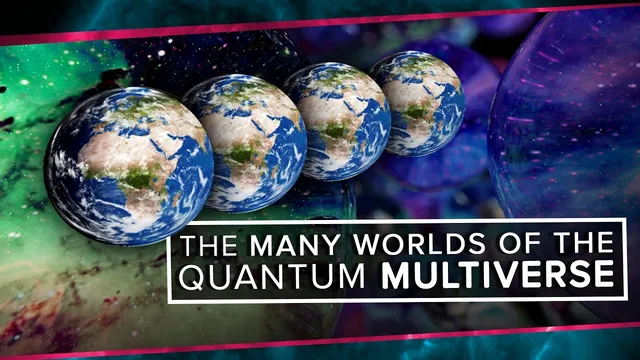
The Many Worlds of the Quantum Multiverse
Based on PBS Space Time's video on YouTube. If you like this content, support the original creators by watching, liking and subscribing to their content.
Superposition describes quantum systems as probability clouds over multiple possible properties, captured by a wave function.
Briefing
Quantum mechanics’ “weirdness” hinges on superposition: subatomic systems behave like probability clouds of multiple possible properties at once, described mathematically by a wave function. The double-slit experiment makes the point vividly. When photons, electrons, or even molecules pass through two slits, they land on a detector screen in an interference pattern—evidence that each particle’s journey acts like a blend of many possible trajectories. In this picture, a particle effectively “tries out” all paths between launch and detection, and the measurement outcome corresponds to which possibilities most strongly shape the final result.
The central puzzle is what turns that quantum superposition into the single, definite classical reality people experience. In the Copenhagen interpretation, measurement collapses the wave function, forcing the system to pick one outcome for the measured property. That collapse is treated as the boundary between quantum and classical worlds, and it is inherently nondeterministic: the universe selects among possibilities randomly, even if some outcomes are more likely than others.
Schrödinger’s cat was designed to expose how unsettling that boundary can be. If radioactive decay is a quantum event that exists in superposition until observed, then the cat tied to that event should also be in a superposition—alive and dead—until the box is opened. The thought experiment pushes the question further: why should the cat collapse the wave function, but not the physicist outside, or the rest of the universe that is not being observed? Copenhagen-style answers often shift the issue to scale, arguing that superposition effectively stops at macroscopic sizes.
Decoherence offers one mechanism for that scale change. When quantum histories remain coherent, they can interfere, producing the double-slit pattern and entanglement correlations. But once a system interacts with its environment, coherence is lost: different branches of the wave function stop aligning and can no longer interfere. In that sense, the “collapse” looks less like a physical snapping into place and more like the practical disappearance of interference between alternatives.
Many worlds takes a different route: the wave function never collapses. Instead, when quantum possibilities diverge, the universe branches into multiple non-communicating timelines, each containing a version of the observer who experiences a particular outcome. In the double-slit experiment, that means the superposed histories do not merge into one; they persist as separate branches. People find themselves in branches that correspond to the more common outcomes—such as bright interference bands—because those branches are more heavily weighted by probability.
Everett’s 1957 proposal, developed in his thesis “The Theory of the Universal Wave Function,” is deterministic: every branch unfolds predictably according to cause and effect. That removes the need for fundamental randomness, but it introduces existential discomfort—an enormous number of “versions of you” across branching histories. Even so, many worlds remains an interpretation. It matches quantum mechanics’ successful mathematics but has not yet produced a widely accepted, decisive prediction that uniquely distinguishes it from other interpretations. The result is a framework that trades wave-function collapse for branching universes, leaving open why probabilities emerge and how classical experience arises from the branching structure.
Cornell Notes
Quantum superposition means quantum systems don’t have a single definite set of properties; they behave like probability clouds described by a wave function. The double-slit experiment shows this directly through interference patterns, even when particles are sent one at a time. Copenhagen resolves the quantum-to-classical transition by saying measurement collapses the wave function, producing one outcome with fundamentally random selection. Decoherence explains why interference disappears at macroscopic scales when systems interact with their environment. Many worlds avoids collapse entirely: the wave function always evolves, and reality branches into multiple non-interacting timelines, with observers ending up in branches consistent with the probabilities of different outcomes.
What does superposition mean in practice, and how does the double-slit experiment demonstrate it?
How does Copenhagen explain the transition from quantum possibilities to a single observed outcome?
Why did Schrodinger’s cat challenge Copenhagen-style collapse, and what role does decoherence play in modern answers?
What is the many worlds interpretation, and how does it reinterpret the double-slit experiment?
What makes many worlds deterministic, and what philosophical unease does it introduce?
Review Questions
- How does decoherence differ from Copenhagen’s wave-function collapse as an explanation for why classical behavior emerges?
- In many worlds, what happens to quantum superpositions after a measurement-like interaction, and why do observers still experience definite outcomes?
- What unresolved issues remain for many worlds despite its agreement with quantum mechanics’ mathematical predictions?
Key Points
- 1
Superposition describes quantum systems as probability clouds over multiple possible properties, captured by a wave function.
- 2
The double-slit experiment’s interference pattern supports the idea that quantum histories contribute together rather than acting like a single fixed path.
- 3
Copenhagen treats measurement as a real collapse of the wave function, producing one outcome with fundamental randomness.
- 4
Decoherence explains how environmental interactions destroy interference between quantum branches, making classical-looking outcomes effectively emerge.
- 5
Many worlds replaces collapse with branching: the wave function always evolves, and different outcomes correspond to different non-interacting timelines.
- 6
Many worlds is deterministic within each branch, but it raises existential concerns about the reality of many versions of oneself.
- 7
Despite strong mathematical consistency, many worlds has not yet delivered a widely accepted, uniquely distinguishing prediction from other interpretations.