The medical test paradox, and redesigning Bayes' rule
Based on 3Blue1Brown's video on YouTube. If you like this content, support the original creators by watching, liking and subscribing to their content.
High sensitivity and specificity do not directly translate into a high probability of disease after a positive result when prevalence is low.
Briefing
An accurate medical test can still produce a surprisingly low chance that a positive result is truly correct—because disease prevalence and the test’s false positives reshape what “accuracy” means for an individual. Using a breast-cancer screening example with 1% prevalence, 90% sensitivity, and 91% specificity, the test correctly flags 9 out of 10 women with cancer but also produces 89 false positives among 990 women without cancer. When a woman tests positive, the probability she actually has cancer becomes 9/(9+89) ≈ 1 in 11. The paradox is that the test is “over 90% accurate” in the usual sense, yet its positive predictive value (PPV) can be arbitrarily low when the disease is rare.
The counterintuitive gap shows up in real-world reasoning. In 2006–2007, psychologist Gerd Gigerenzer ran statistics seminars for practicing gynecologists using the same numbers as the breast-cancer scenario: prevalence around 1%, sensitivity 90%, specificity 91%. Many doctors answered that a positive result implies something like a 9-in-10 chance of cancer—far off the correct 1-in-11. The mismatch isn’t a logical contradiction; it’s a “veridical paradox,” meaning the facts are provably true but feel wrong when people treat test accuracy as if it directly converts into personal risk.
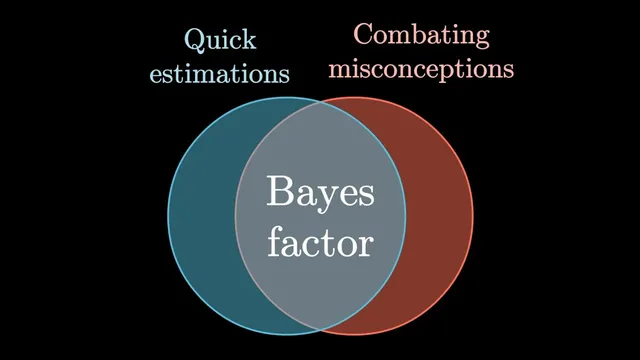
The fix starts with reframing what tests do. Rather than delivering a final probability, a test updates a prior—the baseline chance of disease before seeing results. In the example, the prior is 1 in 100. The test doesn’t replace that with 90% certainty; it shifts it to about 1 in 11, roughly an order-of-magnitude change. That updating strength can be summarized by a Bayes factor (also called a likelihood ratio), computed for a positive result as sensitivity divided by the false positive rate. Here, 0.9 / 0.09 = 10. A practical rule follows: multiply the prior odds by the Bayes factor.
Odds make the mathematics feel less like a trap. Prior odds are the number with cancer divided by the number without it; after a positive test, those odds are scaled by the Bayes factor. With 1% prevalence, prior odds are 1:99; multiplying by 10 yields 10:99, which converts back to about 1 in 11. If prevalence rises to 10%, prior odds become 1:9; after multiplying by 10, the result is 10:9, or roughly 53%—matching what a concrete population count predicts. The same logic works for negative results too, using a different factor: false negative rate divided by specificity (about 1 in 9 in the example), which reduces prior odds by about an order of magnitude.
Finally, the discussion contrasts the odds-and-Bayes-factor version of Bayes’ rule with the more common probability form. The odds framing cleanly separates prior information from test accuracy, making it easier to swap priors and chain multiple pieces of evidence (like symptoms or multiple tests). The standard formula remains valuable as a compact representation of the sample-population counting method, but the odds approach reduces ambiguity—especially because a Bayes factor is not a probability and therefore can’t be mistaken for “the chance your result is false.”
Cornell Notes
The breast-cancer screening example shows why “high accuracy” doesn’t guarantee a high probability that a positive result is correct. With 1% prevalence, sensitivity 90%, and specificity 91%, a positive test yields only about a 1 in 11 chance of actually having cancer (PPV = 9/(9+89)). Many clinicians misread sensitivity/specificity as if they directly translate into personal risk, producing answers like 9 in 10. The remedy is to treat testing as Bayesian updating: start with a prior (pre-test risk) and apply a Bayes factor. For a positive result, the Bayes factor equals sensitivity divided by the false positive rate; update prior odds by multiplying by this factor. This framing also clarifies negative results and makes multi-evidence updates more straightforward.
Why does a test with 90% sensitivity and 91% specificity still give only ~1/11 chance of cancer after a positive result?
What misconception did many doctors show in Gigerenzer’s seminars?
How does the Bayes factor help turn test accuracy into an update of personal risk?
How do odds-based updates reproduce the breast-cancer numbers without heavy calculation?
How does the logic change for a negative test result?
What practical advantage does the odds-and-Bayes-factor framing offer over the usual probability form of Bayes’ rule?
Review Questions
- In the breast-cancer example (1% prevalence, 90% sensitivity, 91% specificity), compute the number of true positives and false positives in a group of 1,000 women and derive the PPV.
- What is the Bayes factor for a positive test in the example, and how does it relate to sensitivity and the false positive rate?
- Why do odds-based updates work cleanly for both low and higher prevalence, while a naive “accuracy equals probability” interpretation fails?
Key Points
- 1
High sensitivity and specificity do not directly translate into a high probability of disease after a positive result when prevalence is low.
- 2
Positive predictive value (PPV) depends on the balance between true positives and false positives, which prevalence strongly controls.
- 3
Treat test results as Bayesian updates: start with a prior probability (or prior odds) and then apply evidence from the test.
- 4
For a positive test, the Bayes factor equals sensitivity divided by the false positive rate; update prior odds by multiplying by this factor.
- 5
Odds framing makes Bayes’ rule easier to apply and reduces confusion because a Bayes factor is not a probability.
- 6
The same updating logic applies to negative results, using a Bayes factor based on false negative rate and specificity.
- 7
The odds-and-Bayes-factor form makes it simpler to swap priors and combine multiple evidence sources (e.g., symptoms or multiple tests).