The Miniature Microcars of Amsterdam
Based on Not Just Bikes's video on YouTube. If you like this content, support the original creators by watching, liking and subscribing to their content.
Amsterdam treats the Kanto microcar as a handicap vehicle, enabling bicycle-lane use and sidewalk parking tied to disability status.
Briefing
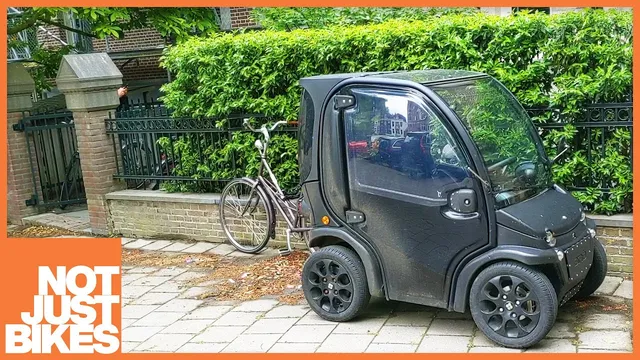
Amsterdam’s most distinctive microcars aren’t just quirky street furniture—they’re a live policy test about who gets to use shared space, and what kinds of vehicles cities should encourage. The Netherlands’ most common microcar, the Kanto (first produced in 1995), is treated as a disability-focused vehicle. That special classification lets Kanto drivers use bicycle lanes and park on sidewalks, with designated parking areas marked for these vehicles. In practice, Kanto ownership is often tied to mobility needs: one variant removes the seat so a wheelchair user can ride directly inside. Municipal support also plays a role, since Amsterdam provides counters (microcar units) to residents with limited mobility, and subsidies can reduce costs.
That framework is now colliding with a different microcar: the Bureau, an Italian-designed electric microcar that’s widely seen in wealthier Amsterdam neighborhoods as a second car or corporate vehicle—often for real estate agents. Because Bureau drivers have used rules originally intended for Kanto-type handicap vehicles, a judge ruled last year that a Bureau does not qualify as a handicapped vehicle. The result is a shift toward “normal car” requirements: Bureau drivers need license plates and driver’s licenses, Bureau vehicles can no longer use bicycle lanes, and they must park in legal parking spaces like other cars. Exceptions still exist for disabled people, but the overall direction is tighter enforcement.
Amsterdam is responding by trying to make microcars a legitimate alternative rather than a loophole. New rules allow Bureau owners to buy a citywide parking pass that permits parking in any car parking spot across Amsterdam for a flat yearly fee. The policy question is whether that convenience—paired with the Bureau’s electric power—will be enough to steer more residents toward microcars instead of conventional vehicles.
The debate echoes broader transportation conflicts in other cities. Some places struggle with “square peg” vehicles that don’t fit existing infrastructure: scooters clog sidewalks or feel too risky for roads; bicycles can be hard to park; and cars remain dangerous to pedestrians and cyclists. Amsterdam’s advantage is that cycling is fully integrated into street design, which makes micro-mobility work better.
Looking further out, the transcript points to Peachtree City, Georgia, as a rare example of a city designed with a parallel road network for golf carts. But microcars are portrayed as feasible in the Netherlands largely because built-up areas have enough slow, traffic-calmed streets. In North America, where speeds are higher and vehicle design has trended toward heavier, larger safety-oriented cars, microcars would be far less safe.
The closing argument ties vehicle size to city safety and efficiency: heavier cars are less fuel-efficient and more harmful to vulnerable road users. Even when modern cars are safer for occupants, the added mass and dimensions increase risk for pedestrians, cyclists, and smaller vehicles. The takeaway is a planning challenge—how many trips could be shifted to smaller electric vehicles, especially for commercial and business use, while keeping streets safe enough for the smallest “metal boxes” to operate. Microcars, the transcript concludes, have a place in modern cities if rules and infrastructure keep them from becoming a hazard or a workaround.
Cornell Notes
Amsterdam’s microcar boom hinges on disability policy, enforcement, and street design. Kanto microcars—produced since 1995—are classified as handicap vehicles, allowing use of bicycle lanes and sidewalk parking, including variants designed for wheelchair users and municipal support for residents with limited mobility. The Bureau, an Italian-designed electric microcar, has been treated differently: a judge ruled it is not a handicapped vehicle, forcing Bureau drivers to follow standard car rules (plates, driver’s licenses, no bicycle lanes, legal parking). Amsterdam is trying to keep microcars viable by offering Bureau owners a citywide parking pass. The broader lesson is that microcars can reduce negative impacts compared with conventional cars, but only if cities manage safety, speed, and access rules.
Why does the Kanto microcar receive different access than other microcars in Amsterdam?
What changed for Bureau drivers after a court ruling?
How is Amsterdam trying to encourage Bureau use without relying on disability loopholes?
Why are microcars portrayed as more feasible in the Netherlands than in North America?
What does Peachtree City, Georgia illustrate about designing cities for small vehicles?
Review Questions
- How do Amsterdam’s rules for Kanto and Bureau differ, and what legal reasoning drives that difference?
- What specific policy tool (besides enforcement) does Amsterdam use to make Bureau microcars more practical?
- According to the transcript, what street-speed and infrastructure conditions determine whether microcars are safe enough to operate?
Key Points
- 1
Amsterdam treats the Kanto microcar as a handicap vehicle, enabling bicycle-lane use and sidewalk parking tied to disability status.
- 2
Kanto variants include wheelchair-access designs, and Amsterdam provides municipal support (counters) for residents with limited mobility.
- 3
A court ruling reclassified the Bureau microcar as not handicapped, requiring standard car compliance: plates, driver’s licenses, no bicycle lanes, and legal parking.
- 4
Amsterdam responded with a citywide parking pass for Bureau owners to improve convenience while keeping access rules consistent.
- 5
Microcar feasibility depends heavily on slow, traffic-calmed street environments; higher-speed networks make them far riskier.
- 6
The transcript links vehicle size and weight to broader safety and efficiency tradeoffs, arguing heavier cars increase harm to pedestrians and cyclists.
- 7
The city-design lesson is that small-vehicle compatibility improves when infrastructure (roads and parking) is planned for them, not retrofitted.